Suriname Religious Demographics and Trends
Suriname is characterized by a rich and diverse religious landscape, reflecting its multicultural history. The country's spiritual composition is a blend of global faiths and local traditions, with significant populations of Christians, Hindus, and Muslims living side by side.
By analyzing data from the 2004 and 2012 censuses, as well as findings from the Pew Research Center, we can observe how the religious identity of the nation has evolved over time and how it varies across different geographic regions.
Key Facts
- Christianity is the largest religious group, growing from 40.7% in 2004 to 48.4% in 2012.
- Hinduism and Islam represent the next largest faith groups, consistently making up a significant portion of the population.
- The 2012 census recorded a total population of 541,638 people.
- Religious distribution varies wildly by province, with some areas showing high concentrations of specific faiths.
- Winti, a traditional Afro-Surinamese religion, is recognized as a distinct faith practiced by a portion of the population.
National Religious Shifts (2004–2012)
Between 2004 and 2012, Suriname saw a notable increase in the number of people identifying as Christian. The population of Christians rose from 200,744 to 262,320. Similarly, the Hindu population grew from 98,240 to 120,623, and the Muslim population increased from 66,307 to 75,053.
One of the most striking changes in the census data is the decrease in "Religion not stated" responses, which plummeted from 15.7% in 2004 to just 3.2% in 2012, suggesting more precise reporting in the later survey.
| Religion | 2004 Number | 2004 % | 2012 Number | 2012 % |
|---|---|---|---|---|
| Christianity | 200,744 | 40.7% | 262,320 | 48.4% |
| Hinduism | 98,240 | 19.9% | 120,623 | 22.3% |
| Islam | 66,307 | 13.5% | 75,053 | 13.9% |
| Other or none | 50,334 | 10.2% | 66,560 | 12.3% |
| Not stated | 77,204 | 15.7% | 17,082 | 3.2% |
| Total | 492,829 | 100.0% | 541,638 | 100.0% |
Regional Distribution by Province
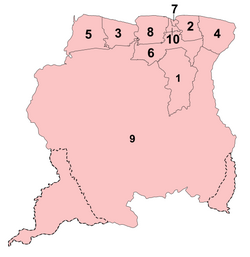
The religious makeup of Suriname is not uniform across its territory. Different provinces exhibit distinct spiritual leanings based on local demographics.
For instance, in 2004, the province of Coronie showed a very high Christian presence at 75.0%, while Nickerie had a strong Hindu plurality at 43.2%. In contrast, the province of Commewijne had a significant Muslim population at 40.4%. Tribal and other faiths were most prominent in Sipaliwini (26.8%) and Marowijne (11.5%).
Detailed Denominational Breakdown (2012)
The 2012 census provides a deeper look into the specific denominations within the major faith groups.
Christianity
The Catholic Church is the largest single denomination, accounting for 21.6% of the total population. This is followed by Pentecostalism (Full Gospel) at 11.18% and the Moravian Church at 11.16%. Other groups include Jehovah's Witnesses (1.2%), Calvinism (0.7%), and Lutheranism (0.5%).
Hinduism
The majority of Hindus in Suriname identify as Sanatani Hindus (18% of the total population), followed by Arya Samaj Hindus (3.1%) and other forms of Hinduism (1.2%).
Islam
The Muslim community is composed of various branches, including other forms of Islam (7.3%), Sunni Islam (3.9%), and Ahmadi Islam (2.6%).
Other Faiths and Unaffiliated
Suriname also hosts smaller religious communities and traditional beliefs. Winti, a local spiritual tradition, is practiced by 1.8% of the population. Kejawen Javanism accounts for 0.8%, and Judaism represents a small minority at 0.0%. Approximately 7.5% of the population reported having no faith.
External Perspectives: Pew Research (2010)
Data from the Pew Research Center in 2010 aligns closely with national census trends. Their findings indicated that Christians were the largest community at 51.6%, followed by Hindus at 19.8% and Muslims at 15.2%. Pew also noted folk traditions (5.3%), the unaffiliated (5.4%), and smaller groups of Buddhists and Jews (both under 1%).
Frequently Asked Questions
Which is the largest religious group in Suriname?
Christianity is the largest religious group, representing 48.4% of the population according to the 2012 census.
What are the primary denominations of Christianity in Suriname?
The most prominent denominations are the Catholic Church, Pentecostalism (Full Gospel), and the Moravian Church.
How is Hinduism distributed among the population?
The majority of Hindus are Sanatani Hindus, with a smaller percentage identifying as Arya Samaj Hindus.
What is Winti?
Winti is a traditional faith practiced in Suriname, recorded as being followed by 1.8% of the population in the 2012 census.
Which province had the highest percentage of Hindus in 2004?
Nickerie had the highest percentage of Hindus in 2004, at 43.2%.