Surin Pitsuwan: The Diplomat Who Transformed ASEAN
Surin Pitsuwan was a distinguished Thai diplomat and politician of Malay descent who left an indelible mark on the geopolitical landscape of Southeast Asia. Best known for his tenure as the 12th Secretary-General of the Association of Southeast Asian Nations (ASEAN), Pitsuwan transitioned the organization from a quiet regional grouping into a proactive global player. His career was defined by a rare blend of academic rigor and political pragmatism, allowing him to navigate complex international tensions with sophistication.
Key Facts
- Role: 12th Secretary-General of ASEAN (2008–2012).
- Government Service: Served as Thailand's Minister of Foreign Affairs from 1997 to 2001.
- Education: Held degrees from Thammasat University, Claremont McKenna College, and a PhD from Harvard University.
- Legacy: Championed "flexible engagement" and the establishment of the ASEAN Human Rights Commission.
- Foundation: The Surin Pitsuwan Foundation continues his work in education, diplomacy, and human security.
Academic Foundations and Early Career
Surin Pitsuwan's ascent in diplomacy was rooted in an extensive academic background. He began his studies at Thammasat University in Thailand, earning a BA in political science. He later graduated cum laude from Claremont McKenna College in California in 1972. With support from the Rockefeller Foundation, he earned an MA from Harvard University in 1974.
Pitsuwan's intellectual curiosity led him to the American University in Cairo, Egypt, where he spent a year and a half studying Arabic and conducting research between 1975 and 1977. He further expanded his expertise as a researcher for the Ford Foundation and the Thai Studies Institute at Thammasat University. Between 1983 and 1984, he served as a congressional fellow under the American Political Science Association (APSA) in the US Capitol and taught international relations at the American University in Washington, D.C. He completed his PhD at Harvard in 1982 with a dissertation titled Islam and Malay Nationalism.
Rise in Thai Politics
Pitsuwan entered the political arena in 1986 when he was elected as a member of parliament for Nakhon Si Thammarat. His rise was rapid; he served as secretary to the Speaker of the House of Representatives in 1986 and as assistant secretary to the Minister of Interior in 1988. By 1992, he had become the Deputy Minister of Foreign Affairs, a role he held until 1995.
From 1997 to 2001, he served as the Minister of Foreign Affairs under Prime Minister Chuan Leekpai. During this period, he also chaired the ASEAN Regional Forum from 1999 to 2000. Parallel to his political duties, Pitsuwan remained committed to academia, teaching at Thammasat University and contributing as a writer for two English daily newspapers in Bangkok.
Leadership as ASEAN Secretary-General
On January 1, 2008, Surin Pitsuwan became the 12th Secretary-General of ASEAN, succeeding Ong Keng Yong. Unlike many of his predecessors, Pitsuwan was the first Secretary-General to bring significant political experience to the role. He was described by The Economist as an "activist" leader who sought a more dynamic role for the organization.
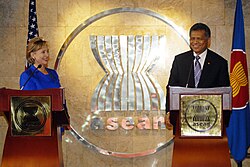
Under his stewardship, ASEAN shifted its approach toward member states. Pitsuwan advocated for flexible engagement—a policy he first championed as Foreign Minister—which encouraged increased interaction with Myanmar's leaders in exchange for reform steps. This was a departure from the previous "constructive engagement" policy, which critics argued ignored government repression. His leadership was instrumental in the creation of the ASEAN Human Rights Commission and the inclusion of the United States in the East Asia Summit.
Summary of Professional Milestones
| Period | Position/Role | Key Focus/Organization |
|---|---|---|
| 1986 | Member of Parliament | Nakhon Si Thammarat, Thailand |
| 1992–1995 | Deputy Minister of Foreign Affairs | Government of Thailand |
| 1997–2001 | Minister of Foreign Affairs | Government of Thailand |
| 2008–2012 | Secretary-General | ASEAN |
| 2013–2017 | Board Member | Centre for Humanitarian Dialogue (HD) |
Global Affiliations and Lasting Legacy
Beyond his official government roles, Pitsuwan was a member of the board of trustees for The Asia Foundation since 2003 and joined the board of the Centre for Humanitarian Dialogue (HD) in 2013. He also contributed to the Commission on Human Security and the World Commission on the Social Dimension of Globalization.
Following his death on November 30, 2017, due to heart failure, his son Fuadi Pitsuwan established the Surin Pitsuwan Foundation in 2019. The foundation focuses on three pillars: education (providing scholarships for ASEAN students), diplomacy (funding interfaith dialogue and conflict resolution), and human security (assisting in disaster relief and development).
Frequently Asked Questions
What was Surin Pitsuwan's most significant contribution to ASEAN?
He is credited with transforming ASEAN into a more active global player, moving the organization away from strict non-interference toward "flexible engagement" and establishing the ASEAN Human Rights Commission.
What is "flexible engagement" in the context of Pitsuwan's diplomacy?
Flexible engagement was a policy that encouraged increased interaction and people-to-people contacts with Myanmar's leadership, provided they took tangible steps toward reform.
Where did Surin Pitsuwan receive his higher education?
He earned his BA from Thammasat University, graduated cum laude from Claremont McKenna College, and obtained both an MA and a PhD from Harvard University.
What is the purpose of the Surin Pitsuwan Foundation?
Established in 2019, the foundation promotes ASEAN integration and academic excellence through scholarships, diplomacy programs focused on conflict resolution, and human security initiatives like disaster relief.
When did Surin Pitsuwan serve as the Secretary-General of ASEAN?
He served as the 12th Secretary-General from January 1, 2008, to December 31, 2012.