Supreme Court of Timor-Leste: History and Constitutional Role
The judicial architecture of Timor-Leste is a testament to the nation's journey toward sovereignty and the rule of law. From its early days under international administration to the establishment of a fully nationalized judiciary, the legal system has evolved to safeguard the constitution and ensure the fair administration of justice.
The Foundations of the Judicial Service
The roots of the modern legal system began with the United Nations Transitional Administration in East Timor (UNTAET). In 2000, UNTAET established a transitional judicial court service designed to bridge the gap toward independence. This initial service was composed of a small cohort of Timorese prosecutors, public defenders, and judges, with the first group of judges officially taking their seats on January 7, 2000.
Following the restoration of independence on May 20, 2002, the nation adopted its Constitution. Section 124 of this document mandated the creation of a Supreme Court, while Section 125 detailed its composition and function. Depending on the specific legal provisions of a case, the Supreme Court may act as the first instance, the second instance, or the sole instance of jurisdiction.
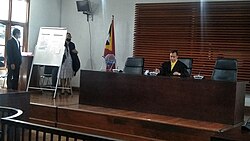
Composition and Appointment of the Court
The Supreme Court is composed of a diverse group of legal experts, including professional judges, magistrates from the ministry, and jurists of merit. The appointment process is divided among different state bodies to ensure a balance of power:
- One judge is appointed by the National Parliament.
- The remaining judges are appointed by the Superior Council for Judicial Magistrates (known in Tetum as the Conselho Superior da Magistratura Judicial).
- The President of the Court is appointed by the President of Timor-Leste, selected from among the judges of the Court of Appeal.
Professionalization and International Support
A significant milestone in the nationalization of the judiciary occurred on June 21, 2007, with the swearing-in of twenty-seven national judges, public defenders, and prosecutors. These professionals were graduates of the legal training center in Caicoli. This transition was supported by the UNDP Justice Strengthening Programme, which was overseen by the Coordination Council and included the public prosecutor-general, the president of the Court of Appeal, and the minister of justice.
The development of this judicial capacity was made possible through the international support of several governments, including Australia, Brazil, the United States of America, Ireland, Norway, Portugal, and Sweden.
Constitutional Competences and Responsibilities
Under Section 126 of the Constitution, the Supreme Court holds extensive powers to ensure the legality of state actions. Its primary responsibilities include:
Constitutional Oversight
The court handles all legal constitutional questions. This includes checking for unconstitutional conduct by administrative and legal organs of the state, as well as reviewing the constitutionality of laws, ordinances, and referendums. It also examines unconstitutional rulings from lower courts or unconstitutionality by omission.
Political and Electoral Regulation
The Supreme Court plays a critical role in the democratic process by examining the legality of the formation, registration, or dissolution of political parties and their coalitions. During presidential elections, the court verifies that candidates meet all legal requirements. Furthermore, it monitors the conformity of all electoral processes with the law, examines the final results, and officially announces them.
| Category | Details |
|---|---|
| Constitutional Basis | Sections 124, 125, and 126 of the Constitution |
| Appointment Bodies | National Parliament, Superior Council for Judicial Magistrates, President of Timor-Leste |
| Key Competences | Constitutional review, electoral validation, political party registration |
| Training Hub | Legal training center in Caicoli |
Key Facts
- The transitional judicial service was established by UNTAET in 2000.
- The Supreme Court was mandated by the Constitution upon independence on May 20, 2002.
- The first group of 27 national judicial officers was sworn in on June 21, 2007.
- The court has the authority to officially announce election results.
- International support for judicial training came from seven nations, including Portugal, Brazil, and the USA.
Frequently Asked Questions
When was the Supreme Court of Timor-Leste established?
While a transitional service began in 2000 under UNTAET, the Supreme Court was formally called for by the Constitution following the restoration of independence on May 20, 2002.
Who appoints the President of the Supreme Court?
The President of the Court is appointed by the President of Timor-Leste, and must be chosen from among the judges of the Court of Appeal.
What is the role of the Supreme Court in elections?
The court examines the legal requirements for presidential candidates, ensures the electoral process conforms to the law, examines the results, and officially announces them.
How are the judges of the Supreme Court appointed?
One judge is appointed by the National Parliament, while the others are appointed by the Superior Council for Judicial Magistrates.
What constitutes the court's constitutional oversight?
The court reviews the constitutionality of laws, ordinances, and referendums, and checks for unconstitutional conduct by the state's legal and administrative organs.