Supreme Court of the Philippines: A Comprehensive History of the Judiciary
The judicial system of the Philippines is a complex tapestry woven from indigenous customs, Spanish colonial administration, American legal frameworks, and a modern commitment to democratic independence. From the small community-led barangays to the current high court, the evolution of Philippine law reflects the nation's journey toward sovereignty and the rule of law.
Pre-Hispanic Legal Foundations
Before the arrival of Spanish colonizers, the Philippines consisted of independent barangays—small communities of 30 to 100 families. Each was led by a datu (local chief) who held absolute executive, legislative, and judicial power, serving also as the commander-in-chief during wartime.
Laws within these communities were either oral traditions passed down through generations or written decrees promulgated by the datu and a council of elders. In cases of dispute, the datu acted as the judge while elders served as the jury. For conflicts between different barangays, neutral datus or elders acted as mediators. Criminal cases often employed trial by ordeal, a practice based on the belief that deities would protect and reveal the innocence of the accused.
The Spanish Colonial Era and the Real Audiencia
Spanish rule began with Miguel López de Legazpi, who was confirmed as Governor and Captain-General in 1569. Initially, Legazpi held total administrative and judicial control. However, reports of oppression and the disregard of royal decrees led to the establishment of the Real Audiencia of Manila on May 5, 1583. This high court was designed to ensure good government and the fair administration of justice.
The Audiencia consisted of a president, three oidores (auditors), a fiscal (prosecuting attorney), and various clerks. While it primarily handled appeals from lower magistrates, it could try significant civil cases in the first instance. Over the centuries, the court underwent several reorganizations, eventually splitting into two chambers—the sala de lo civil and sala de lo criminal—by 1879.
To expand judicial reach, territorial audiencias were established in Cebu (1886) and Vigan (1893), though their decisions remained appealable to the Audiencia of Manila and the Supreme Court of Spain.
Transition to American Jurisdiction
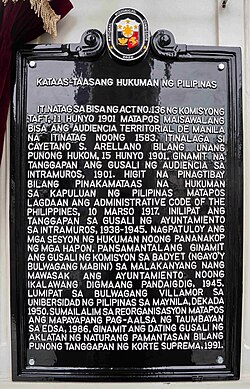
The American occupation beginning in August 1898 brought immediate changes. Military Governor Wesley Merritt suspended the jurisdiction of the Real Audiencia and other minor courts, transferring criminal trials to U.S. military commissions. Civil jurisdiction was gradually restored, and on May 29, 1899, the high court was reestablished as the Supreme Court of the Philippine Islands.
The modern foundation was laid on June 11, 1901, with Act No. 136 (the Judiciary Law of the Second Philippine Commission). This act reorganized the system into the Supreme Court, Courts of First Instance, and Justice of the Peace courts. Initially composed of one chief justice and six associate justices appointed by the U.S. President, the court's membership grew to nine by 1917 under the Administrative Code.
The Commonwealth and Japanese Occupation
The 1935 Constitution established the Commonwealth of the Philippines, increasing the Supreme Court's membership to eleven. This era was pivotal for judicial independence, as it secured tenure for justices, prohibited the reduction of their compensation, and established impeachment as the sole method of removal. The Court also gained the power to create its own rules for legal practice and court procedures.
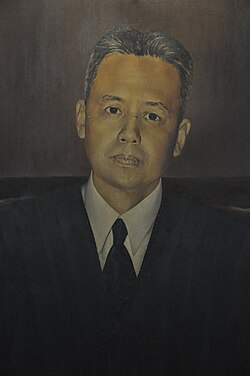
During the Japanese occupation in World War II, the Court's structure remained largely intact, though the Imperial Japanese Force's military governor required approval for certain acts. This period is marked by the tragedy of José Abad Santos, the fifth Chief Justice, who was executed by Japanese troops in May 1942 after refusing to collaborate with the military government.
Independence and the Modern Era
Following the Treaty of Manila in 1946, the Philippines gained full independence. The treaty ensured that the U.S. Supreme Court ceased to have appellate review over Philippine cases, except for those already pending at the time of independence.
The 1973 Constitution further expanded the Court to fifteen members and granted it administrative supervision over all lower courts, a power previously held by the Department of Justice. This period also saw the Court navigate the legal complexities of Martial Law, including the legality of the 1973 Constitution and the totality of government authority held by President Marcos.
The 1987 Constitution, enacted after the EDSA Revolution, expanded the definition of judicial power. It now includes the duty to determine if any branch of government has committed a grave abuse of discretion, effectively limiting the "political question doctrine" (the idea that certain political issues are beyond judicial review). To ensure impartiality, the Judicial and Bar Council was created to recommend appointees to the judiciary.
Modern Innovations: One-Stop Shop and REAL Justice
The Supreme Court continues to modernize through its Strategic Plan for Judicial Innovations. On March 1, 2024, a "One-stop shop" was opened to house the Judicial Records office, Fiscal Management and Budget Office, and the Office of the Bar Confidant.
Additionally, the REAL Justice (Remote Hearing and Equal Access to Law and Justice) program was launched. This initiative utilizes retrofitted buses as mobile courts to reach remote areas, providing technology and bail procedures to citizens in far-flung regions who would otherwise lack access to the legal system.
| Era/Law | Total Members | Key Change/Authority |
|---|---|---|
| Act No. 136 (1901) | 7 | 1 Chief Justice, 6 Associate Justices |
| Administrative Code (1917) | 9 | 1 Chief Justice, 8 Associate Justices |
| 1935 Constitution | 11 | 1 Chief Justice, 10 Associate Justices; Judicial independence |
| 1973 Constitution | 15 | Current membership size; Supervision of lower courts |
Key Facts
- Indigenous Roots: Early justice was administered by the datu in independent barangays.
- Spanish Influence: The Real Audiencia of Manila (est. 1583) served as the first high court.
- American Foundation: Act No. 136 of 1901 officially established the current Supreme Court structure.
- Constitutional Shift: The 1987 Constitution expanded judicial power to review "grave abuse of discretion" by the government.
- Accessibility: The REAL Justice program uses mobile buses to bring legal services to remote areas.
Frequently Asked Questions
What was the role of the datu in pre-colonial law?
The datu served as the executive, legislative, and judicial head of the barangay, acting as a judge in disputes while a group of elders served as the jury.
How did the 1987 Constitution change judicial power?
It expanded the Court's power to include the duty to determine if any government branch has committed a grave abuse of discretion, thereby reducing the scope of the political question doctrine.
Who was José Abad Santos?
He was the fifth Chief Justice of the Supreme Court who was executed by Japanese forces in 1942 for refusing to collaborate with their military government.
What is the Judicial and Bar Council?
It is a constitutionally created body responsible for recommending appointees for vacancies in the Supreme Court and other lower courts to ensure judicial independence.
What is the REAL Justice program?
It is a mobile court initiative that uses retrofitted buses to provide remote hearings, technology, and bail procedures to citizens in difficult-to-reach areas.