Understanding the Supreme Court of Korea
The Supreme Court of Korea stands as the highest ordinary court in the Republic of Korea, serving as the final arbiter of justice for the nation. Established in 1948, the court has undergone a profound transformation—evolving from a body once subject to autocratic influence into a cornerstone of a modern, democratic judicial system.
Today, the Supreme Court holds comprehensive final appellate jurisdiction over all cases originating from ordinary and military courts. It also exercises judicial review at the sub-statutory level, ensuring that laws and regulations align with the Constitution.

Key Facts
- Established: 1948
- Current Chief Justice: Jo Hee-de (since December 8, 2023)
- Location: Seocho, Seoul
- Current Number of Justices: 14 (expanding to 26 by 2028)
- Justice Term: Six years, renewable until the mandatory retirement age of 70
- Jurisdiction: Final appellate jurisdiction over ordinary and military courts
Historical Evolution
The Early Years and Autocratic Influence
During the First Republic, the judicial structure was divided between the Supreme Court and a Constitutional Committee. While the first Chief Justice, Kim Byung-ro, successfully defended judicial independence from the administration of President Syngman Rhee, the court's autonomy declined following his retirement in 1957. During this era, the court faced criticism for "judicial murder," where it issued death sentences in political cases orchestrated by dictators.
The Path to Democratization
The relationship between the judiciary and the executive remained strained through various regimes. Following the 1961 coup, the power of judicial review was transferred to the Supreme Court, yet the court often maintained deference toward military leaders. A notable moment of resistance occurred in 1971 when the Court declared a statute regarding national compensation unconstitutional, leading to presidential retaliation against the justices.
The turning point arrived with the 1987 democratization and the establishment of the Sixth Republic. This era restored the Constitutional Court with full powers of constitutional review and introduced a mechanism allowing citizens to file constitutional complaints directly, preventing the executive from undermining judicial independence.
Composition and Structure
The Justices and the Expansion Plan
The Supreme Court is composed of the Chief Justice and associate justices. Under the Court Organization Act, the number of justices was historically set at 14. However, to address a massive case backlog—which saw approximately 40,000 substantive cases in 2025—the National Assembly passed an amendment on February 28, 2026, to expand the court to 26 justices. This expansion involves appointing four new justices annually for three years starting in 2028.
Appointment and Tenure
The Chief Justice is appointed by the President of South Korea, subject to approval by the National Assembly. Associate justices serve initial six-year terms. While terms are renewable, current trends in the Sixth Republic show that justices rarely seek reappointment to avoid potential risks to judicial independence. Once in office, justices are protected from removal except through impeachment or a sentence of imprisonment, and they are strictly prohibited from engaging in political activities.
The Council of Supreme Court Justices
The Council of Supreme Court Justices (대법관회의) is a critical body consisting of all Supreme Court justices, including the Chief Justice. This council must provide consent for the Chief Justice to appoint lower ordinary court judges.
Supporting Staff: Research Judges
Due to the immense volume of appeals, the court relies heavily on research judges. These specialized staff members provide essential legal analysis and support. As of April 2022, the court employed approximately 100 research judges and 30 judicial researchers to manage the complex judicial process.
The Court's Operations and Facilities
Jurisdiction and Procedures
The Supreme Court handles a vast workload, typically receiving between 35,000 and 50,000 appeal cases annually. Most cases are resolved through smaller panels, while only a small fraction (roughly 10 to 20 cases per year) are selected for en banc hearings (전원합의체)—sessions where the full court deliberates on significant legal matters.
The Supreme Court Building
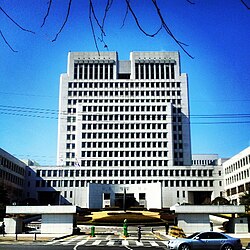
Since 1995, the Supreme Court has been located in Seocho, Seoul. The facility is a massive complex spanning approximately 66,500 square meters across 16 floors and two underground levels. The building houses the Supreme Court in the main center, the National Court Administration in the east wing, and the law library in another wing. At the main entrance, the values of freedom (자유), equality (평등), and justice (정의) are prominently engraved.
| Feature | Details |
|---|---|
| Total Justices (Current) | 14 (Expanding to 26 by 2028) |
| Chief Justice Appointment | Presidential appointment with National Assembly approval |
| Associate Justice Term | 6 years (Renewable) |
| Mandatory Retirement Age | 70 years old |
| Political Activity | Strictly prohibited |
Frequently Asked Questions
What is the difference between the Supreme Court and the Constitutional Court in Korea?
The Supreme Court is the highest ordinary court, handling final appeals for civil, criminal, and administrative cases. The Constitutional Court is a separate body specifically tasked with constitutional review, such as determining the constitutionality of laws and handling impeachment cases.
Why is the number of Supreme Court justices being increased?
The expansion from 14 to 26 justices is intended to ease a chronic backlog of cases. In 2025, the court faced roughly 40,000 substantive cases, meaning each justice was responsible for an average of 3,500 cases. The increase aims to protect the right to a fair trial by reducing reliance on summary dismissals.
Can a Supreme Court justice be removed from office?
Yes, but only under specific legal circumstances. According to the Constitution, a justice cannot be removed from office except through impeachment or upon receiving a sentence of imprisonment.
What is an "en banc" hearing?
An en banc hearing (전원합의체) is a session where the full body of Supreme Court justices participates in a case. These are reserved for the most significant legal issues, as the vast majority of cases are decided by smaller panels of justices.
How are research judges different from regular judges?
Research judges are core staff members who provide detailed legal analysis and support to the justices. They play a vital role in managing the high volume of appeals and ensuring that the complex legal reasoning required for Supreme Court decisions is thoroughly prepared.