Supralocal Organizations in Quebec
In Quebec, municipal governance extends beyond individual towns and cities through supralocal organizations. These entities coordinate essential services and planning among neighboring municipalities, ensuring that regional needs are met efficiently and cohesively.
Regional County Municipalities (RCMs)
Regional County Municipalities, known as RCMs (or MRCs in French), serve as the primary coordination bodies for neighboring municipalities. There are currently 86 RCMs across the province. While most municipalities belong to an RCM, certain exceptions exist. Municipalities within the Urban agglomeration of Montreal do not belong to an RCM, and several cities hold powers usually reserved for RCMs, including Québec, Saguenay, Trois-Rivières, Longueuil, Lévis, Shawinigan, Sherbrooke, Laval, Mirabel, Rouyn-Noranda, Gatineau, Les Îles-de-la-Madeleine, and La Tuque.
The responsibilities of an RCM are broad, focusing on regional stability and growth. Their primary duties include territorial planning, realty assessment, waste management, emergency planning, and local economic development. They also provide employment assistance and manage the local financing of the local development centre (CLD).
Governance and Voting
The RCM council exercises the organization's powers. This council consists of a warden and the mayors of each member municipality, occasionally including other elected municipal officials. The warden's selection varies by RCM: they may be appointed by the council (requiring them to be a mayor) or elected by universal suffrage (in which case they cannot hold any other elective office).
To ensure fair representation, voting strength is determined partly by population. However, a specific formula is applied to prevent a small number of large municipalities from making decisions unilaterally.
Unorganized Territories
Some areas in Quebec are unorganized territories—unincorporated lands that do not belong to any specific municipality. In these instances, municipal authority is exercised directly by the RCM or its equivalent.
Nord-du-Québec Administration
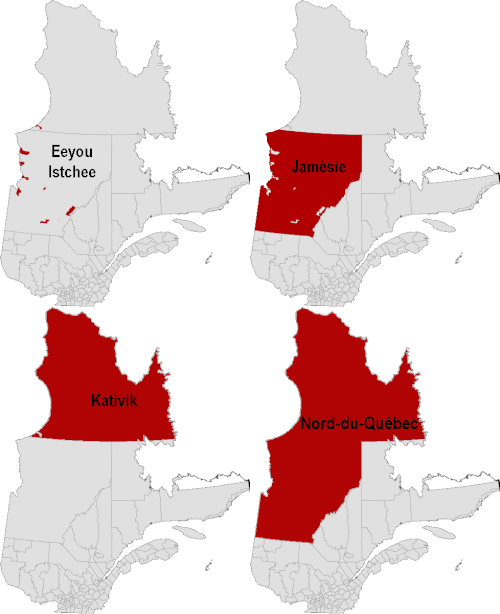
The Nord-du-Québec region is structured differently, divided into three territories that are equivalent to regional municipalities:
- Kativik Regional Government: Provides regional services to 14 northern villages and associated Inuit reserved lands, as well as the Naskapi village municipality of Kawawachikamach. The Cree village of Whapmagoostui is an enclave and does not participate in this government.
- Jamésie: This territory surrounds but does not administer the towns of Chibougamau, Chapais, Lebel-sur-Quévillon, and Matagami, nor the unconstituted localities of Radisson, Valcanton, and Villebois. These towns supply their own services.
- Eeyou Istchee James Bay Regional Government: An uncontiguous territory enclaved within Jamésie, it provides regional services to nine Cree village municipalities and their associated reserved lands.
Metropolitan Communities
Metropolitan communities (CMs) manage areas of common interest for their constituent municipalities. Their jurisdiction typically covers urban planning, economic development, the promotion of international trade, artistic and cultural development, public transportation, and waste management. Each CM also operates under specific legislative jurisdictions.
Quebec has two metropolitan communities:
- Communauté métropolitaine de Montréal (CMM): Comprising 82 municipalities, the CMM encompasses four RCMs and overlaps with six others. The council is chaired by the mayor of Montreal.
- Quebec City Metropolitan Community: This includes the Agglomoration of Quebec (containing four municipalities not in an RCM) and municipalities within the RCMs of L'Île-d'Orleans, parts of La Côte-de-Beaupré, and La Jacques-Cartier. The council is chaired by the mayor of Quebec City.
Key Facts
- There are 86 Regional County Municipalities in Quebec.
- RCMs manage critical infrastructure like waste management and territorial planning.
- Unorganized territories are managed by their respective RCM or equivalent.
- The CMM is the largest metropolitan community, consisting of 82 municipalities.
- The Nord-du-Québec region uses three unique regional equivalents instead of standard RCMs.
| Organization Type | Primary Focus | Key Examples/Regions | Governance Lead |
|---|---|---|---|
| RCM (MRC) | Territorial planning & local development | 86 RCMs across Quebec | Warden and member Mayors |
| Metropolitan Community | Urban planning & public transit | Montreal (CMM), Quebec City | Mayor of the central city |
| Regional Equivalents | Northern regional services | Kativik, Eeyou Istchee James Bay | Regional Government |
Frequently Asked Questions
What is the purpose of a Regional County Municipality?
RCMs coordinate services among neighboring municipalities, focusing on regional needs such as waste management, emergency planning, and territorial development.
Who leads an RCM council?
An RCM is led by a warden, who is either appointed from among the member mayors or elected by universal suffrage.
Do all Quebec municipalities belong to an RCM?
No. Municipalities in the Urban agglomeration of Montreal are not in an RCM, and several larger cities (such as Laval and Gatineau) possess powers usually reserved for RCMs.
What are unorganized territories?
These are unincorporated areas that do not belong to any specific municipality; therefore, the RCM or its equivalent exercises municipal authority over them.
How do Metropolitan Communities differ from RCMs?
Metropolitan communities focus on large-scale urban interests like international trade and public transportation for major city hubs, whereas RCMs handle broader regional planning and local development.