Sugarbirds: The Specialized Nectar Feeders of Southern Africa
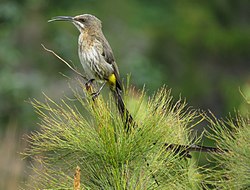
The sugarbirds are a unique group of passerine birds found exclusively in southern Africa. Belonging to the genus Promerops and the family Promeropidae, these birds are easily recognized by their brownish plumage, long downcurved bills, and strikingly elongated tails. While they share a similar appearance and lifestyle with sunbirds or Australian honeyeaters, they are not closely related to either group.
Key Facts
- Distribution: Restricted to southern Africa.
- Diet: Primarily nectar from Protea flowers, supplemented by insects.
- Specialization: Significant pollinators of the Protea genus.
- Physical Traits: Long, tubular, frilled tongues and massively elongated tails.
- Species: Only two species exist: the Cape sugarbird and Gurney's sugarbird.
Taxonomy and Evolutionary History
The genus Promerops was established in 1760 by French zoologist Mathurin Jacques Brisson, with the Cape sugarbird (Promerops cafer) serving as the type species. The name is derived from the Ancient Greek pro ("close to" or "similar") and Merops, the genus containing bee-eaters.
Determining the exact lineage of sugarbirds has historically been a subject of scientific debate. Early theories linked them to Australasian honeyeaters, while 1970s research using egg white proteins mistakenly grouped them with starlings. Modern molecular studies suggest they have few close relatives and are currently classified as a monotypic family. However, they do form a clade with the Modulatricidae, a group of three enigmatic African species.
Physical Characteristics
Sugarbirds are medium-sized birds, weighing between 26 and 46 g and measuring 23 to 44 cm in length. A significant portion of this length—between 15 and 38 cm—consists of their elongated tails. In both species, males possess longer tails and are slightly larger and heavier than females.
Their bills are long, slender, and slightly curved. Interestingly, females have slightly shorter bills, which allows the two sexes to utilize different feeding niches. The skull and tongue structures are very similar to those of honeyeaters, a classic example of convergent evolution—where unrelated species evolve similar traits to adapt to similar environments. Their tongues are long, protrusible, tubular, and frilled at the tip for efficient nectar extraction.
Species and Distribution
There are two recognized species of sugarbirds, both exhibiting high genetic diversity and large effective population sizes with no signs of inbreeding.
| Common Name | Scientific Name | Distribution |
|---|---|---|
| Cape sugarbird | Promerops cafer | Western Cape and Eastern Cape provinces of South Africa |
| Gurney's sugarbird | Promerops gurneyi | Lesotho, Mozambique, South Africa, Swaziland, and Zimbabwe |
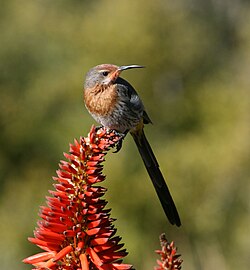
Gurney's sugarbird is found from Zimbabwe southwards, though its distribution is disjunct, resulting in two accepted subspecies. The Cape sugarbird is found specifically in the Cape provinces, inhabiting fynbos (a Mediterranean-type shrubland) and occasionally moving into nurseries and gardens.
Behavior and Ecology
Sugarbirds maintain a symbiotic relationship with plants of the Protea genus. They rely on the nectar from Protea inflorescences for most of their energy and, in turn, serve as vital pollinators for these plants.
To supplement their sugar-rich diet, sugarbirds hunt insects, particularly flies and bees from the family Apidae. They obtain these insects through hawking, a hunting method where the bird flies out from a perch to capture prey in mid-air.
Regarding their social lives, sugarbirds are monogamous. During the breeding season, males defend specific territories. The females typically lay two eggs in a nest situated in the fork of a tree.
Frequently Asked Questions
Are sugarbirds related to honeyeaters?
No. While they look and behave similarly due to convergent evolution, molecular studies show they are not closely related to Australian honeyeaters.
What do sugarbirds eat?
Their primary energy source is nectar from Protea flowers, but they also eat insects, such as flies and bees, which they catch while flying.
How many species of sugarbirds are there?
There are two species: the Cape sugarbird (Promerops cafer) and Gurney's sugarbird (Promerops gurneyi).
Where can sugarbirds be found in the wild?
They are restricted to southern Africa, with Gurney's sugarbird found in several countries including Zimbabwe and Mozambique, and the Cape sugarbird found in South Africa's Cape provinces.
Why are sugarbirds important to their ecosystem?
They are considered significant pollinators for the Protea genus of plants, helping to maintain the health of the protea scrub and fynbos habitats.