Sugar House: A History of Salt Lake City's Vibrant District
Established in 1853, just six years after Brigham Young led Latter-Day Saint settlers into the valley, Sugar House has evolved from a pioneer industrial experiment into one of Salt Lake City's most recognizable neighborhoods. Its unique identity is rooted in a blend of early agricultural ambition, civic transformation, and modern urban redevelopment.
The Origins of the Name
The district owes its name to the Deseret Manufacturing Company, which operated a sugar beet test factory in a converted blacksmith shop. This early industrial venture was established with the help of Philip DeLaMare, a convert born in Jersey. The specific name "Sugar House" was suggested by Margaret McMeans Smoot, the wife of Abraham O. Smoot, who served as the mayor of Salt Lake City at the time.
From Prisons to Parks
During the 19th and early 20th centuries, the area was home to the Sugar House Prison, the first state prison in Utah. This facility remained in operation until 1951, when it was closed and relocated to Draper. Following the prison's closure, the buildings were demolished to make way for community assets, resulting in the creation of Highland High School and the expansive Sugar House Park.
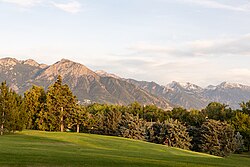
The neighborhood's identity has remained resilient despite attempts to change it. In 1928, during the dedication of the Sprague Library, Mayor John F. Bowman proposed that the area be renamed "South East Salt Lake City," but the community rejected the suggestion, preserving the historic Sugar House name.
Commerce and the "Furniture Row"
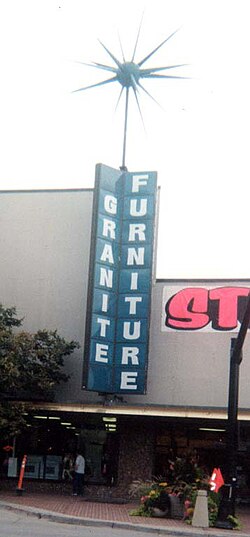
In the early 20th century, the intersection of 1100 East and 2100 South became known as "furniture row" due to the presence of three prominent furniture stores. While Sterling Furniture continues to operate today, other landmarks have vanished; Rockwood Furniture closed in 1999, and Granite Furniture ended its 80-year run at its Sugar House location in 2004.
The Shift to Modern Retail
The retail landscape shifted significantly in 1990 with the completion of the Sugar House Center, which introduced large national chains to the district for the first time. This was followed in 1998 by the construction of The Commons, a shopping center located east of the town center (the "Granite Block") and adjacent to the Sugar House Center. The Commons was built to address low patronage and has since been a subject of both praise and criticism.
Urban Redevelopment and the "Sugar Hole"
The corner of 1100 East and 2100 South, known as the Granite Block, underwent a controversial transformation starting in September 2007. Developer Craig Mecham announced plans to redevelop the site, leading to the demolition of buildings on the eastern half of the block in early 2008, which Mecham claimed were unsafe due to age.
The project faced significant local opposition from residents and business owners who feared that chain stores would displace independent local shops. Furthermore, the Great Recession stalled construction, leaving a fenced-off demolition site that locals derisively nicknamed the "Sugar Hole." In December 2010, Mecham submitted a revised plan, replacing planned office spaces and condos with apartments while maintaining street-level retail. Funding was secured in 2011, and the six-story mixed-use building was completed in 2013.
Transit and Connectivity
To improve connectivity between the Sugar House Business District and the TRAX station on 2100 South in South Salt Lake, city officials explored the use of the old Denver and Rio Grande Western Railroad (D&RGW) branch. A 2006 Transportation Alternatives Study commissioned by the Utah Transit Authority, Salt Lake City, and South Salt Lake determined that a trolley on the existing rail line was the best option.
The resulting S Line (originally the Sugar House Streetcar) began service on December 8, 2013. Plans have since been approved to extend the line north along 1100 East to Westminster University.
Key Facts
- Founded: 1853.
- Etymology: Named after a sugar beet test factory by Margaret McMeans Smoot.
- Former Landmark: Site of Utah's first state prison (closed 1951).
- Transit: The S Line streetcar launched in December 2013.
- Retail Evolution: Transitioned from "furniture row" to national chains via the Sugar House Center (1990).
| Year | Event |
|---|---|
| 1853 | Sugar House established. |
| 1928 | Proposal to rename area "South East Salt Lake City" rejected. |
| 1951 | Sugar House Prison closed and moved to Draper. |
| 1990 | Sugar House Center completed, bringing national chains. |
| 1999 | Rockwood Furniture closes. |
| 2004 | Granite Furniture closes its Sugar House location. |
| 2013 | S Line streetcar begins service; Granite Block redevelopment completed. |
Frequently Asked Questions
Why is the area called Sugar House?
The name comes from a sugar beet test factory operated by the Deseret Manufacturing Company in a former blacksmith shop. The name was suggested by Margaret McMeans Smoot.
What happened to the first Utah state prison?
The Sugar House Prison closed in 1951 and moved to Draper. The original site was cleared to create Sugar House Park and Highland High School.
What was "furniture row"?
Furniture row was the corner of 1100 East and 2100 South, which was home to three furniture stores. Today, only Sterling Furniture remains of the original three.
What is the "Sugar Hole"?
The "Sugar Hole" was a derisive nickname for the fenced-off demolition site at the Granite Block during a period when redevelopment was stalled by the Great Recession.
What is the S Line?
The S Line is a vintage-style rail trolley that connects the Sugar House Business District to the TRAX station on 2100 South, utilizing a branch of the old Denver and Rio Grande Western Railroad.