Stuttgart Airport: A Gateway to the Stuttgart Metropolitan Region
Located in the heart of Baden-Württemberg, Stuttgart Airport (IATA: STR, ICAO: EDDS) serves as a critical aviation hub for the Stuttgart Metropolitan Region. Spanning the municipalities of Leinfelden-Echterdingen, Filderstadt, and Stuttgart, this public airport provides essential connectivity for business and leisure travelers alike.
Originally built in 1939 and officially opened in 1948, the airport has evolved over nearly eight decades into a modern facility. It operates at an elevation of 1,276 feet (389 meters) above mean sea level (AMSL), managing a diverse array of scheduled and charter flights.
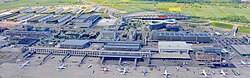
Key Facts
- Operator: Flughafen Stuttgart GmbH.
- Primary Runway: A single concrete runway (07/25) measuring 3,345 meters (10,974 feet).
- 2025 Passenger Volume: 9,585,033 passengers (a 4.7% increase).
- Major Hub For: Eurowings, Condor, SunExpress, and TUI fly Deutschland.
- Infrastructure: Includes a dedicated concrete helipad (H1) measuring 30 meters.
Airport Infrastructure and Facilities
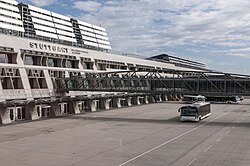
The airport is designed to handle high volumes of traffic through a streamlined terminal system. The landside view showcases the integration of Terminals 1 through 3, providing a cohesive experience for departing and arriving passengers.
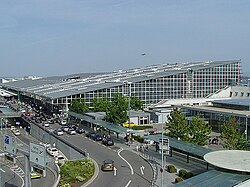
Terminals and Passenger Experience
Terminal 1 serves as a primary focal point of the airport's operations. It features expansive main halls and a dedicated departure area designed to manage the flow of millions of annual travelers efficiently.
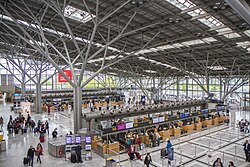
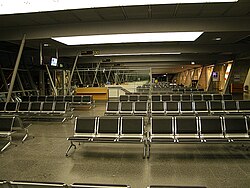
Airside Operations
The airport's operational efficiency is managed by a sophisticated air traffic control tower, ensuring the safety of the 95,765 aircraft movements recorded in 2025.
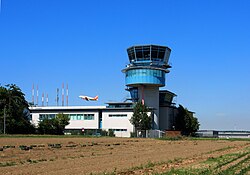
The apron area provides the necessary space for aircraft parking and ground handling services, supporting a wide variety of aircraft types from regional jets to large charter planes.
Airlines and Destinations
Stuttgart Airport is a major base for several airlines, with Eurowings dominating the market share at 40.2%. Other significant carriers include SunExpress (8.0%), Turkish Airlines (6.9%), and TUI fly (6.3%).
The airport offers a vast network of destinations. Domestic routes are highly popular, with Berlin Brandenburg, Hamburg, and Frankfurt ranking as the busiest internal connections. Internationally, Palma de Mallorca is the most frequented destination, followed by Istanbul and London.
Passenger Airline Network
- European Hubs: Direct flights to Vienna (Austrian Airlines), Amsterdam (KLM), Warsaw (LOT Polish Airlines), and Zurich (Swiss International Air Lines).
- Mediterranean and Leisure: Extensive seasonal and year-round services to Greece (Aegean Airlines), Spain (Vueling), and Turkey (Pegasus, AJet).
- Eastern Europe: Connections to Bucharest, Budapest, and Sofia via Wizz Air.
Cargo Operations
Beyond passenger travel, the airport is a vital logistics node. Cargo operations are supported by specialized carriers including DHL Aviation, FedEx Feeder, and Atlas Air, connecting Stuttgart to hubs like Cologne/Bonn, Leipzig/Halle, and Paris-Charles de Gaulle.
Transportation and Accessibility
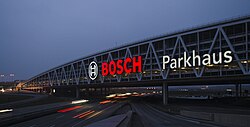
Accessibility is a cornerstone of the airport's design. It is linked via a major motorway and features extensive parking facilities to accommodate private vehicle travelers.
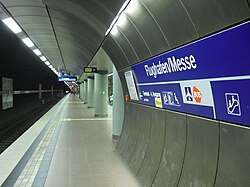
For those using public transit, the Stuttgart Flughafen/Messe station provides seamless integration with the regional suburban railway network, facilitating quick transfers to the city center and the nearby trade fair grounds.
Airport Statistics Summary
The following table summarizes the operational performance and capacity of Stuttgart Airport.
| Metric | Value | Trend |
|---|---|---|
| Total Passengers | 9,585,033 | +4.7% |
| Aircraft Movements | 95,765 | +1.7% |
| Cargo Volume (Metric Tons) | 34,597 | -4.3% |
| Runway Length | 3,345 m | N/A |
Frequently Asked Questions
Which airline has the largest presence at Stuttgart Airport?
Eurowings is the largest airline operating at the airport, accounting for 40.2% of the traffic.
What are the busiest international destinations from STR?
The most popular international routes are to Palma de Mallorca, Istanbul, and London.
How is the airport connected to the city of Stuttgart?
The airport is accessible via a major motorway and the Stuttgart Flughafen/Messe suburban railway station.
What is the length of the main runway?
The main concrete runway (07/25) is 3,345 meters (10,974 feet) long.
Does Stuttgart Airport handle cargo flights?
Yes, the airport handles significant cargo traffic through operators such as DHL Aviation, FedEx Feeder, and Atlas Air.