Student-Teacher Ratios: Impact on Education and Student Performance
The student-teacher ratio (or student-faculty ratio) is a fundamental metric in education that represents the number of students assigned to every one teacher in an institution. For instance, a ratio of 10:1 means there are 10 students for every single teacher. While this figure is often used interchangeably with class size, the two are distinct concepts that can vary independently based on how a school manages its staff and resources.
A similar metric used in early childhood education is the staff-child ratio, which tracks the number of children a childcare provider or staff member is responsible for supervising.
Key Facts
- Global Variance: OECD primary education ratios average just below 16, but range from 11 in Hungary and Luxembourg to 40 in Brazil.
- Ratio vs. Class Size: The student-teacher ratio is typically lower than the average class size.
- Economic Impact: Data suggests students from schools with lower ratios and better-educated staff often earn higher wages as adults.
- Subject Specifics: Lower ratios are often considered more effective for teaching complex subjects like physics, chemistry, and mathematics.
- Long-term Gains: Early exposure to small classes can lead to increased achievement in later grades, particularly in science and reading.
The Relationship Between Ratios and Class Size
It is a common misconception that the student-teacher ratio is a direct mirror of class size. In reality, several factors can decouple these two numbers. The number of teachers assigned to non-teaching duties, the number of classes each teacher leads, and the presence of multiple teachers in a single classroom all influence the final calculation.
Furthermore, specialized programs can skew the data. If a school provides very small classes for special education or second-language learners, the overall institutional ratio may appear low, even if the average student experiences much larger classes.
For example, both the United States and Israel have an average student-faculty ratio of 15. However, the average class size in the United States is 21, while in Israel, it is 27.
Institutional and Legislative Implications
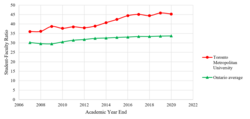
In the realm of tertiary education, a low student-teacher ratio is frequently used as a primary selling point to attract prospective students. Conversely, high ratios are often used as evidence of underfunding or as a catalyst for legislative change. In the United States, some states have mandated maximum ratios for specific levels, such as kindergarten.
However, these figures are often reported as means, which can be misleading. A school with one class of 30 students and another of 10 students can claim an average ratio of 20:1, despite the disparity in student experience. These ratios also serve as operational signals: a very high ratio (e.g., 50:1) typically triggers the hiring of new staff, while an excessively low ratio may lead to combined classes or staff reductions.
The Challenge of Large Classes
Overcrowded classrooms can be disruptive and create a wide spectrum of learning abilities within a single group. This often forces teachers to spend disproportionate time helping lower-attaining students assimilate information, which can slow the progression of the curriculum for the rest of the class. This dynamic often forms the basis for the creation of advanced or honors classes.
Effects on Student Performance
Research indicates that lower student-teacher ratios are particularly beneficial for complex subjects. Interestingly, schools with lower ratios tend to be more exclusive, fee-paying, or located in non-inner urban areas, often serving a larger proportion of white students.
The impact of these ratios on achievement is a subject of ongoing debate. Some analysts argue that extra resources have a negligible effect on achievement while the student is actually in school. However, economists have found a correlation between well-endowed schools—characterized by lower pupil-teacher ratios and highly educated staff—and greater success in the job market later in life.
Smaller classes generally benefit all pupils through increased individual attention. Low-attaining students at the secondary level benefit most, as they are less likely to drift off-task compared to those in large classes where instruction is delivered to the whole group. In reading and science, small classes help reduce the achievement gap in later grades.
Notably, cultural perspectives vary. In East Asian countries like Japan, larger class sizes are sometimes valued, particularly in preschool, for the socialization opportunities they provide children.
| Factor | Low Ratio / Small Class | High Ratio / Large Class |
|---|---|---|
| Instruction | High individual attention | Whole-group instruction |
| Complex Subjects | More effective for Physics/Math/Chem | More challenging to deliver |
| Student Outcome | Potential for higher adult wages | Higher risk of students drifting off-task |
| Socialization | Focused interaction | Higher peer-to-peer socialization (e.g., Japan) |
Frequently Asked Questions
What is the difference between student-teacher ratio and class size?
The student-teacher ratio is a broad institutional average of students per teacher, whereas class size is the actual number of students in a specific classroom. Factors like non-teaching duties and specialized small groups mean the ratio is usually lower than the average class size.
How do student-teacher ratios vary globally?
Ratios vary significantly by country. According to OECD data, primary education ratios range from as low as 11 in Hungary and Luxembourg to as high as 40 in Brazil.
Do smaller classes actually improve academic performance?
Yes, particularly for low-attaining students and those studying complex subjects. Smaller classes allow for more individual attention, which reduces the achievement gap in science and reading in later grades.
Can a low student-teacher ratio be misleading?
Yes, because ratios are often reported as means. A school can average a 20:1 ratio even if some classes are 30:1 and others are 10:1, masking the actual experience of many students.
Are there any benefits to larger class sizes?
In some cultures, such as in Japan, larger classes are valued for the social opportunities they provide, allowing children to interact and socialize within a larger group, especially during preschool.