Stromatolites: The Ancient Architects of Earth's Early Life
Long before the rise of complex animals or lush forests, the Earth's landscapes were shaped by microscopic engineers. Stromatolites (from the Ancient Greek strôma meaning 'layer' and líthos meaning 'rock') are layered sedimentary formations known as microbialites. These structures are not single organisms, but rather the result of collective biological activity that has left a permanent mark on the geological record for billions of years.
These formations are created primarily by photosynthetic microorganisms, including cyanobacteria, sulfate-reducing bacteria, and Pseudomonadota (formerly known as proteobacteria). These microbes produce sticky, adhesive compounds that trap and cement sand and other mineral particles, creating mineralized "microbial mats." As these mats grow, they build up layer by layer, resulting in the characteristic lamination that defines a stromatolite.
![Fossilized stromatolite in Strelley Pool chert, about 3.4 billion years old,[1] from Pilbara Craton, Western Australia](/images/d4/ce/d4ce1d9d0ab8078dd4c0574d9f31485bb58970bb728bfbab30b7d0510e23973a.jpg)
Key Facts
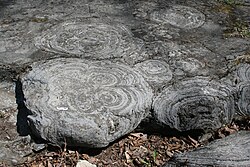
- Composition: Formed by microbial mats of cyanobacteria and other bacteria cementing sedimentary grains.
- Age: Some fossilized examples date back approximately 3.4 billion years.
- Peak: Their abundance and diversity peaked around 1.25 billion years ago.
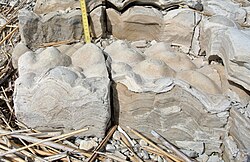
- Structure: Characterized by distinct layers (lamination) and can grow to a meter or more in size.
- Modern Status: Now rare in the Holocene epoch, primarily found in extreme or protected environments.
The Fossil Record and Ancient History
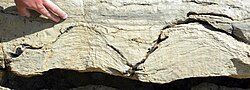
Stromatolites are among the most significant constituents of the early fossil record, providing a window into the first forms of life on Earth. Their presence allows scientists to track the evolution of early biological processes and the oxygenation of the planet.
While they dominated the early oceans, their prevalence declined sharply. By the start of the Cambrian period, stromatolites had fallen to only 20% of their peak abundance. Paleontologists propose two primary theories for this decline:
- The Cambrian Substrate Revolution: The emergence of complex grazing creatures that consumed the microbial mats, preventing the structures from forming.
- Microscopic Bioturbation: The rise of protozoa, such as foraminifera, which disrupted the layering process, favoring the formation of thrombolites (clotted microbialites) over the laminated stromatolites.
Morphology and Diversity
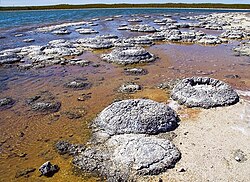
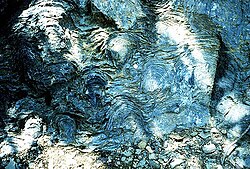
The physical appearance of stromatolites varies based on environmental conditions and the types of microbes involved. While many are dome-shaped, others can be columnar or branched. A related structure, the oncoid, is essentially an unfixed stromatolite, ranging from a few millimeters to several centimeters in size.
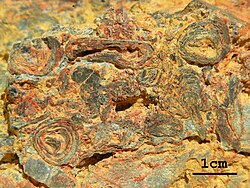
The study of these laminations involves complex microscopic and mathematical methods to interpret the temporal and environmental significance of each layer. Because they can grow to over a meter in height, they provide a substantial physical record of the environment in which they grew.
Modern Occurrences
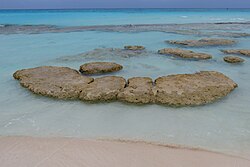
In the modern era, living stromatolites are rare and typically restricted to environments where grazing animals cannot survive, such as highly saline or extreme waters.
Saline Environments
Inland saline waters, such as the Cuatro Ciénegas Basin in the Mexican desert, host unique ecosystems of stromatolites. In Mexico's Alchichica Lake, two distinct generations exist: aragonite-rich columnar-dome structures (dated to 1,100 years before present) and spongy, cauliflower-like thrombolytic structures composed of hydromagnesite, huntite, and calcite (dated to 2,800 years before present).
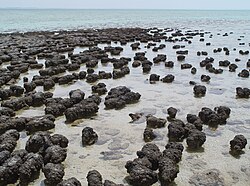
The Exuma Cays in the Bahamas represent the only known open marine environment where modern stromatolites continue to prosper.
Freshwater and Unique Locations
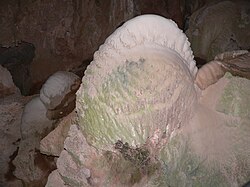
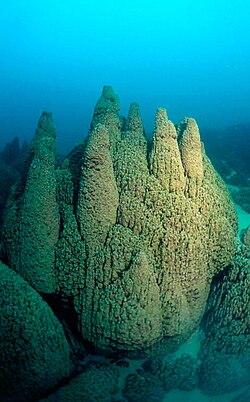
Stromatolites also appear in freshwater settings, such as the microbialite towers of Pavilion Lake in British Columbia. They have even been found in unusual subterranean environments, such as the "Crayback" stromatolite in Nettle Cave within the Jenolan Caves of New South Wales, Australia.
Summary of Stromatolite Characteristics
| Type/Location | Key Characteristics | Typical Environment |
|---|---|---|
| Ancient Fossils | Laminated, mineralized rock | Precambrian sedimentary beds |
| Modern Marine | Active microbial mats | Exuma Cays, Bahamas |
| Modern Saline | Aragonite or Hydromagnesite | Alchichica Lake, Mexico |
| Oncoids | Small, unfixed spheres | Various basins (e.g., Franceville) |
| Thrombolites | Clotted, non-laminated structure | Modern and ancient basins |
Frequently Asked Questions
What exactly is a stromatolite?
A stromatolite is a layered sedimentary formation created by the activity of photosynthetic microorganisms, primarily cyanobacteria, which trap and bind sediment into mineralized mats.
Why are stromatolites important to science?
They provide some of the oldest evidence of life on Earth, with some fossils dating back 3.4 billion years, helping scientists understand early biological evolution and atmospheric changes.
Why did stromatolites disappear from most of the ocean?
It is widely believed that the evolution of grazing animals during the Cambrian period led to the consumption of the microbial mats, while protozoa may have disrupted their layered growth.
Where can I see living stromatolites today?
Living examples are rare but can be found in Shark Bay, Western Australia, the Exuma Cays in the Bahamas, and certain saline lakes in Mexico.
What is the difference between a stromatolite and a thrombolite?
Stromatolites are characterized by distinct, fine layers (lamination), whereas thrombolites have a clotted, spongy internal structure without clear layering.