Strathmore History: From Grand Estates to Suburban Development
The story of Strathmore is one of transformation, where the sprawling private estates of Long Island's elite were gradually reshaped into the residential communities seen today. From the legacy of the Vanderbilt family to the development efforts of Levitt & Sons, the area's evolution reflects the broader shift toward suburbanization in New York.
The Southern Strathmores: South, Vanderbilt, and Village
Much of the southern region of Strathmore originated as the estate of Frank A. Munsey. Upon his death, the land was bequeathed to the Metropolitan Museum of Art. While the museum developed a portion of the land as Munsey Park, the area south of Northern Boulevard (NY 25A) was sold to the Vanderbilt family. For approximately a decade, the Vanderbilts held the land, including a mansion previously owned by Louis Sherry; this structure now serves as the Strathmore–Vanderbilt Country Club, with memberships deeded to residents of the subdivision.
Other sections south of Northern Boulevard, including the Strathmore Village area and much of the Americana Manhasset, were developed on the former estates of Genevieve Macaulay and Robert G. Elbert.
The community has faced significant challenges over the years. In February 1944, a massive fire devastated the Strathmore Village shopping area, destroying 15 shops and the Levitt & Sons real estate office. The damage was estimated at $250,000 in 1944 USD.
Later, in the 1990s, a community effort failed to save the former Manhasset Club (originally the Village Bath Club). Despite a petition signed by over 1,000 residents to have the Manhasset Park District purchase the site, and a failed attempt to have the Town of North Hempstead landmark the main building—which was designed to resemble a Frank Lloyd Wright California hunting lodge—the 2.5-acre property was demolished to make way for new homes.
Failed Incorporation and Infrastructure Controversies
Between 1949 and 1950, residents of South Strathmore, Strathmore–Vanderbilt, and Strathmore Village attempted to merge into a single legal entity called the "Incorporated Village of Strathmore." However, the proposal was rejected in a referendum vote of 742 to 248. Under New York protocol, the plan required approval from more than half of the voters to proceed.
In 1956, the community faced another crisis when the New York State Department of Public Works proposed the Manhasset Bypass (also known as the Miracle Mile Bypass). This project would have shifted New York State Route 25A slightly south, cutting diagonally through southwestern South Strathmore.
The proposed four-to-six lane bypass, estimated to cost between $5,000,000 and $8,000,000 (1956 USD), would have required the acquisition of ten homes through eminent domain—the power of a government to take private property for public use with payment. The project also would have impacted two churches, the Munsey Park Elementary School, and a major entrance to the South Strathmore subdivision. Due to intense resident protests, politicians in Albany eventually scrapped the proposal.
North Strathmore and the Onderdonk Legacy
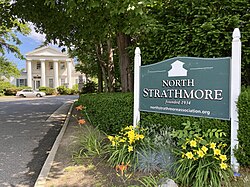
North Strathmore was originally the property of Horatio Gates Onderdonk, a member of a prominent Long Island family. In 1933, the land was sold to Levitt & Sons, who began developing the area into a residential neighborhood.
Development was not without friction. In the late 1940s, a proposal to build a 3-acre park in North Strathmore sparked controversy. Many Manhasset residents argued that the broader community should not fund a park that would primarily benefit North Strathmore residents. Consequently, a $45,000 (1949 USD) bond referendum was defeated, and the park was never built.
The neighborhood's architectural centerpiece, the historic Horatio Gates Onderdonk House, was preserved by Levitt & Sons and underwent an extensive rehabilitation during the 1980s.
Key Facts
- Original Landowners: Key estates included those of Frank A. Munsey, the Vanderbilt family, Robert G. Elbert, Genevieve Macaulay, and Horatio Gates Onderdonk.
- Developer: Levitt & Sons played a primary role in the development of North Strathmore.
- Major Loss: A 1944 fire caused $250,000 in damages to the Strathmore Village shopping area.
- Political Shift: A 1949-1950 attempt to incorporate as a village was defeated 742-to-248.
- Infrastructure Victory: Residents successfully protested the 1956 Manhasset Bypass proposal.
| Event/Location | Key Figure/Entity | Outcome/Detail |
|---|---|---|
| South Strathmore Land | Frank A. Munsey / Met Museum | Sold to Vanderbilt family; became residential/club area. |
| North Strathmore Land | Horatio Gates Onderdonk | Sold to Levitt & Sons in 1933. |
| Manhasset Bypass | NY Dept of Public Works | Proposed 1956; scrapped after community protest. |
| Manhasset Club | Town of North Hempstead | Landmark status denied; demolished for homes. |
| Incorporation Vote | Local Residents | Rejected 742-to-248 (1949-1950). |
Frequently Asked Questions
What is the history of the Strathmore–Vanderbilt Country Club?
The club is located in a mansion previously owned by Louis Sherry and later the Vanderbilt family. Residents of the Strathmore–Vanderbilt subdivision hold deeded memberships to the club.
Why was the Manhasset Bypass proposal rejected?
The proposal was scrapped by politicians in Albany following strong protests from residents. The bypass would have required the use of eminent domain to take ten homes and portions of two churches and a school.
Who developed North Strathmore?
North Strathmore was developed by Levitt & Sons after they purchased the land from Horatio Gates Onderdonk in 1933.
What happened to the Manhasset Club?
Despite efforts by over 1,000 residents to save the club and have its Frank Lloyd Wright-inspired building landmarked, the request was denied by the North Hempstead Landmarks Commission, and the property was demolished for new housing.
Was Strathmore ever an incorporated village?
No. While there was a proposal between 1949 and 1950 to incorporate South Strathmore, Strathmore–Vanderbilt, and Strathmore Village, the plan was rejected by voters in a referendum.