Strategic Petroleum Reserve: Safeguarding United States Energy Security
The Strategic Petroleum Reserve (SPR) is a massive emergency stockpile of petroleum managed by the United States Department of Energy (DOE). As the largest publicly known emergency oil supply in the world, it serves as a critical buffer against global supply disruptions, ensuring that the U.S. economy can continue to function during severe energy crises.
Established in 1975, the SPR was a direct response to the 1973–1974 oil embargo, which highlighted the vulnerability of the American economy to foreign oil supply interruptions. By storing millions of barrels of crude oil in underground salt caverns, the U.S. can mitigate the impact of price spikes and shortages.
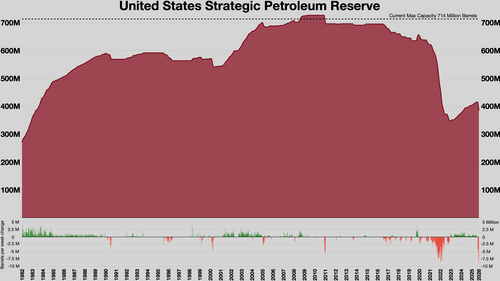
Key Facts
- Total Capacity: 714 million barrels across sites in Texas and Louisiana.
- Current Inventory: 311.4 million barrels (as of July 17, 2026).
- Maximum Withdrawal Rate: 2.7 million barrels per day.
- Primary Purpose: To mitigate supply disruptions and maintain national energy security.
- International Role: The U.S. is a founding member of the International Energy Agency (IEA) and must maintain stocks covering at least 90 days of net imports.
Operational Capacity and Inventory
The SPR utilizes specialized underground storage to hold two types of oil: sweet crude (low sulfur) and sour crude (high sulfur). As of March 2025, with market prices at $66 per barrel, the reserve held over $9.5 billion in sweet crude and approximately $12.9 billion in sour crude.
While the total capacity is vast, the actual utility of the reserve is limited by its drawdown capacity—the speed at which oil can be physically removed from the caverns. With a maximum withdrawal rate of 2.7 million barrels per day, it would take approximately 115 days to fully deplete the current inventory.
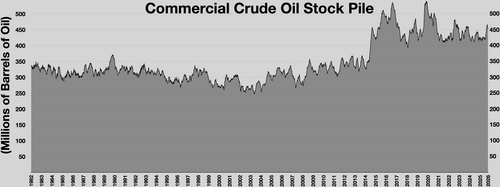
Current Inventory Metrics
Based on 2023 and 2024 data, the inventory of 311.4 million barrels represents:
- Approximately 15 days of oil based on 2023 daily consumption (20.275 million barrels/day).
- Approximately 37 days of oil based on 2024 daily import levels (8.420 million barrels/day).
Storage Facilities
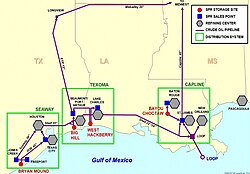
The SPR is distributed across four primary sites in the Gulf Coast region, chosen for their geological stability and access to shipping channels.
| Facility | Location | Storage Capacity (Barrels) | Drawdown Capacity (Barrels/Day) |
|---|---|---|---|
| Bryan Mound | Freeport, Texas | 184 million | 1.5 million |
| Big Hill | Winnie, Texas | 90 million | 0 (Construction outage) |
| West Hackberry | Lake Charles, Louisiana | 88 million | 0.75 million (Low inventory) |
| Bayou Choctaw | Baton Rouge, Louisiana | 51 million | 0.45 million |
Historical Usage and Policy Shifts
Historically, the SPR was used primarily for genuine emergencies, such as the 1990–1991 Desert Storm crisis and Hurricane Katrina in 2005. However, in recent years, the reserve has been used more frequently for market stabilization and federal funding.
Legislative Mandates and Deficit Funding
Since 2015, Congress has mandated several sales of SPR oil to fund federal spending. Acts such as the Bipartisan Budget Act of 2015 and the 21st Century Cures Act have required the sale of millions of barrels to deposit revenues into the U.S. Treasury. Between 2017 and 2026, these mandated sales accounted for roughly 18.2% of the reserve's contents.
Recent Major Releases
The Biden administration executed the largest release in SPR history starting March 31, 2022, releasing 1 million barrels per day for 180 days to combat high gasoline prices. By September 2023, this had contributed to a 45% reduction in the reserve. While efforts were made to replenish the stock at prices below $79 per barrel, rising prices led to the cancellation of further purchases by April 2024.
More recently, in March 2026, Secretary of Energy Chris Wright announced a coordinated release of 172 million barrels over 120 days. This action was part of a larger International Energy Agency effort involving 32 nations to lower energy prices following conflicts with Iran.
Frequently Asked Questions
What is the purpose of the Strategic Petroleum Reserve?
The SPR is an emergency stockpile designed to protect the United States from severe oil supply interruptions, ensuring energy security and stabilizing prices during global crises.
How quickly can oil be released from the SPR?
Oil can begin entering the marketplace approximately 13 days after a presidential order is issued, with a maximum physical withdrawal rate of 2.7 million barrels per day.
Why has the SPR inventory decreased recently?
Inventory has decreased due to a combination of Congressional mandates to fund federal spending and executive decisions to release oil to lower domestic gasoline prices and respond to international geopolitical tensions.
What is the difference between sweet and sour crude in the SPR?
Sweet crude has a lower sulfur content and is generally more valuable, while sour crude has a higher sulfur content and typically trades at a discount.
Is the U.S. meeting its international oil obligations?
As a member of the IEA, the U.S. is obligated to maintain stocks equivalent to 90 days of net imports. While levels have fluctuated, the U.S. also contributes 43.9% of the petroleum in any IEA-coordinated release.