Stover Canal: The Industrial Lifeline of the Ball Clay Trade
In the late 18th century, the ball clay industry—producing a high-quality clay essential for pottery—was expanding rapidly. However, the bulkiness of the product made transport a significant logistical challenge. To solve this, James Templer of Stover House, Teigngrace, envisioned a waterway that could efficiently move clay from the pits to the coast.
Construction began in January 1790, funded entirely by Templer. While he originally planned to extend the canal to Bovey Tracey and create a branch to Chudleigh, the project eventually concluded at Ventiford, Teigngrace. Despite passing the Templer's Estate Act 1792 to raise additional capital, Templer did not invoke its powers, as the canal had already reached its functional destination.
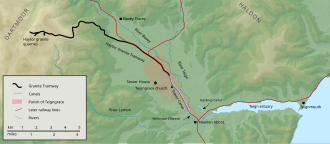
Key Facts
- Length: 1.7 miles (2.7 km) featuring five locks.
- Primary Purpose: Transporting ball clay and later granite.
- Major Client: Josiah Wedgwood and Sons (1798–1815).
- Unique Feature: The Graving Dock lock, which functioned as a dry dock.
- Final Closure: Formally abandoned in March 1943.
Engineering and Infrastructure
The canal was a sophisticated piece of engineering for its time, utilizing three separate feeders to maintain water levels. Two feeders—one from the Ventiford Brook (which also supplies Stover Lake) and one from the River Bovey at Jewsbridge—supplied the top pound. A third feeder from the River Teign at Fishwick entered the system just below lock 4.
The canal terminated at the tidal Whitelake channel, providing a direct route to the River Teign and its docks. The infrastructure evolved over time; the first three locks originally relied on earth banks rather than side walls, though these were later upgraded to timber or brick.
Specialized Lock Designs
The locks varied significantly in size and function. While most were long enough to accommodate two barges end-to-end, the Graving Dock lock was limited to a single barge at 56 feet (17 m). Conversely, the Jetty Marsh lock was a massive 215 by 45 feet (66 m × 14 m). An inscription dating to 1841 suggests the Jetty Marsh lock was reconstructed as a basin to allow barges to wait for the tide.
The Graving Dock lock is particularly notable in the United Kingdom for its design, featuring a side dock that allowed it to serve as a dry dock (a basin that can be emptied of water for ship repair) when the lock was empty. Both the Jetty Marsh and Graving Dock locks are now Grade II listed structures.
Commercial Evolution and Ownership
The canal's success was cemented in 1798 through a major contract with Josiah Wedgwood and Sons. Wedgwood remained the primary recipient of the ball clay until 1815, after which the trade diversified to other ports and pottery manufacturers.
The industrial utility of the canal expanded in 1820 when George Templer, James' son, opened the Haytor Granite Tramway. This connected granite quarries at Haytor Rocks to the canal basin at Ventiford, adding granite traffic to the existing clay trade for the next 40 years.
Ownership shifted several times throughout the 19th century:
- 1829: Sold by George Templer to Edward St Maur, 11th Duke of Somerset.
- 1862: Sold for £8,000 to the Moretonhampstead and South Devon Railway. The railway company maintained the section up to Graving Dock lock for barge repairs.
- 1877: Ownership passed to the Great Western Railway, though it remained leased to the clay-pit company Watts, Blake and Co.
| Feature/Event | Detail |
|---|---|
| Construction Start | January 1790 |
| Total Length | 1.7 miles (2.7 km) |
| Number of Locks | 5 |
| Key Commodities | Ball Clay, Granite |
| Formal Abandonment | March 1943 |
The Decline of the Waterway
As transport needs evolved, traffic on the canal gradually dwindled. Operations finally ceased in 1937. However, because of a 14-year lease held by Watts, Blake and Co., the canal was not formally abandoned until March 1943. The waterway remained filled with water until 1951, when a breach in one of the banks caused flooding in a nearby clay pit, effectively ending the canal's physical existence.
Frequently Asked Questions
Who funded the construction of the Stover Canal?
The canal was initially constructed at the personal expense of James Templer, who invested over £1,000 into the project starting in 1790.
What made the Graving Dock lock unique?
It is considered unique in the UK because it was reconstructed with a side dock, allowing it to function as a dry dock for barge repairs when the lock chamber was empty.
How did the Haytor Granite Tramway relate to the canal?
Built by George Templer and opened in 1820, the tramway transported granite from Haytor Rocks to the canal basin at Ventiford, supplementing the existing ball clay trade.
When did the canal officially stop operating?
While traffic ceased in 1937, the canal was not formally abandoned until March 1943, following the expiration of a lease held by Watts, Blake and Co.
Which famous pottery company used the canal?
Josiah Wedgwood and Sons held a major contract for the transport of ball clay via the canal from 1798 until 1815.