Steamboat Operations on the Wenatchee Reach
Between 1891 and 1915, a unique era of maritime transport flourished on the inland Columbia River in Washington. This specific section of the waterway, known as the Wenatchee Reach, served as a vital link for transportation and commerce. Unlike the lower routes of the Columbia, navigation on the Wenatchee Reach was never continuous with the downriver sections, creating a distinct operational zone for the vessels that plied these waters.
The Establishment of River Commerce
By the 1890s, the railroad had successfully reached Wenatchee, but transportation options ended there, leaving the upper Columbia inaccessible by rail. Recognizing this gap, Alexander Griggs, a seasoned steamboat captain from the Mississippi River, arrived in Wenatchee around 1891. In 1893, he founded the Columbia and Okanogan Steamboat Company to manage the 70-mile (110 km) stretch of river extending from Wenatchee to the mouth of the Okanogan River.
Overcoming Navigation Challenges
Navigating the Wenatchee Reach was a perilous task due to rapids, snags (submerged trees or logs), and large rock formations. To make the river passable, the Corps of Engineers blasted away major rocks and cleared debris. To assist boats in traversing the most difficult rapids, the Corps installed massive ringbolts—heavy metal loops anchored directly into the riverbank rocks.
Steamboats utilized these bolts by hooking a cable to the ring and wrapping the other end around an on-board steam-powered winch, effectively cranking the vessel up the rapids. In addition to these mechanical aids, horse-drawn tow paths along the riverbanks were used to pull boats through treacherous sections.
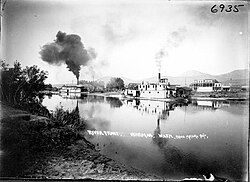
The Fleet and Its Fate
At its peak, Captain Griggs operated a fleet of eight or nine vessels. The fleet included the Alexander Griggs, W.H. Pringle, Selkirk, Gerone, Columbia, Oro, Camano, North Star, Chelan, and Okanogan. However, the river claimed several ships early on; the Alexander Griggs and W.H. Pringle were lost at Entiat, while the Selkirk sank at Rock Island.
| Category | Details | |
|---|---|---|
| Operational Period | Approx. 1891–1915 | |
| Primary Route | Wenatchee to the mouth of the Okanogan River | 70 miles (110 km) |
| Key Figure | Captain Alexander Griggs | |
| Primary Company | Columbia and Okanogan Steamboat Company | |
| Navigation Aids | Ringbolts, steam winches, and horse tow paths |
The Decline of the Steamboat Era
The decline of the service began around 1910 as business dwindled, largely due to competition from a Great Northern Railway branch line extending north to Oroville. Four of the company's boats were laid up during this time. On July 8, 1915, these four moored vessels were destroyed in a single, spectacular fire. Because none of the ships were insured, the loss was total.
The company's final vessel, the Enterprise, sank just four days later on July 12, 1915, at Brewster's Landing. Other independent vessels also met unfortunate ends; the St. Paul burned in 1915. Only the Del Rio, Robert Young, and later the Bridgeport (introduced in 1917) continued to operate on the routes above Wenatchee into the mid-1920s.
Key Facts
- Route Length: The primary navigation stretch was 70 miles (110 km) from Wenatchee to the Okanogan River mouth.
- Founder: Alexander Griggs, a former Mississippi River captain, established the Columbia and Okanogan Steamboat Company in 1893.
- Engineering: Ringbolts and steam winches were essential for navigating rapids.
- Catastrophic Loss: Four uninsured boats burned simultaneously on July 8, 1915.
- Competition: The Great Northern Railway's expansion to Oroville contributed to the industry's decline.
Frequently Asked Questions
What was the Wenatchee Reach?
The Wenatchee Reach refers to the section of the inland Columbia River extending approximately 70 miles from Wenatchee, Washington, to the mouth of the Okanogan River.
How did steamboats navigate the river's rapids?
Boats used a combination of horse-drawn tow paths and a system of ringbolts installed by the Corps of Engineers. Captains would attach cables to these bolts and use steam-powered winches to pull the boats upstream.
Why did steamboat operations eventually stop?
The service declined due to a lack of business and increased competition from the Great Northern Railway, which built a branch line north to Oroville.
What happened to the Columbia and Okanogan Steamboat Company fleet?
Many boats were lost to the river's rapids. In July 1915, four uninsured boats burned while moored at Wenatchee, and the company's last boat, the Enterprise, sank shortly thereafter at Brewster's Landing.
Did any steamboats operate after 1915?
Yes. While the primary company collapsed, the Del Rio and Robert Young continued operating, and the Bridgeport began service in 1917, maintaining operations above Wenatchee into the mid-1920s.