Stanford Rugby Football: The Golden Era of the Early 20th Century
At the turn of the 20th century, Stanford University embarked on a fascinating athletic detour, pivoting from American football to rugby union—a sport characterized by continuous play and the absence of forward passes. For over a decade, Stanford established itself as a powerhouse in the sport, competing against local clubs, international touring teams, and collegiate rivals in a series of high-stakes matches.
The Lanagan Years (1906–1908)
Stanford's transition to rugby began in 1906 under head coach James F. Lanagan. Despite having no prior experience in the sport, Lanagan was retained due to his success as a football coach. To prepare, he traveled to Vancouver, British Columbia, to study the game's nuances. This dedication paid off as Stanford won its first five games of the 1906 season.
During this era, Stanford competed for the Cooper Keith Trophy, a prestigious prize contested against club teams in the Vancouver area. While the team struggled initially in British Columbia, they dominated the first rugby-style "Big Game" against California.
By 1908, Lanagan's third and final season, Stanford reached a peak of early success with a 12–2 record. The team not only secured its third consecutive Big Game victory but also finally captured the Cooper Keith Trophy. The season concluded with a challenging match against the Wallabies, the Australian national team, resulting in a 13–3 loss.
The Presley Era and the Rise of Dominance (1909–1912)
Following Lanagan's departure, George J. Presley took the helm. A former player and assistant coach, Presley led the team through a period of immense defensive strength. In both 1909 and 1910, Stanford won its first seven games of the season by shutout.
However, the rivalry with California remained a hurdle. After seven years of dominance, Stanford lost the Big Game in 1909. The 1910 matchup was particularly historic, as it is recognized as the first intercollegiate game to feature card stunts in the stands. Despite Presley's impressive overall record of 30–8–1, he struggled against the Bears, finishing his tenure with a 0–3–1 record in the Big Game.
The Brown Era and International Challenges (1913–1916)
Floyd C. Brown succeeded Presley, bringing in elite talent such as Danny Carroll, a gold medalist from the 1908 Summer Olympics with the Australian national team. The 1913 season was marked by a stark contrast in competition: while Stanford dominated local clubs, they suffered two blowout losses to the New Zealand All Blacks, losing 54–0 and 56–0 during the legendary team's North American tour.
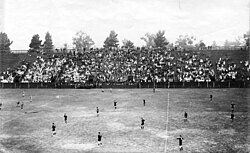
These humbling defeats intensified the desire among some to return to American football, but the team continued to excel. In 1914, Stanford achieved its greatest success, going undefeated and defeating California 26–8 before a record crowd of 26,000 spectators.
By 1915, rugby's popularity in U.S. colleges had waned, leaving only Santa Clara as a collegiate opponent. Stanford continued to dominate local all-star and club teams, maintaining a nearly flawless record through 1916.
The Final Whistle (1917)
The rugby era came to an abrupt end in 1917. Under coach Jim Wylie—himself a former All Black—Stanford played a single game against Santa Clara, winning 15–11. The onset of World War I led President Ray Lyman Wilbur to cancel all intercollegiate athletics as students enlisted and the campus became the regional headquarters for the Students' Army Training Corps. When athletics resumed in 1919, Stanford returned to American football.
Key Facts
- Peak Performance: The 1914 season was the most successful in program history, ending in an undefeated 10–0 record.
- International Experience: Stanford faced world-class competition, including the Australian Wallabies and the New Zealand All Blacks.
- The Big Game: The rivalry with California continued through the rugby era, with the 1910 game pioneering the use of card stunts.
- Coaching Lineage: Most coaches (Presley, Brown, and Wylie) were former Stanford rugby players.
Season Summary Table
| Season | Head Coach | Record | Notable Achievement/Event |
|---|---|---|---|
| 1906 | James F. Lanagan | 6–2–1 | First rugby season; won first rugby Big Game |
| 1907 | James F. Lanagan | 8–4 | Second consecutive Big Game win |
| 1908 | James F. Lanagan | 12–2 | Won Cooper Keith Trophy |
| 1909 | George J. Presley | 8–1 | First Big Game loss in seven years |
| 1910 | George J. Presley | 7–1 | First intercollegiate game with card stunts |
| 1911 | George J. Presley | 10–3 | Added USC to the schedule |
| 1912 | George J. Presley | 5–3–1 | Worst record of the rugby era |
| 1913 | Floyd C. Brown | 8–3 | Played New Zealand All Blacks |
| 1914 | Floyd C. Brown | 10–0 | Undefeated season |
| 1915 | Floyd C. Brown | 10–0–1 | Only collegiate opponent was Santa Clara |
| 1916 | Floyd C. Brown | 9–1 | Last full season of rugby |
| 1917 | Jim Wylie | 1–0 | Final game before WWI hiatus |
Frequently Asked Questions
Why did Stanford switch from football to rugby?
While the source does not explicitly state the reason for the initial switch, it notes that Stanford played rugby from 1906 until 1917, during which time rivals like USC and California also experimented with the sport before eventually returning to American football.
Who were the New Zealand All Blacks?
The All Blacks are the New Zealand national rugby team. They toured North America in 1913, where they defeated Stanford in two matches with scores of 54–0 and 56–0.
What was the Cooper Keith Trophy?
The Cooper Keith Trophy was a prize that Stanford competed for against various club teams based in the Vancouver area of British Columbia.
How did the "Big Game" change during the rugby era?
The Big Game between Stanford and California was played as a rugby match for several years. Notably, the 1910 game is credited as the first intercollegiate event to feature card stunts in the stadium.
Why did Stanford stop playing rugby in 1917?
The program ended due to the impact of World War I. President Ray Lyman Wilbur canceled intercollegiate athletics as students enlisted and the campus served as the regional headquarters for the Students' Army Training Corps.