St Bathans: A Journey Through New Zealand's Gold Mining and Prehistoric Past
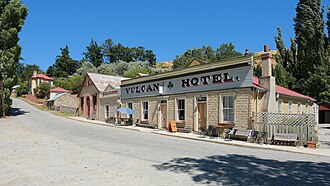
Nestled in the heart of Central Otago, St Bathans is a town where history and nature converge. Once a bustling hub of the Otago gold rush, this former gold and coal mining settlement has transitioned from an industrial center into a serene holiday retreat. Today, visitors are drawn to its well-preserved historic architecture and a landscape shaped by both human ambition and prehistoric forces.
The town was named by early surveyor John Turnbull Thomson after Abbey St Bathans, a village in the Scottish Borders where Thomson's maternal grandfather was born. Located 40 kilometers northwest of Ranfurly and 60 kilometers northeast of Alexandra, the town sits near Dunstan Creek, framed by the St Bathans Range and the Dunstan mountains.
Key Facts
- Location: Central Otago, New Zealand, near the Dunstan Creek.
- Primary History: Former center for gold and coal mining.
- Main Attraction: The Vulcan Hotel, a Category I historic place.
- Natural Wonder: Blue Lake, a 168-meter deep man-made pit.
- Scientific Significance: Home to the St Bathans fauna and the unique SB mammal.
The Legacy of Gold and the Blue Lake
The landscape of St Bathans bears the permanent marks of its mining heritage. The most striking example is Blue Lake. This small, man-made lake was created through gold-sluicing—a process of using high-pressure water to wash away earth to reveal gold—which transformed the 120-meter high Kildare Hill into a massive pit.
After mining operations ceased in 1934, the pit filled with water. The lake acquired a distinctive blue hue, caused by minerals leaching from the surrounding rocks. Today, Blue Lake serves as a popular camping spot where swimming is permitted.
The Vulcan Hotel: History and Hauntings
The town's primary tourist attraction is the Vulcan Hotel. Originally constructed in 1882 from mud brick and known as the Ballarat Hotel, this restored public house is registered as a Category I historic place by Heritage New Zealand.
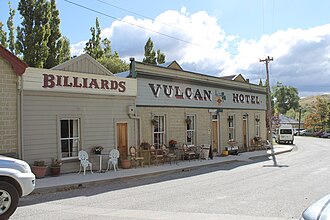
Beyond its architectural value, the Vulcan Hotel is reputed to be one of New Zealand's most famous haunted buildings. Local lore suggests that Room 1 is inhabited by the spirit of a young woman known as "the Rose," who is believed to have been strangled to death in the hotel during the 1880s.
Geology and the St Bathans Fauna
St Bathans is of immense importance to the scientific community due to the St Bathans fauna. This refers to a rich palaeontological section of the lower Bannockburn Formation of the Manuherikia Group, dating back 19 to 16 million years.
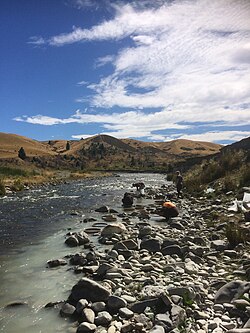
The fossils are found in littoral zone sediments—deposits from the shoreline of a body of water—which were once part of a large, shallow prehistoric freshwater lake known as Lake Manuherikia. These layers are exposed along the Manuherikia River, allowing researchers to uncover a diverse array of ancient life.
The Enigmatic SB Mammal
In 2006, scientists discovered nontherian mammal fossils in the Manuherikia Group. This find was groundbreaking, as it was previously believed that bats were the only terrestrial mammals native to New Zealand. This creature, dubbed the SB mammal, possesses a lineage distinct from monotremes (egg-laying mammals), eutherians (placental mammals), and metatherians (marsupials).
Diverse Ancient Taxa
The St Bathans formation has yielded a vast array of other fossils, including:
- Birds: Moa, a primitive kiwi (Proapteryx), the enigmatic Aptornis, parrots, pigeons, herons, a palaelodid flamingo, and various waterfowl including the endemic Miotadorna and Manuherikia.
- Reptiles: Mekosuchine crocodiles, turtles, skinks, tuatara, and geckoes.
- Other: Petrels, rails, a possible seagull, and an owlet-nightjar.
Climate and Environment
Situated at an elevation of 585 meters, St Bathans experiences a climate characterized by cool winters and mild summers. The following table provides the average climate data for the region.
| Month | Mean Max Temp (°C) | Mean Temp (°C) | Mean Min Temp (°C) | Avg Rainfall (mm) |
|---|---|---|---|---|
| January | 22.6 | 16.1 | 9.6 | 61.0 |
| April | 16.1 | 10.3 | 4.5 | 58.0 |
| July | 8.3 | 3.4 | -1.5 | 37.0 |
| October | 16.0 | 10.1 | 4.3 | 58.0 |
| Yearly Avg | 15.8 | 10.0 | 4.2 | 646.0 |
Frequently Asked Questions
How was Blue Lake formed?
Blue Lake is a man-made feature created by gold-sluicing, which carved a 168-meter deep pit into Kildare Hill. After mining stopped in 1934, the pit filled with water and turned blue due to minerals in the surrounding rock.
What is the SB mammal?
The SB mammal is a prehistoric nontherian mammal discovered in 2006. It is significant because it proves that terrestrial mammals other than bats existed in New Zealand, with a lineage separate from placental mammals, marsupials, and monotremes.
Is the Vulcan Hotel actually haunted?
While not scientifically proven, the Vulcan Hotel is reputed to be one of New Zealand's most haunted buildings, specifically Room 1, which is said to be haunted by a woman known as "the Rose" from the 1880s.
What can visitors do in St Bathans today?
Visitors often engage in gold-prospecting, visit the historic Vulcan Hotel, camp and swim at Blue Lake, and explore the town's preserved historic buildings.
What is the St Bathans fauna?
The St Bathans fauna refers to a collection of fossils from 19–16 million years ago found in the Bannockburn Formation. It includes a wide variety of ancient birds, crocodiles, turtles, and the unique SB mammal.