Square Dance: A Global History of Rhythm, Tradition, and Community
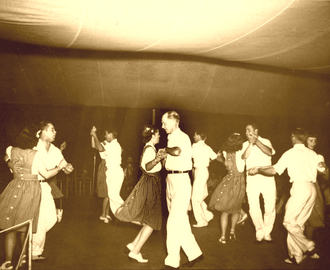
A square dance is a vibrant social activity involving eight dancers—typically four couples—arranged in a square formation. With one couple positioned on each side facing the center, these dances create a dynamic geometric pattern of movement. While often associated with the American West, square dancing is part of a massive global spectrum of social movement, including country dances, folk dances, barn dances, and ceilidh dances. With over 100 different formations in existence, the Square and the Longways Set remain the most iconic.
Key Facts
- Core Formation: Typically involves four couples (eight dancers) arranged in a square.
- Global Reach: Modern western square dance is taught in approximately 30 countries.
- Official Status: 31 U.S. states have designated square dancing as their official state dance.
- The Caller: A central figure who directs dancers through specific moves, a practice that evolved from African American musical traditions.
- Standardization: Modern western square dance is governed by Callerlab, the International Association of Square Dance Callers.
The Historical Evolution of the Square
The roots of square dancing are deeply intertwined with European social traditions. One early influence was the Morris dance, an energetic English dance for six men. This evolved into the English country dance, which featured various group formations. In 1651, John Playford published The English Dancing Master, a seminal work documenting 105 dances. Notably, some of these early entries specifically used the term "square dance."
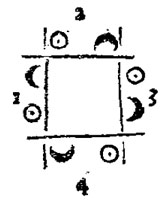
By the early 1800s, English country dances merged with 18th-century French quadrilles—dances for four couples in a square—to create the foundation for what would become the American tradition. When European settlers arrived in North America, these dances underwent significant transformation. Following the American Revolution, the quadrille gained immense popularity. As African American musicians provided accompaniment, they began "calling out" the steps to help dancers keep pace, a practice that eventually birthed the modern professional caller.
Major Styles of Square Dancing
United States and Canada
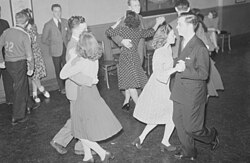
In North America, square dancing is generally divided into two primary categories: traditional and modern.
Traditional Square DanceAlso known as old-time square dance, this style is not standardized and varies by region. The three main styles include Northeast/New England, Southeast/Appalachian, and Western. These forms are often danced to live acoustic music, such as the fiddle, banjo, or guitar, and are deeply rooted in local heritage.
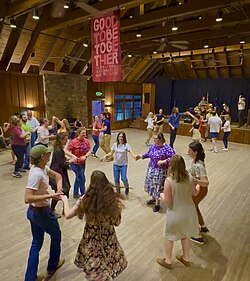
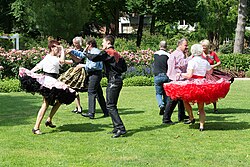
Modern western square dance evolved from the western style of traditional dance. It was significantly promoted in the early 20th century by industrialist Henry Ford, who integrated square dancing into public school physical education curricula. Today, this form is highly standardized through the Callerlab syllabus. Unlike traditional styles, modern dancers learn a specific "program" of moves, allowing them to dance with others internationally using English-language calls.
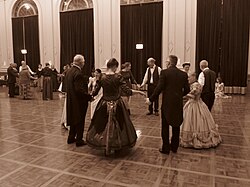
United Kingdom and Ireland
In the British Isles, square dancing takes several distinct forms:
- Playford Dances: Derived from Playford's 17th-century publications, these range from gentle steps to energetic leaps.
- Regional Folk Dances: Local traditions like the Goathland or Cumberland square eight involve memorized moves performed in village settings.
- Irish Set Dance: A square dance characterized by specific stepping, such as the flat-foot polka step. In this style, couples are referred to as "tops" or "sides" rather than "heads" or "sides."
- Scottish Country Dance: A distinct regional tradition within the broader folk spectrum.
The Role of Music and Callers
Music is the heartbeat of the dance, but its style depends heavily on the genre. Traditional dances often rely on jigs and reels played on acoustic instruments like the fiddle, banjo, or accordion. In contrast, modern western square dance utilizes a wide array of recorded music, including pop, country, rock, and even hip-hop, typically maintaining a steady tempo of 120–128 beats per minute.
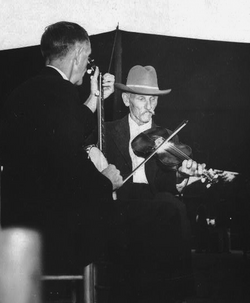
The caller is essential for navigating the dance. In traditional settings, callers might use between ten and thirty calls, often explaining new moves as they go. In modern western square dancing, callers use a standardized set of moves. The most common level, Mainstream, consists of approximately 70 core moves. Because the caller dictates the sequence, no two modern western dances are ever exactly alike.
Summary of Dance Styles
| Feature | Traditional Square Dance | Modern Western Square Dance |
|---|---|---|
| Standardization | Regional/Non-standardized | Highly standardized (Callerlab) |
| Music Type | Live acoustic (Fiddle, Banjo) | Recorded (Pop, Country, Rock) |
| Call Method | Traditional/Instructional | Program-based (Mainstream, etc.) |
| Global Presence | Local/Folk communities | International (approx. 30 countries) |
Frequently Asked Questions
What is the difference between a head couple and a side couple?
In most square dance formations, the head couples are the first and second couples (the top and foot of the square), while the side couples are the third and fourth couples located on the sides of the square.
How do dancers know what move to do next?
In modern western square dancing, a caller announces the moves (calls) in real-time. Dancers learn a specific set of moves called a "program" so they can react instantly to the caller's instructions.
Is there a specific dress code for square dancing?
It varies. Traditional groups often have no specific dress code. However, some modern western events request traditional square dance attire (western-style clothing), while many clubs prefer a casual or "proper" dress code.
Why is square dancing so popular in the United States?
Square dancing is strongly associated with American culture, partly due to its 20th-century connection to the romanticized image of the American cowboy and its promotion in schools and through various cultural revivals.
Can I dance square dance if I don't speak English?
While instruction is often provided in the local language, modern western square dance calls are almost always given in English. This standardization allows dancers to participate in clubs all over the world once they learn the terminology.