Spokane Transit Authority: A History of Regional Public Transportation
The evolution of public transit in the Spokane region is a story of adaptation, moving from horse-drawn carriages and electric streetcars to a sophisticated regional bus network. For over 130 years, the systems serving the Inland Empire have shifted in response to urban growth, economic fluctuations, and changing commuter habits.
Key Facts
- Origins: Transit began in 1888 with horse-drawn streetcars.
- Peak Streetcar Era: Ridership hit 37.98 million in 1910.
- Funding Shift: Transitioned from a city household tax to a regional sales tax in 1981.
- Modern Milestone: Launched the City Line bus rapid transit (BRT) in July 2023.
- Recent Growth: Fixed route ridership reached an all-time high of 11.3 million in 2014.
The Early Era: Streetcars and Interurbans (1880s–1970s)
Public transit in Spokane began in 1888 with a horse-drawn streetcar connecting downtown to the Browne's Addition neighborhood. By November 1889, the city introduced its first electrically powered streetcar, which served the area now known as the University District. For several decades, private developers operated these lines as part of broader real estate strategies.
By 1896, the Spokane Street Railway Company dominated the landscape with 23 miles of track arranged in a "cartwheel" pattern emanating from a hub at Riverside Avenue and Howard Street.
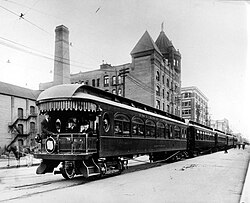
By 1910, competition between Washington Water Power and the Spokane Traction Company drove ridership to a peak of 37.98 million rides, including electric Interurban lines (electric railways connecting cities) that reached as far as Moscow, Idaho. However, the rise of private automobiles and "jitneys" (small privately owned buses) led to financial instability. In 1922, voters approved charter amendments to reduce taxes on infrastructure, leading to the creation of the Spokane United Railways Company, a subsidiary of Washington Water Power.
The streetcar system was gradually replaced by motorized coaches throughout the 1930s. Bus ridership peaked in 1946 at 26 million passengers. The system was owned by the Spokane City Lines Company (part of National City Lines) in 1945 before being transferred to the City of Spokane in 1968, funded by a $1 household tax.
Transition to a Regional System (1980s)
By 1980, the flat $1 household tax was no longer sustainable due to inflation and the fact that most residential growth was occurring outside city limits. This led to the creation of a Public Transportation Benefit Area (PTBA), shifting the model from a city-centric system to a regional one.
On March 10, 1981, voters approved a 0.3% sales tax to replace the household tax. This change allowed the agency to expand bus services beyond the city limits. Initially, the system operated under three branches: START (administration), STS (fixed route), and SASTA (paratransit). These were unified under the Spokane Transit Authority (STA) brand on September 23, 1982.
In September 1989, the agency expanded its infrastructure by opening the Valley Transit Center on 4th Avenue at University Road in Spokane Valley, providing a dedicated passenger island and park-and-ride facilities.
Infrastructure and Financial Challenges (1990s–2000s)
To improve downtown accessibility and passenger comfort, STA opened "The Plaza" in 1995. This $20 million indoor urban transit center replaced the old street-side hub at Howard and Riverside. While functional, the facility's design—featuring Italian tile and cougar statues—became a point of local controversy.
The late 1990s and early 2000s were marked by financial volatility. The loss of matching funds from Washington State's motor vehicle excise tax in 1999 forced the agency to seek more funding. After an initial failure in 2002, voters approved an increase in the sales tax to 0.6% in 2004, which was later made permanent in 2008.
During this time, the agency also explored rail options. The Light Rail Steering Committee studied a corridor from Downtown Spokane to Liberty Lake, eventually preferring a single-track system using Diesel Multiple Units (DMU)—self-propelled railcars. However, an advisory vote in 2006 showed negative public response to the project, halting further investment.
Modernization and the Future (2010s–2020s)
In 2010, STA adopted the "Connect Spokane" comprehensive plan to create a high-performance network. Despite service cuts during the Great Recession, ridership climbed to a record 11.3 million in 2014. The 2016 "STA Moving Forward" plan further expanded the system, leading to the 2018 opening of the West Plains Transit Center, which allowed passengers from Cheney, Medical Lake, and Airway Heights to connect without traveling through downtown Spokane.
The COVID-19 pandemic caused a sharp decline in ridership, dropping from 9.97 million in 2019 to 5.24 million in 2021. Recovery began in 2022, accompanied by the launch of a new fare collection system featuring mobile payments and fare capping.
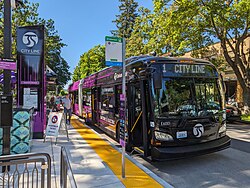
In July 2023, STA launched City Line, its first bus rapid transit (BRT) line, which provided over 700,000 rides in its first year. The agency also introduced double-decker buses in September 2025 for the Spokane–Cheney express routes. Although a collision with a low-clearance bridge in January 2026 temporarily disrupted service, the fleet resumed operations in February 2026.
| Era | Primary Mode | Funding Model | Key Milestone |
|---|---|---|---|
| 1888–1930s | Streetcars / Interurbans | Private / City Charter | Peak ridership of 37.98M (1910) |
| 1940s–1970s | Motorized Coaches | $1 Household Tax | City acquisition of system (1968) |
| 1980s–2010s | Regional Bus Network | 0.3% to 0.6% Sales Tax | Formation of STA (1982) |
| 2020s–Present | BRT / Double-Decker Bus | Sales Tax / Fare-based | Launch of City Line (2023) |
Frequently Asked Questions
What was the original form of transit in Spokane?
Transit began in 1888 with horse-drawn streetcars running between downtown Spokane and the Browne's Addition neighborhood.
Why did Spokane shift from a household tax to a sales tax in 1981?
The flat $1 household tax did not keep up with inflation and failed to capture revenue from residential growth occurring outside the city limits. The 0.3% sales tax provided a more sustainable, regional funding model.
What is the City Line?
Launched in July 2023, City Line is the Spokane Transit Authority's first bus rapid transit (BRT) line, designed for high-frequency, efficient urban travel.
Did Spokane ever implement light rail?
No. While the Light Rail Steering Committee studied a corridor to Liberty Lake and proposed using Diesel Multiple Units (DMU), a 2006 advisory vote indicated public opposition, and the project did not proceed.
How did the COVID-19 pandemic affect STA ridership?
Fixed route ridership saw a significant drop, falling from 9.97 million boardings in 2019 to 5.24 million in 2021, before beginning a recovery in 2022.