Soviet State Emblem: The Evolution of a Global Symbol
The state emblem of the Union of Soviet Socialist Republics (USSR) was more than a mere government seal; it was a carefully crafted visual manifesto. Designed to project the ideology of the new socialist state to the world, the emblem evolved over seven decades to reflect the shifting borders and political landscape of the Soviet Union.
The process began in the autumn of 1922 at Goznak, the state mint and printing works, where the Commission for the Development of Soviet Symbolics first convened. By January 10, 1923, the Presidium of the Central Executive Committee (CEC) established a formal commission to finalize the state emblem and flag, mandating the inclusion of the sun, the hammer and sickle, and the famous motto: "Proletarians of all countries, unite!"
The Design Process and Rejected Concepts
Initially, the task of creating the coat of arms was assigned to Goznak artists, including Dmitry S. Golyadkin, Yakov B. Dreyer, and Ivan Shadr. One notable submission came from K.I. Dunin-Borkovsky, who attempted to apply classical heraldry—the traditional system of designing coats of arms—by placing the hammer and sickle within a heraldic shield.
However, the commission rejected all Goznak sketches. They viewed the conservative European shield layout as outdated, preferring the bold, graphic style of early 1920s poster art. The commission sought a symbol that embodied four key principles:
- The unity of workers and peasants.
- The international nature of the state.
- The USSR's readiness for voluntary expansion.
- The central motto of proletarian unity.
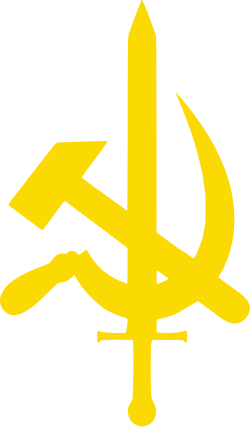
Even early conceptual ideas were scrutinized for their tone. One proposed emblem included a sword alongside the hammer and sickle, but this was rejected by Vladimir Lenin, who argued that a sword was too militaristic and not a symbol of the state.
The Path to the Final Design
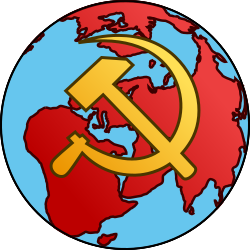
The breakthrough came from Vasily Korzun, an artist outside of Goznak. Korzun proposed the central image of a hammer and sickle hovering over a globe—an idea originally suggested by cartographer Vladimir Adrianov to symbolize that the Union was open to all states in the world.
To refine the composition, the commission brought in young artist Ivan Dubasov. The design underwent further political refinement; for instance, Avel Yenukidze, Secretary of the Presidium of the Central Executive Committee, suggested replacing the "USSR" monogram at the top with a red five-pointed star to better represent the state's ideology.
Chronological Evolution of the Emblem
First Version (1923–1936)
Accepted on July 6, 1923, and finalized on September 22, the first version was enshrined in Article 70 of the 1924 Soviet Constitution. It featured the hammer and sickle over a globe, framed by ears of wheat and topped with a red star. The motto appeared in six languages: Russian, Ukrainian, Belarusian, Georgian, Armenian, and "Turko-Tatar" (representing Azerbaijani and later Uzbek and Turkmen SSRs).
In 1931, the design was updated to include Tajik (in the Persian alphabet) following the formation of the Tajik SSR, and the Russian inscription was moved to the center.
Second Version (1936–1946)
With the 1936 Constitution, the number of republics grew to eleven. The emblem was updated to include eleven ribbons, adding Kazakh, Kyrgyz, Turkmen, and Uzbek. During this period, the Tajik inscription transitioned to the Latin alphabet.
Third Version (1946–1956)
Following World War II and the annexation of the Baltic states, Bessarabia, and parts of Finland, the USSR expanded to 16 republics. On June 26, 1946, the emblem was updated to include 16 ribbons. This version was notably asymmetrical, with the Russian ribbon in the center, eight ribbons on the left, and seven on the right. Additionally, several Turkic languages were transitioned from Latin to Cyrillic script.
Fourth and Final Version (1956–1991)
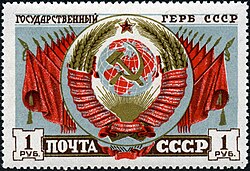
The final major change occurred on September 12, 1956, when the Karelo-Finnish SSR was demoted to an autonomous republic within the Russian SFSR. Consequently, the Finnish ribbon was removed, leaving 15 languages. A minor correction to the Belarusian text followed in 1958.
Key Facts
- Core Symbols: Hammer (industry), Sickle (agriculture), Globe (internationalism), and Red Star (ideology).
- Primary Designers: Vasily Korzun and Vladimir Adrianov developed the concept; Ivan Dubasov executed the final drawings.
- Language Shifts: The number of motto translations grew from 6 to 16, eventually settling at 15.
- Longevity: While the USSR dissolved in 1991, the emblem appeared on banknotes until 1994 and on some passports until 2002.
| Version Period | Number of Languages | Key Changes |
|---|---|---|
| 1923–1936 | 6 to 7 | Initial design; addition of Tajik in 1931. |
| 1936–1946 | 11 | Added Kazakh, Kyrgyz, Turkmen, and Uzbek. |
| 1946–1956 | 16 | Added Baltic states, Moldovan, and Finnish; shift to Cyrillic. |
| 1956–1991 | 15 | Removal of Finnish ribbon. |
Frequently Asked Questions
Why was the sword removed from the early designs?
Vladimir Lenin rejected the inclusion of a sword because he believed it was too militaristic and did not align with the symbols of the Soviet state.
What did the globe on the emblem represent?
Proposed by cartographer Vladimir Adrianov, the globe symbolized that the Soviet Union was open to all states of the world, reflecting the internationalist goals of the USSR.
How did the languages on the emblem change over time?
The languages changed to reflect the number of constituent republics. It started with six, peaked at sixteen after the annexation of the Baltic states and other territories, and ended with fifteen after the Karelo-Finnish SSR was reorganized.
Who were the primary artists responsible for the final look?
While many Goznak artists provided early sketches, the final composition was developed by Vasily Korzun and Vladimir Adrianov, with the final technical drawings produced by Ivan Dubasov.
When did the emblem officially stop being used?
Although the USSR dissolved in 1991, the emblem remained on banknotes until 1994 and was used on Soviet passports until 2002.