Southern Quechua: The Most Spoken Indigenous Language of the Andes
Southern Quechua (known natively as Urin qhichwa) is a powerhouse of linguistic heritage in South America. As the most widely spoken regional grouping within the Quechuan language family, it boasts approximately 6.9 million speakers. Alongside Guaraní, it holds the distinction of being one of the only indigenous languages in the Americas with a speaker population exceeding 5 million.
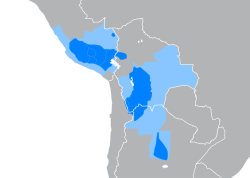
Geographically, Southern Quechua is spoken across the Andes south of a line running between Huancayo and Huancavelica in central Peru. Its reach extends through the Peruvian regions of Ayacucho, Cusco, and Puno, across much of Bolivia, and into parts of northwest Argentina.
Key Facts
- Speaker Count: Approximately 6.9 million people.
- Primary Regions: Peru, Bolivia, Argentina, and recognized as a minority language in Chile.
- Language Type: Agglutinating (words are formed by adding multiple suffixes to a root).
- Official Status: Official language in Bolivia and Peru; regional official status in Argentina.
- Major Dialects: Cusco, Ayacucho, Puno (Collao), North Bolivian, and South Bolivian.
Classification and Dialects
In the traditional classification established by linguist Alfredo Torero, Southern Quechua is categorized as Quechua II-C. This distinguishes it from other branches such as Central Quechua (Q I), North Peruvian Quechua (II a), and Kichwa (II b).
Regional Variations
While these dialects are generally mutually intelligible, they possess distinct characteristics:
- Ayacucho Quechua: Notable for lacking the aspirated and ejective stop consonants found in other varieties.
- Cusco-Collao Quechua: A grouping that includes Cusco and Puno (Collao) varieties, though they are not monolithic.
- Bolivian Quechua: Morphologically distinct from the Peruvian varieties, with North Bolivian being more phonologically conservative than South Bolivian.
- Santiagueño Quechua: Spoken in Argentina, this divergent variety lacks aspirated/ejective series and retains an ancient s–š distinction lost in other Southern varieties.
Standardization and Writing System
To bridge the gap between regional dialects, linguist Rodolfo Cerrón Palomino developed a standard orthography. This system acts as a compromise, utilizing conservative pronunciation features to remain viable across different regions. It is widely adopted by academic institutions in Peru and Bolivia, as well as by technology companies like Microsoft for software translation.
The writing system uses the Latin script. A key feature of the official orthography is the treatment of vowels: the letters e and o are not used for native Quechua words. Instead, these sounds appear as allophones (predictable variations) of i and u when they occur next to the consonants q, qh, and q'.
Comparison of Regional Spellings
| Ayacucho | Cusco | Standard | English Translation |
|---|---|---|---|
| upyay | uhyay | upyay | to drink |
| llamkay | llank'ay | llamk'ay | to work |
| ñuqanchik | nuqanchis | ñuqanchik | we (inclusive) |
| -chka- | -sha- | -chka- | progressive suffix |
| punchaw | p'unchay | p'unchaw | day |
Linguistic Structure
Phonology
Southern Quechua features a complex consonant system, including aspirated (e.g., pʰ, tʰ) and ejective (e.g., pʼ, tʼ) stop consonants, though these are absent in the Ayacucho and Santiagueño dialects. The vowel system includes a range of front, central, and back vowels with varying lengths.
Grammar and Morphology
Quechua is an agglutinating language, meaning it builds complex words by attaching a series of suffixes to a basic root. Each suffix adds a specific layer of meaning. The standard sentence order is SOV (Subject-Object-Verb).
Key grammatical features include:
- Bipersonal Conjugation: Verbs agree with both the subject and the object.
- Inclusive vs. Exclusive "We": The language distinguishes between a "we" that includes the listener (ñuqanchik) and one that excludes them (ñuqayku).
- Noun Suffixes: Nouns use suffixes to indicate possession, number (plural -kuna), and case (such as locative -pi or dative -paq).
The Concept of Time and Space
One of the most striking aspects of Quechua for non-native speakers is its spatial-temporal orientation. The adverb qhipa means both "behind" and "future," while ñawpa means both "ahead/in front" and "past." This reflects a worldview where the past is in front of the speaker (because it can be seen and remembered) and the future is behind (because it is unknown).
Evidentiality
Southern Quechua employs a sophisticated system of evidentiality, where specific morphemes indicate the source of the speaker's information. This ensures the veracity of the statement is clear to the listener.
- -m(i): Indicates direct evidence (the speaker witnessed the event).
- -ch(a): Indicates inferred evidence or conjecture.
- -s(i): Indicates reported evidence or hearsay.
Frequently Asked Questions
How many people speak Southern Quechua?
There are approximately 6.9 million speakers, making it one of the most widely spoken indigenous languages in the Americas.
What is an agglutinating language?
An agglutinating language is one where words are constructed by adding multiple suffixes to a root, with each suffix typically representing a single, distinct meaning.
Why are there different ways to spell the same word in Quechua?
Because Southern Quechua consists of several regional dialects (like Cusco and Ayacucho), different spelling conventions evolved. A standard orthography was created by Rodolfo Cerrón Palomino to provide a unified system for all varieties.
How does Quechua view the future and the past?
Unlike English, Quechua associates the past with being "in front" (since it is known/seen) and the future with being "behind" (since it is unknown).
What is evidentiality in the context of Quechua?
Evidentiality is a grammatical requirement to mark how the speaker knows the information they are sharing—whether they saw it personally, inferred it, or heard it from someone else.