Southern Live Oak
The Southern live oak (Quercus virginiana) is a majestic, semi-evergreen tree that serves as a living symbol of the Southeastern United States Coastal Plain. Renowned for its massive size and sprawling canopy, this species is an iconic feature of the "Old South" landscape, where ancient specimens continue to thrive in the Deep South.
Unlike true evergreens, the southern live oak is semi-evergreen. It retains its foliage nearly year-round, dropping old leaves only immediately before new growth emerges in the spring. This biological quirk sometimes leads to the misconception that the tree is suffering from oak wilt when leaves turn yellow or brown during winter.
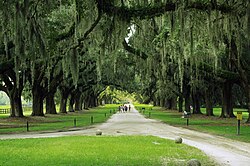
Key Facts
- Scientific Name: Quercus virginiana
- Conservation Status: Least Concern (IUCN 3.1)
- Native Range: Southeastern US Coastal Plain, from Virginia to Texas.
- Hardiness: Reliably hardy to USDA Zone 8a.
- Defining Feature: Extremely wind-resistant due to a low center of gravity and extensive root system.
- State Symbol: Official state tree of Georgia.
Botanical Description
The southern live oak is characterized by its dark, thick, and longitudinally furrowed bark. Its leaves are stiff, leathery, and simple, featuring shiny dark green tops and pale gray, tomentose (densely hairy) bottoms. These leaves typically range from 2 to 15 centimeters in length.
The tree's reproductive organs include green hanging catkins (male flowers) measuring 7.5 to 10 centimeters. Its acorns are small (1 to 2.5 cm), oblong, and vary in color from tan-brown to nearly black.
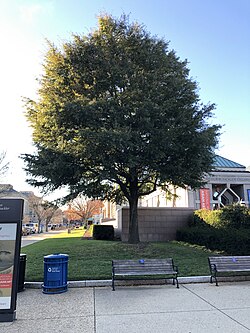
Growth Habit and Structure
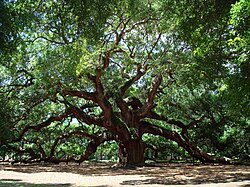
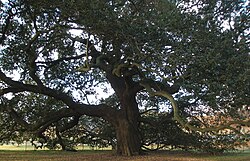
Depending on the environment, the southern live oak can vary from a shrub-like form to a massive tree. Open-grown specimens typically reach heights of 20 meters (66 ft) with a limb spread of nearly 27 meters (89 ft). A distinctive trait of the species is its lower limbs, which often sweep down toward the ground before curving upward.
Historically, Native Americans utilized this flexibility by bending saplings to grow at extreme angles, creating permanent trail markers.
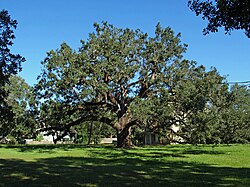
Distribution and Habitat
The native range of Quercus virginiana begins in southeast Virginia and follows a narrow coastal band through North Carolina and South Carolina. As it moves south, the range expands inland across Georgia, Florida (including the northern Florida Keys), Mississippi, Louisiana, and into Texas, ending just past Port Lavaca.
These trees are typically found in maritime forests, savannas, and grasslands, rarely ascending above 90 meters (300 ft) in elevation. They thrive in acidic soils (pH 5.5 to 6.5) and can handle a wide range of moisture levels, provided there is good soil drainage. They are particularly resilient to salt spray and moderate soil salinity.
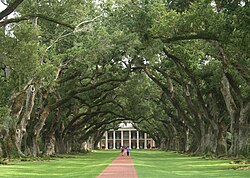
Ecology and Resilience
The southern live oak is a powerhouse of survival. Its deep taproot, which evolves into a widespread root system, combined with a low center of gravity, makes it exceptionally resistant to the sustained winds of hurricanes.
The species also exhibits high fire tolerance. Because the crowns are often too high for ground fires to reach, and the roots are hardy, the trees can sprout vigorously even after a burn. Furthermore, the dense cover of live oak forests often prevents the growth of flammable understory, acting as a natural firebreak for adjacent areas.
Cultivation and Uses
Cultivated in USDA Zone 8 and south, the southern live oak is popular as a specimen or shade tree in the US, Mexico, Europe, and Australia. Once established, these long-lived trees—some exceeding 400 years of age—require only occasional supplemental water.
Historically, the wood was prized for shipbuilding. Because the wood is hard, heavy, and incredibly strong, it was used for the framework of wooden ships. A famous example is the USS Constitution, whose frame was built from southern live oak harvested from St. Simons Island, Georgia. The density of the grain was so great that the ship could survive cannon fire, earning it the name "Old Ironsides."
Famous Specimens
Across the South, several legendary live oaks are preserved as landmarks:
- The Seven Sisters Oak: The largest certified southern live oak, estimated between 500 and 1,000 years old.
- The Angel Oak: Located on Johns Island, SC, with a limb spread of 57 meters (187 ft).
- The Big Tree: An estimated 1,000-year-old giant in Rockport, Texas.
- The Emancipation Oak: A historic tree at Hampton University, Virginia, recognized by National Geographic.
- The McDonogh Oak: An 800-year-old specimen in New Orleans, LA, supported by beams to protect its massive limbs.
| Feature | Detail |
|---|---|
| Scientific Name | Quercus virginiana |
| Leaf Type | Semi-evergreen, leathery, shiny green top |
| Typical Height | Up to 20 meters (66 ft) |
| Key Strength | Hurricane and salt-spray resistance |
| Primary Use | Historic shipbuilding, shade, and ornamentation |
| Soil Preference | Acidic, well-drained sandy loams |
Frequently Asked Questions
Is the southern live oak a true evergreen?
No, it is semi-evergreen. It drops its leaves in the spring immediately before new leaves emerge, rather than losing them in the autumn.
Why is this tree so resistant to hurricanes?
Its resistance comes from a combination of a low center of gravity, a deep initial taproot that develops into an extensive widespread root system, and strong, flexible limbs.
What is the difference between the southern live oak and the escarpment live oak?
While closely related, the escarpment live oak (Quercus fusiformis) is more cold-hardy and is found further inland, such as in Southwestern Oklahoma, whereas the southern live oak hugs the coast.
How old can southern live oaks become?
They are very long-lived; many specimens in the Deep South are over 400 years old, with some famous examples estimated to be up to 1,000 years old.
What makes the wood of the southern live oak special?
The wood is exceptionally hard, heavy, and strong. This made it the ideal material for the structural frames of historic naval ships, providing durability against heavy impacts.