Southeast Washington, D.C.
Washington, D.C. is uniquely organized into four quadrants, with the U.S. Capitol serving as the central point of division. Among these, the Southeast (SE) quadrant offers a diverse blend of historic landmarks, military installations, and modern urban development. Geographically, it stands as the second-smallest quadrant of the city.
The boundaries of Southeast are clearly defined: it begins south of East Capitol Street and extends east of South Capitol Street. A defining natural feature of the area is the Anacostia River, which bisects the quadrant. This division has led to the common use of the term Near Southeast to describe the portion of the quadrant located west of the river.
Key Facts
- Location: South of East Capitol Street and east of South Capitol Street.
- Size: The second-smallest of the four D.C. quadrants.
- Major Waterway: The Anacostia River.
- Key Districts: Includes Capitol Hill, Hill East, and Anacostia.
- Notable Landmark: "The Big Chair" on Martin Luther King Jr. Avenue.
Neighborhoods and Landmarks
The Southeast quadrant is home to a wide array of residential and commercial hubs. From the historic streets of Capitol Hill and Hill East to the vibrant community of Anacostia, the area reflects the multifaceted nature of the nation's capital.
Sports and Entertainment
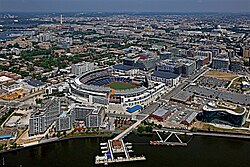
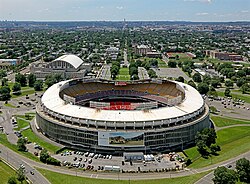
The region is a major destination for sports fans, featuring Nationals Park, the home of the city's Major League Baseball team, and the historic RFK Stadium. These venues are central to the Navy Yard neighborhood and the surrounding areas.
Culture and History
History is embedded in the landscape of Southeast. The quadrant contains the Congressional Cemetery, the historic St. Elizabeths Hospital, and the remains of several forts dating back to the Civil War. Visitors can also explore the local flavors and crafts at Eastern Market.
Military and Government Presence
The area maintains a strong military connection, housing the U.S. Marine Barracks and the Joint Base Anacostia-Bolling (JBAB), a combined installation supporting various military branches.
The Anacostia River Waterfront
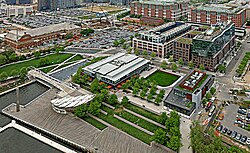
The waterfront serves as a vital ecological and recreational corridor for the city. The Anacostia River front provides scenic views and public spaces that connect the different sections of the quadrant.
Southeast Quadrant Summary
| Category | Details |
|---|---|
| Boundaries | South of East Capitol St / East of South Capitol St |
| Key Neighborhoods | Capitol Hill, Hill East, Anacostia, Navy Yard |
| Major Landmarks | Nationals Park, RFK Stadium, Eastern Market, The Big Chair |
| Military Sites | Joint Base Anacostia-Bolling, U.S. Marine Barracks |
| Geographic Rank | Second-smallest quadrant |
Frequently Asked Questions
What is "Near Southeast"?
Near Southeast refers to the portion of the Southeast quadrant that is located west of the Anacostia River.
Where is "The Big Chair" located?
The Big Chair is a well-known landmark located on Martin Luther King Jr. Avenue within the Southeast quadrant.
Which sports stadiums are in Southeast D.C.?
The quadrant is home to both Nationals Park and RFK Stadium.
What are the boundaries of the Southeast quadrant?
The Southeast quadrant is located south of East Capitol Street and east of South Capitol Street.
What historic sites can be found in Southeast?
Notable historic sites include the Congressional Cemetery, St. Elizabeths Hospital, and several Civil War-era forts.