South Korean Won: History, Currency Details, and Evolution
The South Korean won (KRW) is the official currency of the Republic of Korea. Managed by the Bank of Korea, the won has undergone several transformations since the mid-20th century to stabilize the national economy and combat inflation. From its early iterations to the modern, high-security banknotes used today, the won reflects South Korea's rapid economic development and cultural heritage.
The currency is identified by the ISO 4217 code KRW and the symbol ₩. While the primary unit is the won, a smaller subunit called the jeon exists, where 100 jeon equal 1 won, though it is rarely used in modern daily transactions.
Key Facts
- ISO Code: KRW (Numeric: 410)
- Central Bank: Bank of Korea
- Production: Korea Minting and Security Printing Corporation (KOMSCO)
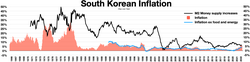
- Current Inflation: 2.4% (as of June 2024)
- Exchange Rate: Approximately US$1 = 1,368 KRW
- Banknote Denominations: ₩1,000, ₩2,000, ₩5,000, ₩10,000, ₩50,000
- Coin Denominations: ₩1, ₩5, ₩10, ₩50, ₩100, ₩500
The Evolution of the Won
The First South Korean Won (1945–1953)
The first iteration of the won was introduced in October 1945. During this period, the currency experienced significant volatility. For example, the value of the U.S. dollar rose from 15 won in 1945 to 6,000 won by April 1951. Due to this instability, the first won was replaced by the hwan on February 15, 1953, at a conversion rate of 1 hwan to 100 won.
The Second South Korean Won (1962–Present)
The current version of the won was re-introduced on June 10, 1962. This version aimed for greater stability, with the U.S. dollar exchange rate starting at 125 won in 1962 and gradually adjusting to 580 won by January 1980.
Currency Specifications
Banknotes and Security
Modern banknotes are printed by KOMSCO and feature prominent historical figures and landmarks. To combat counterfeiting, the Bank of Korea introduced a new series of notes between 2006 and 2009. These notes utilize intaglio printing (a process that creates raised ink for a tactile feel) and color-shifting ink on the value numbers.
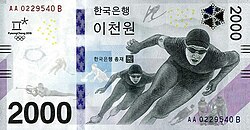
The current denominations include the ₩1,000 (blue), ₩5,000 (orange), ₩10,000 (green), and ₩50,000 (yellow). Additionally, a commemorative ₩2,000 note was issued in 2017 to mark the Pyeongchang Winter Olympics, featuring various winter sports and a painting by Kim Hong-do.
Coins and Composition
South Korean coins have evolved in material to manage production costs. For instance, the ₩10 coin transitioned from high brass to copper-plated aluminium in 2006. Common imagery on coins includes the Rose of Sharon (national flower), the Geobukseon (Turtle Ship), and Admiral Yi Sun-sin.
| Type | Denominations | Primary Material/Color | Key Feature/Figure |
|---|---|---|---|
| Banknotes | ₩1,000, ₩5,000, ₩10,000, ₩50,000 | Paper (Various Colors) | Yi Hwang, Yi I, Sejong the Great |
| Coins | ₩1, ₩5, ₩10, ₩50, ₩100, ₩500 | Aluminium, Brass, Cupronickel | Rose of Sharon, Yi Sun-sin |
Frequently Asked Questions
What is the current exchange rate for the South Korean won?
As of the latest data provided, the exchange rate is approximately 1,368 KRW to 1 US Dollar.
Who is responsible for issuing the won?
The Bank of Korea is the central bank responsible for the issuance of the currency, while the Korea Minting and Security Printing Corporation (KOMSCO) handles the actual printing and minting.
What are the security features of modern won banknotes?
Modern notes include intaglio printing for a raised texture, color-shifting ink on the denomination numbers, and segmented metal threads to prevent counterfeiting.
Is the 'jeon' still used in South Korea?
While the jeon is the official subunit (1/100th of a won), it is no longer used in common daily transactions.
What is the significance of the ₩2,000 note?
The ₩2,000 note is a commemorative issue released in 2017 to celebrate the Pyeongchang Winter Olympics, featuring winter sports and traditional Korean art.