South Korea Men's National Basketball Team: A Legacy of Asian Excellence
The South Korea men's national basketball team has long been a cornerstone of competition within the FIBA Asia zone. Since joining the international basketball community in 1947, the team has established itself as a perennial contender in continental championships, characterized by periods of intense dominance and periods of significant transition.
Managed by the Korean Basketball Association (KBA), the national squad has represented the nation on the world's most prestigious stages, including the Olympic Games and the FIBA World Cup. From the high-scoring legends of the 1970s to the modern era of tactical shifts, the team's journey reflects the evolving landscape of global basketball.
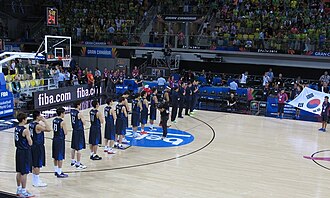
Key Facts
- FIBA Ranking: 57 (as of 13 July 2026)
- Joined FIBA: 1947
- Olympic Appearances: 6
- FIBA World Cup Appearances: 8
- FIBA Asia Cup Appearances: 31
- Asian Games Gold Medals: 4 (1970, 1982, 2002, 2014)
- Current Head Coach: Nikolajs Mazurs
Historical Eras of South Korean Basketball
The Golden Years (1969–1970)
The turn of the 1970s marked a historic peak for South Korean basketball. In 1969, the team secured the Asian Championship, followed by a gold medal at the 1970 Asian Games. This success led to a qualification for the 1970 FIBA World Championship, where South Korea delivered its most impressive global performance. During this tournament, Shin Dong-Pa emerged as a scoring phenomenon, averaging 32.6 points per game—the highest in the competition.
Challenging the Giants (1971–2007)
For several decades, South Korea remained one of the few nations capable of challenging the dominance of China and the Philippines in Asia. A standout moment occurred in 1997 when South Korea interrupted China's championship streak by defeating them in the semifinals to claim the Asian crown. The team's strength often relied on tactical precision; for instance, during the 2007 FIBA Asia Championship, a "four centers" strategy led by players like Ha Seung-jin helped the team achieve a 61% 2-point field goal percentage, securing a bronze medal.
Modern Challenges and Generational Shifts (2008–Present)
The modern era has seen increased competition from West Asian nations such as Iran, Jordan, and Lebanon. Despite this, South Korea remains a major force. The team successfully qualified for the 2014 FIBA World Cup and followed that success by winning gold at the 2014 Asian Games on home soil.
Recent years have been defined by a "generational change," as coaches have integrated younger talent into the roster. This transition faced significant hurdles during the COVID-19 pandemic, which caused disruptions in the Korean Basketball League (KBL) and ultimately led to the team's disqualification from the 2023 FIBA World Cup Asian qualifiers. Currently, the team is focused on rebuilding under new leadership to prepare for future international cycles.
Competitive Record Summary
| Tournament | Appearances | Gold Medals | Silver Medals | Bronze Medals |
|---|---|---|---|---|
| FIBA Asia Cup | 31 | 2 | 11 | 12 |
| Asian Games | 18 | 4 | 5 | 4 |
| FIBA World Cup | 8 | 0 | 0 | 0 |
| Olympic Games | 6 | 0 | 0 | 0 |
Frequently Asked Questions
Who is the current head coach of the South Korean men's national team?
The current head coach is Nikolajs Mazurs.
What was South Korea's biggest win in international play?
The team's largest margin of victory occurred on 20 November 1975, when they defeated Sri Lanka 163–36 in Bangkok, Thailand.
How many times has South Korea won the Asian Games gold medal?
South Korea has won the gold medal 4 times, in the years 1970, 1982, 2002, and 2014.
Why did South Korea withdraw from the 2023 FIBA World Cup Asian qualifiers?
The team was disqualified following a COVID-19 outbreak that affected the roster, preventing them from fielding a full squad for the qualifiers.
Who was the most dominant scorer in South Korean history during a World Cup?
Shin Dong-Pa was a standout performer at the 1970 FIBA World Cup, averaging 32.6 points per game.