South Korea 2012 Presidential Election: Park Geun-hye's Historic Victory
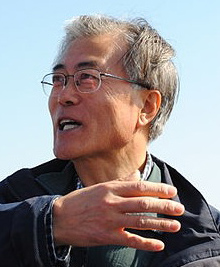
The South Korean presidential election held on 19 December 2012 marked a significant milestone in the nation's political history. The contest resulted in the election of Park Geun-hye, who became the first female president of South Korea. Running as the candidate for the Saenuri Party, Park secured a decisive victory over her primary opponent, Moon Jae-in of the Democratic United Party.
This election was particularly noteworthy for its high voter engagement and the strength of the winner's mandate. Park's share of the popular vote was the highest achieved by any candidate since the establishment of free and fair direct elections in 1987. Furthermore, it was the first time in that era that a candidate won an absolute majority of the vote.

Key Facts
- Winner: Park Geun-hye (Saenuri Party) with 51.56% of the vote.
- Runner-up: Moon Jae-in (Democratic United Party) with 48.02% of the vote.
- Voter Turnout: 75.84%, representing a 12.81 percentage point increase.
- Historic First: Park Geun-hye became the first woman to hold the presidency in South Korea.
- Majority Win: The first candidate to win an absolute majority since 1987.
Political Background and Party Shifts
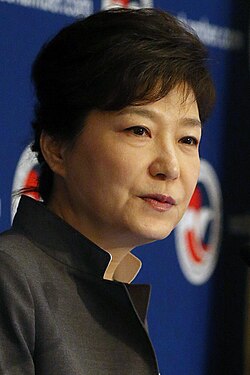
The road to the 2012 election began with a strategic rebranding of the conservative wing. At the end of 2011, Park Geun-hye took control of the Grand National Party, which was renamed the Saenuri Party (meaning "New Frontier Party") in February 2012. Park sought to move the party toward the political center, distancing herself from the previous administration of Lee Myung-bak.
This shift proved successful during the legislative elections in April 2012, where the Saenuri Party achieved an upset victory and regained its majority in the National Assembly. This momentum solidified Park's position as the frontrunner for the party's presidential nomination.

The Nomination Process
Saenuri Party Nomination
The Saenuri Party held its National Convention on 20 August 2012. Park Geun-hye won the nomination in a landslide, receiving 86,589 votes (83.97%), far outpacing other candidates such as Kim Moon-soo and Kim Tae-ho.
Democratic United Party Nomination
The Democratic United Party (DUP) saw a competitive primary process. Moon Jae-in, a Member of the National Assembly, emerged as the nominee after competing against several high-profile figures, including former governors Sohn Hak-kyu and Kim Doo-kwan.

Election Results and Analysis
The final results showed a tight race between the two main candidates, though Park ultimately secured the majority.
| Candidate | Party | Popular Vote | Percentage |
|---|---|---|---|
| Park Geun-hye | Saenuri | 15,773,128 | 51.56% |
| Moon Jae-in | Democratic United | 14,692,632 | 48.02% |
| Kang Ji-won | Independent | 53,303 | 0.17% |
| Kim Soon-ja | Independent | 46,017 | 0.15% |
| Kim So-yeon | Independent | 16,687 | 0.05% |
| Park Jong-sun | Independent | 12,854 | 0.04% |
Regional Performance
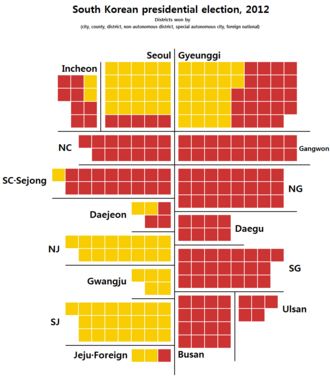
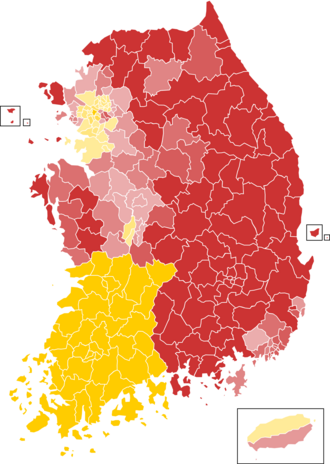
The voting patterns revealed a clear regional divide. Park Geun-hye dominated in the southeast, particularly in Daegu (80.15%) and North Gyeongsang (80.82%). Conversely, Moon Jae-in saw overwhelming support in the southwest, winning Gwangju (91.98%), South Jeolla (89.28%), and North Jeolla (86.25%).
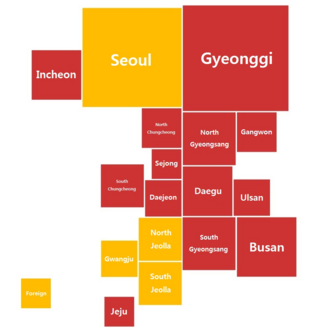
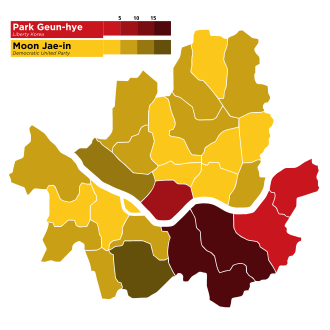
In the highly contested capital, Seoul, Moon Jae-in narrowly led with 51.42% compared to Park's 48.19%. However, Park's strong performance in Gyeonggi province (50.44%) and other regional hubs secured her overall victory.
Frequently Asked Questions
Who was the first female president of South Korea?
Park Geun-hye of the Saenuri Party became the first female president of South Korea after winning the 2012 election with 51.56% of the vote.
What was the voter turnout for the 2012 election?
The voter turnout was 75.84%, which was an increase of 12.81 percentage points over previous levels.
Which party did Moon Jae-in represent?
Moon Jae-in represented the Democratic United Party (DUP).
Why was Park Geun-hye's victory historically significant?
Beyond being the first woman elected to the office, she achieved the highest share of the vote of any candidate since the start of free and fair direct elections in 1987 and was the first to win an absolute majority.
How did the Saenuri Party change before the election?
The party was formerly known as the Grand National Party. Under Park Geun-hye's leadership, it was renamed the Saenuri Party in February 2012 and shifted its platform toward the political center.