Sol S.A. Líneas Aéreas: The Rise and Fall of an Argentine Regional Carrier
Founded in 2005, Sol S.A. Líneas Aéreas was an Argentine airline designed to bridge the gap in regional connectivity. Established through a strategic agreement between the Transatlántica Group and the government of Santa Fe Province, the airline began operations in August 2006. Its primary mission was to enhance air links between the key cities of Córdoba and Santa Fe, positioning itself as a vital player in the interior of Argentina.
Headquartered in Rosario, the airline utilized a hub-and-spoke model to connect various provincial cities, providing essential transport services across the country and into neighboring Uruguay.
Key Facts
- Founded: 2005 (Operations began August 2006).
- Ceased Operations: January 2016 following bankruptcy.
- Primary Hub: Islas Malvinas International Airport (Rosario).
- Secondary Hub: Aeroparque Jorge Newbery (Buenos Aires).
- Fleet: Operated Saab 340 A/B and Bombardier CRJ200 aircraft.
- Network: Served 13 destinations across Argentina and Uruguay.
Corporate Structure and Leadership
The airline operated under the leadership of Horacio Gabriel Angeli, who served as both the president and chief executive officer as of November 2013. The company's operational strategy focused on regional accessibility, often serving smaller airports that were overlooked by larger national carriers.
Fleet and Operational Capacity
Throughout its history, Sol Líneas Aéreas relied on a mix of turboprop and regional jet aircraft to manage its diverse route network. The Saab 340, a twin-engine turboprop, was a staple of their early and mid-term operations.
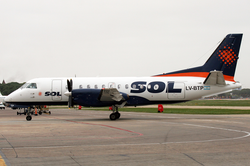
Toward the end of its operations in 2015, the airline attempted to modernize and expand its capacity by leasing Bombardier CRJ200 regional jets from Air Nostrum. While the airline took delivery of the first of six planned CRJ200s in 2015, the fleet expansion was cut short by the company's financial collapse.
| Aircraft Model | Units in Fleet | Orders/Leases | Passenger Capacity |
|---|---|---|---|
| Bombardier CRJ200 | 0 | 5 | 50 |
| Saab 340 A/B | 4 | 0 | 34 |
Destinations and Network
Sol Líneas Aéreas maintained an extensive network that spanned the Argentine interior and extended into Uruguay. Their destinations included major cities like Buenos Aires, Córdoba, and Mendoza, as well as remote southern locations such as Ushuaia and Río Gallegos.
Argentine Destinations
- Central/North: Rosario, Santa Fe, Córdoba, Tucumán, and Mendoza.
- Coastal/Interior: Mar del Plata, Bahía Blanca, Villa Gesell, and San Luis.
- Patagonia: Bariloche, Comodoro Rivadavia, Esquel, Neuquén, Río Gallegos, Río Grande, Trelew, and Ushuaia.
International Destinations
- Uruguay: Montevideo (Carrasco International Airport) and Punta del Este.
Safety Record and Flight 5428
The airline's history was marred by a significant tragedy on May 18, 2011. Flight 5428, a Saab 340A (tail number LV-CEJ), was operating a scheduled domestic service from Córdoba to Comodoro Rivadavia, with stops in Mendoza and Neuquén.
During the final leg of the journey, the aircraft crashed in Prahuaniyeu, Río Negro Province, approximately 25 kilometers southwest of Los Menucos. Despite several distress calls from the pilots, all 22 occupants—including 19 passengers—perished. While a final cause was not determined by September 2011, investigators believed that ice accumulation on the wings was a contributing factor to the crash.
Frequently Asked Questions
When did Sol S.A. Líneas Aéreas stop flying?
The airline filed for bankruptcy and officially ceased all operations in January 2016.
What aircraft did the airline use?
The fleet consisted primarily of Saab 340 A/B turboprops and Bombardier CRJ200 regional jets.
Where was the airline's main hub located?
The primary hub was the Islas Malvinas International Airport in Rosario, Argentina.
Did Sol Líneas Aéreas fly internationally?
Yes, the airline operated flights to Montevideo and Punta del Este in Uruguay.
What caused the crash of Flight 5428?
Although not definitively determined as of September 2011, it is believed that ice accumulation on the aircraft wings played a role in the accident.