Sociedad Sportiva Argentina: The Pioneer of Multi-Sport Culture in Buenos Aires
At the turn of the 20th century, Buenos Aires witnessed the rise of a sporting institution that would redefine the athletic landscape of the region. The Sociedad Sportiva Argentina, affectionately known as La Sportiva, was more than just a club; it was a sprawling hub of athletic diversity and a precursor to the Argentine Olympic Committee (COA). From its origins in equestrianism to hosting international football giants, the club served as the epicenter of Argentine sports during the 1910s.
Key Facts
- Founded: September 23, 1899, as Sociedad Hípica Argentina.
- Key Founder: President Julio Argentino Roca.
- Location: Headquarters at Florida 183; stadium in Palermo, Buenos Aires.
- Legacy: The site now houses the Campo Hípico Militar and the Campo Argentino de Polo.
- Dissolution: Closed in 1914 following land disputes and military takeover.
Foundations and Expansion
The institution began as the Sociedad Hípica Argentina, established to promote amateur equestrian activities. With the support of President Julio Argentino Roca, the Municipality of Buenos Aires granted the club land in Palermo, which featured two specialized tracks and a polo field. By 1900, the club had already inaugurated its first grandstand.
In June 1902, under the presidency of Baron Antonio de Marchi, the club rebranded as the Sociedad Sportiva Argentina. This name change signaled a strategic shift from a purely equestrian focus to a multi-sport approach. The facilities were expanded to include a central area of 335 x 116 meters for football and polo, surrounded by tracks for trot, sulky races, and show jumping.
A Hub for International Football and Athletics
The Sociedad Sportiva became a premier venue for football, hosting the Tie Cup finals in 1902, 1903, and 1905. It holds a special place in history as the site of the Argentina national football team's first home game in September 1903, where they faced "Orientales" (represented by Club Nacional de Football).
The stadium also welcomed prestigious international visitors. In 1904, Southampton FC played Alumni, and in 1905, Nottingham Forest toured the country. A landmark moment occurred on June 24, 1906, when Alumni defeated a South African squad, marking the first victory of an Argentine football team against a British-affiliated side.
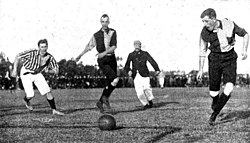
Beyond football, the club was a center for diverse athletic feats. In 1909, the stadium's capacity was increased to 10,000 to accommodate matches featuring English clubs Tottenham Hotspur and Everton. In 1910, the club hosted the Juegos Olímpicos del Centenario (Centennial Olympic Games), where the famous Italian athlete Dorando Pietri won the marathon.
Aviation and Rugby Milestones
The club's influence extended to the skies. On December 25, 1907, the balloon El Pampero departed from the Sociedad Sportiva, carrying Jorge Newbery and Aarón Anchorena across the Río de la Plata to Uruguay.
The club also facilitated the birth of international rugby in the country. On June 12, 1910, the first-ever match of the Argentina national rugby union team took place at the venue against the British and Irish Lions (then known as the "Combined British"). Although Argentina lost 28–3, the match was a foundational moment for the sport in the region.
The Decline and Military Transition
The club's decline began in 1912 when its football team joined the dissident Federación Argentina de Football (FAF). The team struggled, finishing last in both the 1912 and 1913 seasons. Simultaneously, the rise of the Gimnasia y Esgrima Stadium as a football-specific venue reduced the demand for the Sportiva's facilities.
Legal disputes over land ownership between the Municipality of Buenos Aires and the Ministry of War eventually led to the club's dissolution in 1914. In 1924, Minister of War Agustín P. Justo ordered the Army to occupy the facilities permanently. These lands were transformed into the Campo Hípico Militar, which today includes the Campo Argentino de Polo, often referred to as "La Catedral del Polo."
Club Summary
| Category | Details |
|---|---|
| Original Name | Sociedad Hípica Argentina |
| Primary Sports | Equestrianism, Football, Rugby, Athletics, Aviation |
| Key Events | Tie Cup Finals, Centennial Olympic Games, First Rugby International |
| Final Status | Expropriated by the National Army (1924) |
| Current Site | Campo Argentino de Polo / Campo Hípico Militar |
Frequently Asked Questions
Who founded the Sociedad Sportiva Argentina?
The club was founded on September 23, 1899, by a group that included President Julio Argentino Roca, who encouraged its creation to promote amateur equestrian activities.
What is the relationship between the club and the Argentine Olympic Committee?
The Sociedad Sportiva Argentina is considered a predecessor of the Argentine Olympic Committee (COA) due to its role as the primary multi-sport institution in the country during the early 20th century.
Which famous aviation feat started at the club?
The historic crossing of the Río de la Plata by Jorge Newbery and Aarón Anchorena in the balloon El Pampero on December 25, 1907, began at the Sociedad Sportiva.
What happened to the club's stadium?
After the club dissolved in 1914 and the land was expropriated by the Ministry of War in 1924, the site became the Campo Hípico Militar. It now houses the Campo Argentino de Polo.
Did the club have its own football team?
Yes, although it primarily served as a venue for other teams, the club had its own team that competed in the Primera División under the Federación Argentina de Football (FAF) in 1912 and 1913.