The Science and Impact of Snow: From Microscopic Crystals to Global Systems
Snow is far more than just a seasonal weather event; it is a complex physical substance that plays a critical role in Earth's water cycle and shapes the lives of everything from microscopic algae to entire human civilizations. Whether it is a light flurry or a massive blizzard, the properties of snow dictate how we travel, how we build our homes, and how ecosystems survive the winter.
Key Facts
- World Record: Mt. Baker Ski Area, Washington, holds the record for the highest seasonal snowfall at 2,896 cm (95.01 ft) during the 1998–1999 season.
- Melting Point: Snow melts at 0 °C (32 °F).
- Snowflake Diversity: The shape of a snow crystal is determined by specific temperature and saturation ranges in the atmosphere.
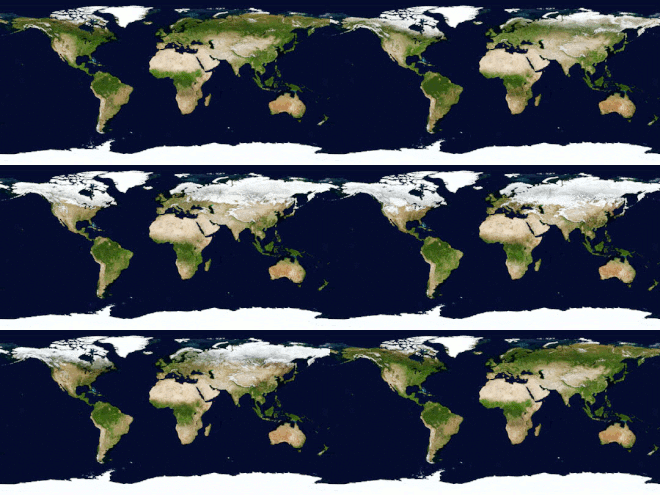
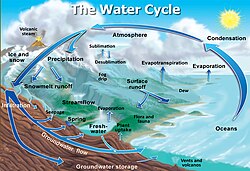
- Water Cycle: Snowfall and snowmelt are essential components of the Earth's hydrological cycle.
- Density: Snow density typically ranges from 0.1 to 0.8 g/cm³.
The Physics of Snow
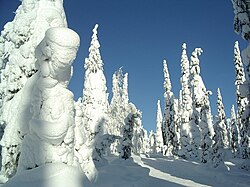
To understand snow, we must look at its physical and mechanical properties. Snow is a highly variable material. Its density (the mass per unit volume) can range from 0.1 to 0.8 g/cm³, which significantly affects its thermal conductivity—the rate at which heat passes through it. For densities between 0.1 and 0.5 g/cm³, thermal conductivity ranges from 0.05 to 0.7 W/(K·m).
Mechanically, snow possesses different strengths depending on its structure. Its tensile strength (resistance to being pulled apart) is between 1.5 and 3.5 kPa, while its compressive strength (resistance to being crushed) is much higher, ranging from 3 to 7 MPa.
Snow Crystal Classification
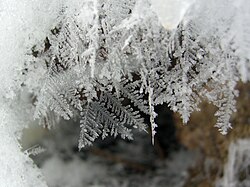
Snowflakes are not all alike. Their shapes are governed by the temperature and the level of moisture (saturation) in the clouds during formation. Scientists classify these crystals into several distinct types:
- 0 to −3.5 °C: Produces solid plates, thin plates, and dendrites (tree-like structures).
- −3.5 to −10 °C: Produces solid prisms, hollow prisms, and needles.
- −10 to −22 °C: Produces thin plates, solid plates, sectored plates, and dendrites.
- −22 to −40 °C: Produces thin plates, solid plates, columns, and prisms.
![An early classification of snowflakes by Israel Perkins Warren[26]](/images/39/c2/39c2684f09e4eef2c593b0dbb515c4acb50970326d0e89b2ec1b06d23771b550.jpg)
Snow Metamorphosis and Structures
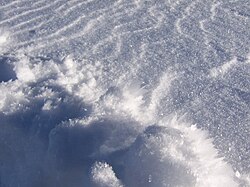
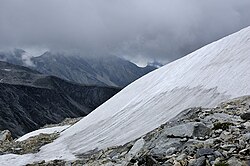
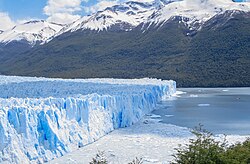
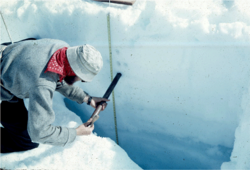
As snow sits on the ground, it undergoes metamorphosis, a process where the crystals change shape due to temperature and pressure. Over time, multi-year snow can transform into firn, a dense stage between snow and glacial ice.
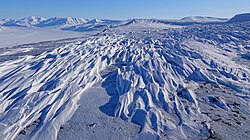
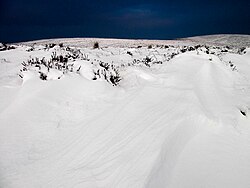
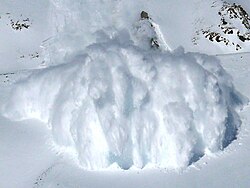
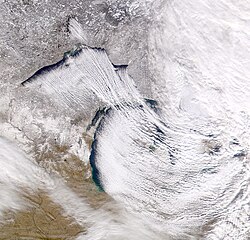
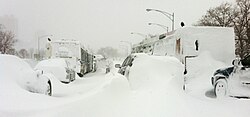
Environmental factors also create unique snow structures. Wind can create sastrugi (sharp irregular ridges) or cause snow to form drifts around obstructions. In extreme cases, the weight and movement of snow can lead to avalanches.
Snowfall Events and Visibility
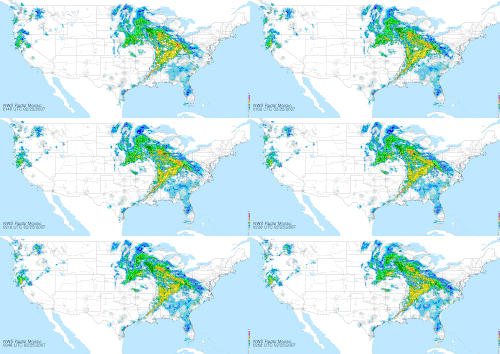
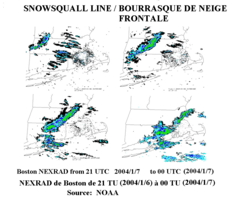
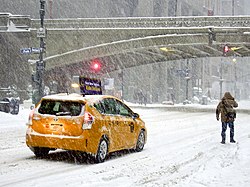
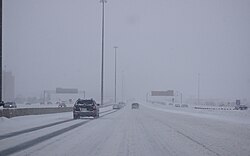
Meteorologists categorize snowfall based on how much it restricts visibility, which is crucial for transportation safety:
- Light: Visibility is greater than 1 kilometer (0.6 mi).
- Moderate: Visibility is restricted between 0.5 and 1 kilometer (0.3 and 0.6 mi).
- Heavy: Visibility is less than 0.5 kilometers (0.3 mi).
Impact on Civilization and Nature
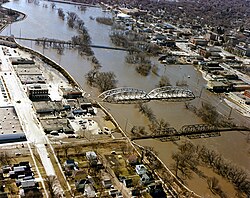
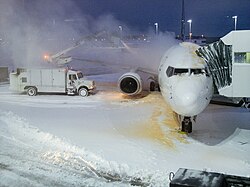
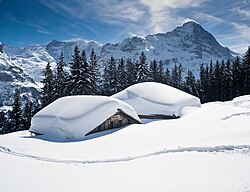
Snow has a profound impact on human infrastructure and the natural world. In transportation, snow requires constant management through plowing and deicing (the application of chemicals to prevent ice bonding). In construction, engineers must account for "ground snow loads" on roofs to prevent structural failure caused by extreme accumulation.
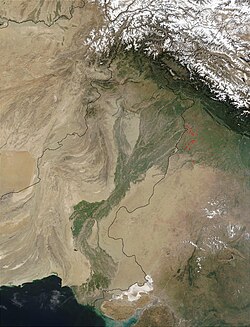
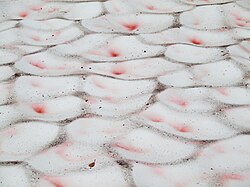
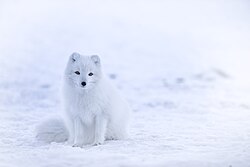
In nature, snow creates unique habitats. Some organisms, like the red algae Chlamydomonas nivalis, thrive in snow, while predators like the Arctic fox hunt animals living beneath the snowpack. Snow also feeds major river systems; for example, snow in the Himalayas feeds the Indus River, which is vital for irrigation in Pakistan and India.
Summary of Snow Properties
| Property Type | Parameter | Value/Range |
|---|---|---|
| Physical | Density (ρ) | 0.1–0.8 g/cm³ |
| Mechanical | Tensile Strength (σt) | 1.5–3.5 kPa |
| Mechanical | Compressive Strength (σc) | 3–7 MPa |
| Thermal | Melting Temperature (Tm) | 0 °C |
| Electrical | Dielectric Constant (εr) | 1–3.2 (for dry snow) |
Frequently Asked Questions
What is the difference between graupel and hail?
Graupel consists of heavily rimed particles that can be spherical, conical, or irregular in shape. Hail, however, is larger (greater than 5 mm) and features a laminar internal structure with a translucent or milky glazed surface, growing through the accretion of supercooled water.
How does snow affect buildings?
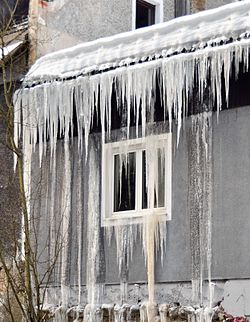
Snow can cause significant structural stress through heavy accumulation on roofs. Additionally, meltwater can lead to the formation of ice dams, where water flows to the eaves and refreezes, potentially causing leaks into walls.
Can snow exist on other planets?
Yes. Scientists have observed "diamond dust" snow on Mars. Other celestial bodies show different types of snow, such as lead sulfide snow on Venus, methane snow on Pluto, and potentially methane snow on Saturn's moon, Titan.
What is the role of snow in the water cycle?
Snow acts as a form of water storage. Through snowfall and subsequent snowmelt, water is redistributed across the landscape, feeding rivers, replenishing groundwater, and providing essential irrigation for agriculture.
How is snow classified by visibility?
Snow is classified as light if visibility is over 1 km, moderate if visibility is between 0.5 and 1 km, and heavy if visibility drops below 0.5 km.