Skinhead Subculture: History, Style, and Evolution
The skinhead (or "skin") is a member of a distinct subculture that first emerged among working-class youth in London, England, during the 1960s. Born from a desire for working-class solidarity and a reaction against social alienation, the movement is characterized by its specific aesthetic and a deep connection to music and labor-class identity. While often misunderstood in popular media, the subculture has evolved through multiple waves, diversifying into various political and musical factions worldwide.
Key Facts
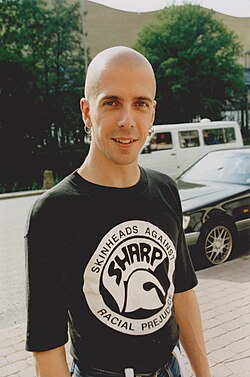
- Origin: London, England, in the 1960s.
- Primary Influences: Mod and rude boy subcultures.
- Defining Style: Shaven or closely cropped hair, Dr. Martens boots, and slim-fitting button-down shirts.
- Musical Roots: Ska, rocksteady, reggae, and later, Oi! and 2 Tone.
- Global Reach: Spread from the UK to North America, Europe, and beyond.
The First Wave: Origins and Working-Class Pride
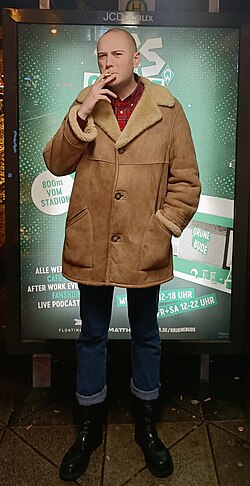
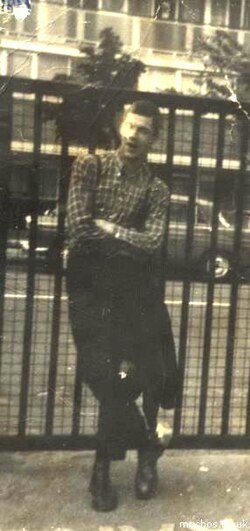
The first wave of skinheads appeared in the late 1960s. These youths rejected the conservatism of the early 1960s as well as the middle-class "peace and love" ethos of the hippie movement. Instead, they embraced an identity rooted in working-class pride and alternative values.
This early movement was a fusion of different outsider cultures. Skinheads incorporated elements of mod fashion (a style focused on neatness and Italian influence) and the culture of Jamaican rude boys (working-class youth from Jamaica). Because these groups lived and interacted in the same poor neighborhoods in Britain, a natural fraternity developed. This intersection heavily influenced their musical tastes, leading them toward Jamaican genres such as ska, rocksteady, and reggae, as well as African-American soul and rhythm and blues.
The Second Wave and the Punk Influence
![Canadian black metal band Blasphemy, described as "black metal skinheads"[32]](/images/63/0f/630f209319b63e95446ab216281783ee356af449daab0f222110a2a2406c0b6c.jpg)
In the late 1970s and early 1980s, the subculture experienced a significant revival. This second wave was heavily influenced by the emergence of punk rock. While some revivalists sought to return to the clean-cut 1969 style, others adopted a more aggressive look influenced by punk's raw energy.
During this era, Oi! emerged as a working-class offshoot of punk rock. It combined standard punk with pub rock, British glam rock, and football chants, serving as a reaction against the perceived "artistic" or "trendy" nature of the early punk scene. Simultaneously, the 2 Tone genre—a fusion of ska, reggae, and punk—became popular via the Coventry-based 2 Tone Records, featuring bands like The Specials and Madness.
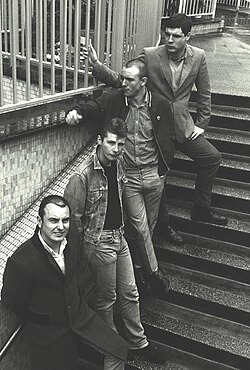
Notable figures of this era included Hoxton Tom McCourt and Gary Hodges, both of whom were members of the band The 4-Skins.
Defining the Skinhead Aesthetic
The skinhead look is designed to reflect a working-class identity, utilizing durable clothing and a disciplined grooming style.
Hair and Grooming
By the early 1970s, the close-cropped or entirely shaved head became the movement's most defining trait. For women, a specific style known as the Chelsea cut (or feather cut) emerged in the late 70s and early 80s. This style features a blunt fringe and longer hair around the temples and sometimes the nape, with the rest of the head shaved or cropped very short.
Clothing and Footwear
The wardrobe typically consists of slim-fitting button-down collar shirts (plain or checked), braces (suspenders), and high-rise straight-leg jeans. Footwear is central to the identity, specifically Dr. Martens or other steel-toe work boots, symbolizing the industrial nature of their roots.
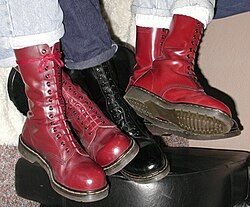
Politics, Racism, and Anti-Racism
While early skinheads were not inherently political, the subculture fractured as it grew. In the late 1970s, some members were recruited by far-right groups like the National Front and the British Movement, leading to the rise of "white power" skinheads. This association, amplified by media reports on football hooliganism and racist violence, led to a widespread public perception that all skinheads were neo-Nazis.
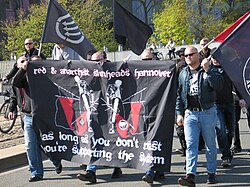
However, many skinheads rejected this extremism. Groups like the Glasgow Spy Kids championed the "Spirit of '69," emphasizing the original multi-racial roots of the culture. On the far left, redskins and anarchist skinheads adopted militant anti-fascist and pro-working-class stances. This led to the formation of organizations such as Anti-Fascist Action and SHARP (Skinheads Against Racial Prejudice), which formed in New York City in 1987 to combat racism within the scene.
The symbol of a crucified skinhead is sometimes used to represent societal alienation or persecution. According to the Anti-Defamation League, this symbol is used by both racist and anti-racist skinheads and may be considered a hate symbol depending on the context.
![A crucified skinhead, a symbol used to convey a sense of societal alienation or persecution against the skinhead subculture. According to the Anti-Defamation League, it is used by both racist skinheads as well as anti-racist skinheads, and it can be considered a hate symbol in certain contexts.[55]](/images/b4/99/b499d20f2e2b7a2e5fc89bd0f13160d95287f057bd25b7bf89d58d43d9996dd0.webp)
Subculture Summary
| Feature | First Wave (1960s) | Second Wave (1970s-80s) |
|---|---|---|
| Primary Influence | Mods & Jamaican Rude Boys | Punk Rock & New Wave |
| Key Music | Ska, Rocksteady, Reggae | Oi!, 2 Tone, Hardcore Punk |
| Core Values | Working-class pride, solidarity | Anti-commercialism, political activism |
| Fashion | Clean-cut, Mod-influenced | Diverse: from traditional to punk-influenced |
Frequently Asked Questions
Were the original skinheads racist?
No. The first wave of skinheads in the 1960s was heavily influenced by Jamaican rude boy culture and music, and the subculture was characterized by interaction and fraternity between white working-class youth and Jamaican immigrants.
What is the difference between a skinhead and a suedehead?
Suedeheads were a derivative of the skinhead movement, generally adopting a slightly more refined look, which included suede shoes and slightly longer hair.
What is Oi! music?
Oi! is a working-class subgenre of punk rock that combines standard punk with elements of football chants, pub rock, and British glam rock. It was a response to the perceived pretentiousness of the early punk scene.
What does SHARP stand for?
SHARP stands for Skinheads Against Racial Prejudice. It is an international organization formed to oppose racism and neo-Nazism within the skinhead subculture.
What is a Chelsea cut?
A Chelsea cut is a hairstyle adopted by some female skinheads, featuring a blunt fringe and longer sections around the temples, while the rest of the head is shaved or cropped very short.