Singing: The Art and Science of the Human Voice
Singing is the art of creating music using the human voice, often regarded as the world's first musical instrument. At its core, singing is the production of musical tones or the utterance of words in a tuneful succession. Whether used for religious devotion, professional performance, or personal comfort, singing remains one of the oldest and most universal forms of human expression.
Those who sing, whether as a hobby or a profession, are known as singers or vocalists. They may perform solo or as part of an ensemble, such as a choir, and can be accompanied by anything from a single instrument to a full symphony orchestra. While many sing informally, professional singers typically specialize in a specific genre—such as classical or rock—though some achieve crossover success across multiple styles.

Key Facts
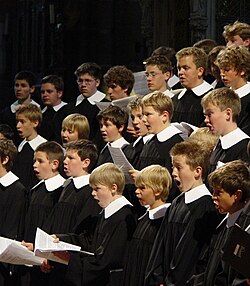
- Universal Expression: Singing is the oldest form of musical expression and can be formal, informal, arranged, or improvised.
- Professional Training: Excellence in singing requires dedication, regular practice, and often the guidance of vocal coaches.
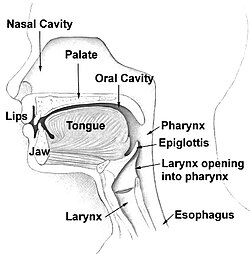
- Physical Process: Sound is initiated in the larynx, modified by resonators, and shaped by articulators.
- Neurological Link: Singing and language share overlapping processing circuits in the brain, including Broca's and Wernicke's areas.
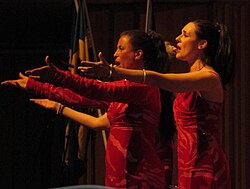
- Diverse Forms: Beyond audible sound, artistic song signing translates lyrics into American Sign Language (ASL) to express rhythm and pitch.
The Mechanics of the Voice

Developing a professional singing voice involves vocal pedagogy—the study of the physical and technical processes of singing. This includes understanding anatomy, physiology, and vocal health to prevent disorders.
The Process of Sound Production
The creation of a sung note follows a specific physiological sequence:
- Breath: Air is taken into the lungs to provide power.
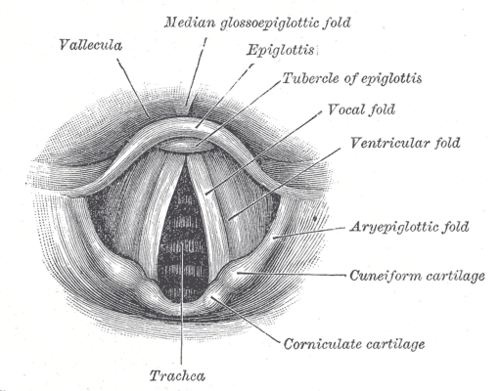
- Phonation: Sound is initiated in the larynx (the voice box).
- Resonation: Vocal resonators receive the sound and influence its quality.
- Articulation: Articulators shape the sound into recognizable words or units.
Vocal Registers and Range
Singers utilize different vocal registers, most notably the chest voice and head voice. Achieving a balanced blend of these registers across a singer's entire range is a primary goal of vocal training. Extending the vocal range depends on three basic rules of energy, space, and depth: as a singer moves higher, they must utilize more energy, more space, and more depth.
The Role of Vibrato
Vibrato is a technique where a sustained note wavers quickly and consistently between a higher and lower pitch. This pulse occurs naturally when there is proper breath support and a relaxed vocal apparatus. Some research suggests it is the result of a neuromuscular tremor in the vocal folds. It is widely used in jazz, popular, and classical music to create a richer tone.
Technical Mastery and Posture
Proper technique begins with the body. Correct posture ensures the respiratory system can function efficiently. Key alignment includes:
- Feet slightly apart with legs straight but knees slightly bent.
- Spine aligned with hips facing forward.
- Abdomen flat and chest comfortably forward.
- Shoulders down and back with the head facing straight forward.
The Cultural and Global Impact of Singing
Singing manifests in countless genres, from the structured arias of opera to the rhythmic delivery of rapping and beatboxing. In the modern era, televised competitions have become primary vehicles for discovering talent. Programs like Sa Re Ga Ma Pa (launched in 1995), American Idol (2002), and The Voice use various formats—such as blind auditions or viewer voting—to promote new artists.

Artistic Song Signing
Singing is not limited to audible sound. Artistic signers translate lyrics into American Sign Language (ASL), modifying signs to express timbre, phrasing, and pitch. This practice is embraced by Deaf, hard of hearing, and hearing performers alike, such as Justina Miles, who interpreted Rihanna's 2023 Super Bowl Halftime Show.

The Neurology of Singing
Recent research indicates a profound link between music and language. While sound waves are initially translated into a tonotopic map at the eardrum, they eventually diverge into separate processing circuits. However, certain brain regions are shared. For example, Brodmann area 47 is involved in processing syntax for both oral/sign languages and musical syntax. Similarly, musical semantics are processed near Wernicke's area, and musical syntax overlaps with Broca's area, both of which are critical for language production.

| Component | Primary Function | Key Requirement |
|---|---|---|
| Larynx | Sound Initiation (Phonation) | Vocal fold vibration |
| Resonators | Tone Quality and Projection | Space and shape adjustment |
| Breath Support | Power and Stability | Proper posture and abdominal control |
| Vibrato | Expressive Tone Enrichment | Relaxed apparatus and steady air |
Frequently Asked Questions
What is the difference between chest voice and head voice?
Chest voice is typically associated with lower pitches and a fuller, warmer sound, while head voice is used for higher pitches and has a lighter, thinner quality. Professional training often focuses on blending these two for a seamless transition across the vocal range.
How does vibrato occur?
Vibrato is a natural result of proper breath support and a relaxed vocal system. Scientifically, it is often viewed as a neuromuscular tremor in the vocal folds that causes a quick, consistent wavering of pitch.
Can people who cannot hear sing?
Yes, through various means. Additionally, artistic song signing allows Deaf and hard of hearing individuals to express the musicality of a song—including rhythm and pitch—using American Sign Language (ASL).
Which parts of the brain are used for singing?
Singing utilizes areas of the brain associated with language, such as Broca's area (syntax) and Wernicke's area (semantics), as well as Brodmann area 47, which processes both musical and linguistic syntax.
What are the basic rules for extending vocal range?
According to McKinney, singing higher requires an increase in three factors: more energy, more space, and more depth. Conversely, singing lower requires a decrease in these three elements.