Sheffield Tram-Train: The UK's First Combined Rail Trial
In 2008, the Department for Transport (DfT) embarked on an ambitious project to transform regional transit in South Yorkshire. The goal was to launch a trial tram-train service on the Penistone line, marking the first time combined tram-train operations—vehicles capable of running on both city tram tracks and national rail lines—were implemented in the United Kingdom.
This innovative scheme was a collaborative effort involving the DfT, Sheffield Supertram, Network Rail, Northern Rail, and the South Yorkshire Passenger Transport Executive (SYPTE). By allowing Supertram services to access the national rail network, the project aimed to integrate multiple transit systems, open new routes, and create a scalable model for future urban expansion.
Beyond the local benefits for Sheffield, the trial was designed as a blueprint for other UK cities. Transport managers from Manchester Metrolink, representatives from South Wales, and those exploring rail links to Glasgow Airport all monitored the project closely. The ability to seamlessly merge heavy rail (high-capacity mainline trains) and light rail (urban trams) is seen as a highly attractive solution for modernizing city connectivity.
Key Facts
- First of its kind: The first combined tram-train operation in the UK.
- Infrastructure: Included a 400-metre chord connecting Network Rail and Supertram networks.
- Electrification: 8 miles (13 km) of the route to Rotherham were electrified.
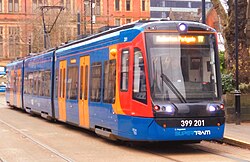
- Rolling Stock: Seven Class 399 vehicles were procured from Vossloh España.
- Budgetary Shift: Costs rose from an initial £15 million estimate to £75.1 million.
Planning and Technical Selection
The project's scope evolved significantly during its planning phase. Initially, the trial was intended for an unelectrified line, which would have required diesel-powered vehicles. However, the plan was revised in 2009 to include on-street running via the existing Supertram network. This shift led to the construction of a new link to the Dearne Valley line to Rotherham.
By electing to electrify the route, the DfT was able to procure more cost-effective electric vehicles. In May 2012, the DfT approved the trial and committed £58 million to fund the 400-metre chord, the electrification of 8 miles of track, and the purchase of seven new vehicles.
In June 2013, Vossloh España was awarded the contract to build the fleet. These units were numbered 201–207 under the Supertram system, but to operate on the mainline, they were registered as Class 399 units (399201–399207) under the TOPS (Total Operations Processing System) scheme. The first unit arrived in December 2015, with the final delivery completed in November 2016.
Implementation Challenges and Delays
The path to operational service was marked by repeated delays. While the first vehicles were expected in September 2015, the timeline shifted several times. In October 2015, Network Rail announced a delay until 2017, citing the need for permission from the transport secretary to build new track at Tinsley.
By May 2016, a 2017 start date was deemed impossible due to the complexity of design and planning. A significant technical hurdle emerged: the entire Supertram network required re-profiling to accommodate the new operations. Consequently, in November 2016, the start date for full services was pushed back to summer 2018.
These setbacks culminated in a critical parliamentary report released in December 2017. The report highlighted that the program's cost had ballooned to £75.1 million—roughly five times the original £15 million budget. The report criticized the DfT for failing to ensure the project still provided value for money amidst "unacceptable cost increases and delays."
Project Summary
| Feature | Detail |
|---|---|
| Vehicle Manufacturer | Vossloh España |
| Vehicle Designation | Class 399 (Units 201–207) |
| Key Infrastructure | 400m chord & 8 miles of electrification |
| Original Budget | £15 million |
| Final Reported Cost | £75.1 million |
| Primary Route | Supertram network to Rotherham via Dearne Valley line |
Frequently Asked Questions
What is a tram-train?
A tram-train is a vehicle designed to operate on both urban light rail (tram) tracks and the national heavy rail network, allowing for seamless travel between city centers and outlying towns.
Why was the project delayed multiple times?
Delays were caused by a variety of factors, including the need for government permission for track construction at Tinsley, complex design and planning issues, and the necessity of re-profiling the entire Supertram network.
Who manufactured the vehicles for the trial?
The seven tram-train units were constructed by Vossloh España.
How much did the project eventually cost?
According to a 2017 parliamentary report, the costs rose to £75.1 million, significantly exceeding the original £15 million budget.
Which other cities showed interest in this technology?
Representatives from Manchester Metrolink, South Wales, and transport managers looking at a rail link to Glasgow Airport expressed interest in the trial's outcomes.