SGI Technology Evolution: From IRIS Workstations to Supercomputing
Silicon Graphics, Inc. (SGI) fundamentally reshaped the landscape of computer graphics and high-performance computing. From its early days providing specialized graphics terminals to building the world's most powerful single-system computers, SGI's journey is a chronicle of innovation in 3D rendering and system architecture.
The Motorola 680x0 Era
SGI's first generation of products began with the IRIS (Integrated Raster Imaging System) 1000 series. Initially introduced in 1984, these were high-performance graphics terminals designed as peripherals for general-purpose computers, such as the Digital Equipment Corporation VAX, to provide raster display capabilities.
The IRIS 1000 Series
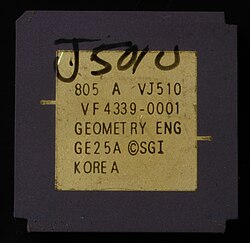
The early 1000 series (models 1000 and 1200) utilized 8 MHz Motorola 68000 CPUs and 768 kB of RAM. Lacking internal disk drives, these systems booted over a network via Excelan EXOS/101 Ethernet cards. A critical component of these machines was the Geometry Engine, designed by Jim Clark and Marc Hannah at Stanford University. This specialized hardware handled vector operations for 3D graphics, achieving approximately 6 million operations per second.
Later models, the 1400 and 1500, increased performance with 10 MHz CPUs and 1.5 MB of RAM. The 1400 featured a 72 MB ST-506 disk drive, while the 1500 utilized a 474 MB SMD-based drive. The first production unit was shipped to Carnegie-Mellon University's Electronic Imaging Laboratory in 1984.
The IRIS 2000 and 3000 Series
By August 1985, SGI transitioned to full UNIX workstations with the IRIS 2000 series, adopting the UNIX System V operating system. This line included standard models (2000-2500) using 68010 CPUs and "Turbo" models (2300T-2500T) featuring 68020 CPUs. These systems introduced 60 Hz monitors and optional Weitek Floating Point Accelerators.
The pinnacle of the Motorola-based line was the IRIS 3000 series. These rack-mounted machines could utilize up to 12 Geometry Engines, marking one of the first widespread uses of hardware graphics accelerators. The IRIS 3130 was particularly powerful, capable of supporting full 3D animation and rendering without the need for a mainframe. By November 1989, SGI had shipped approximately 3,500 units across the 2000 and 3000 series.
The RISC Era and MIPS Integration
With the IRIS 4D series, SGI shifted to RISC (Reduced Instruction Set Computer) architecture using MIPS microprocessors. This transition provided significantly more power and enhanced floating-point capabilities, cementing SGI's reputation in the film and television industries.
Throughout the 1990s, SGI developed a range of MIPS-based servers and workstations running IRIX, SGI's proprietary version of UNIX System V. This included the massive Onyx visualization systems, which could support up to 64 processors. In 1992, SGI acquired MIPS Computer Systems for $333 million to secure its processor supply, renaming it MIPS Technologies Inc.
The Nintendo 64 Collaboration
In 1993, SGI partnered with Nintendo to develop the Reality Coprocessor (RCP) GPU for the Nintendo 64 console. Led by Dr. Wei Yen, this project brought SGI's high-end graphics expertise to the consumer gaming market before the console's 1996 release.
Software Legacy: IRIS GL and OpenGL
SGI originally provided access to its graphics hardware via the proprietary IRIS Graphics Library (IRIS GL). As the library grew complex, SGI streamlined it into OpenGL in 1992. In a strategic move, SGI licensed OpenGL to competitors and formed the OpenGL Architecture Review Board to maintain it as an industry standard. This created the first truly portable, cross-platform API for real-time 3D graphics, a standard that persisted for over two decades until the arrival of Vulkan.
Impact on the Entertainment Industry
SGI's dominance in visual effects was absolute for nearly a decade; from 1995 to 2002, every film nominated for an Academy Award for Distinguished Achievement in Visual Effects was created on SGI systems. The hardware appeared in several films, including Jurassic Park (1993), Twister, and Congo (1995).
Strategic Acquisitions and Transitions
SGI engaged in several high-profile acquisitions to expand its capabilities:
- Alias|Wavefront: Purchased in 1995 for approximately $500 million to bolster 3D software offerings.
- Cray Research: Acquired in 1996 for $740 million, integrating supercomputing technology into SGI servers.
- Intergraph: Acquired the Zx10 Windows workstation line in 2000.
The Shift to Itanium and Xeon
In 1998, SGI announced a transition from MIPS to Intel's Itanium (code-named "Merced"). This move was intended to reduce the cost of developing proprietary CPUs. While the transition was delayed, resulting in stopgap MIPS processors like the R12000, SGI eventually launched the Itanium 2-based Altix servers and Prism workstations, which ran SuSE Linux Enterprise Server instead of IRIX.
By 2006, the Altix was the most powerful computer in the world, featuring 512 Itanium processors under a single OS instance. However, SGI eventually moved toward Intel Xeon processors and cluster architectures. The Altix ICE 8200, a blade-based Xeon system, reached the number 3 spot on the TOP500 list in November 2007 with a massive installation of 14,336 processors.
Key Facts
- First Commercial Computer: The IRIS 1400, shipped to Carnegie-Mellon University in 1984.
- Industry Standard: SGI created OpenGL, the long-standing cross-platform 3D graphics API.
- VFX Dominance: All Oscar-nominated visual effects films from 1995 to 2002 used SGI systems.
- Hardware Milestone: The Altix server achieved the world's most powerful single-system status in 2006 with 512 processors.
- Gaming Contribution: SGI developed the Reality Coprocessor (RCP) for the Nintendo 64.
| Era/Series | Primary CPU | Operating System | Key Feature |
|---|---|---|---|
| IRIS 1000 | Motorola 68000 | Network Boot | Geometry Engine |
| IRIS 2000/3000 | Motorola 68010/68020 | UNIX System V | Hardware Accelerators |
| IRIS 4D / Onyx | MIPS RISC | IRIX | High-end 3D Visualization |
| Altix (Early) | Intel Itanium | SuSE Linux | Massive NUMA Architecture |
| Altix ICE | Intel Xeon | Linux | Cluster/Blade Architecture |
Frequently Asked Questions
What was the Geometry Engine?
The Geometry Engine was a specialized chip designed by Jim Clark and Marc Hannah that handled the complex vector operations required for 3D graphics, capable of roughly 6 million operations per second.
How did SGI contribute to the gaming industry?
SGI developed the Reality Coprocessor (RCP) GPU for the Nintendo 64 console, bringing professional-grade 3D graphics technology to home gaming.
What is the difference between IRIS GL and OpenGL?
IRIS GL was SGI's proprietary graphics API. OpenGL was a streamlined, cleaned-up version of IRIS GL that SGI made available as an open, cross-platform standard for the entire industry.
Why did SGI switch from MIPS to Itanium?
SGI switched to Itanium to avoid the high cost of developing its own high-end processors and to leverage Intel's "super-chip" architecture for its server and workstation lines.
What was the significance of the Altix server in 2006?
The Altix was recognized as the most powerful computer in the world in 2006 because it could run a single instance of an operating system across 512 Itanium processors.