Sewing Fundamentals: Essential Terms and Techniques
Sewing is one of humanity's oldest crafts, dating back to Paleolithic times around 30,000 BC. This universal skill involves stitching materials such as cloth, leather, animal skins, and furs using a needle and thread. Interestingly, the act of sewing actually predates the invention of weaving cloth, serving as a foundational method for creating clothing and tools throughout human history.
Whether you are joining a sewing circle—a social group that meets to work on projects together—or working independently, mastering the basic terminology is the first step toward creating professional-quality garments.
Key Facts
- Sewing dates back to 30,000 BC, predating the weaving of cloth.
- There are seven basic hand stitches: running, backstitch, overcast, cross, buttonhole/blanket, chain, and knot stitches.
- Commercial sewing patterns typically feature seam allowances between 1/4 inch and 5/8 inch.
- A sloper serves as a highly accurate base pattern used to develop more stylized designs.
- The selvage is the self-finished edge of a fabric, running parallel to the warp.
The Anatomy of a Seam
At its most basic level, a seam (or seamline) is the line where two or more pieces of fabric are held together by thread. Achieving a clean seam is essential for the structural integrity and appearance of any garment.
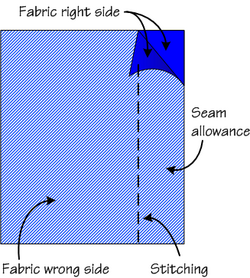
When sewing, you will encounter the seam allowance. This is the area of fabric between the raw edge of the material and the actual stitching line. While these allowances can range from 1/4 inch (6.35 mm) to several inches, most commercial patterns for home sewers utilize a range of 1/4 inch to 5/8 inch.
To maintain the shape of a garment during construction, sewers use staystitching. This is a specific stitch placed inside the seam allowance to prevent the fabric from stretching out of shape.
Fabric and Pattern Basics
Understanding the material you are working with is crucial. The selvage (known as selvedge in British English) refers to the self-finished edges of the fabric. In woven materials, these edges run parallel to the warp and are created when the weft thread loops back at the end of each row. While modern commercial selvages are often discarded, historically, garments were made using full loom-widths joined selvage-to-selvage to minimize waste. In knitted fabrics, the selvage refers to the structurally sound edges that were not cast on or bound off.
For those designing their own clothes, a sloper (also called a Block or Master Pattern) is indispensable. A sloper is a highly accurate base pattern tailored to specific measurements, which is then used as a template to create various stylized patterns.
Specialized Techniques and Terms
- Serging: The process of binding off the edge of a cloth to prevent fraying.
- Surplice: A specific neckline style created by overlapping the left and right bodice pieces to form a "V" shape.
- Seamstress: A woman who specializes in sewing and finishing garments, distinct from a dressmaker.
Tools and Stitching Methods
Every sewist needs a seam ripper, a small tool designed specifically for cutting or unpicking stitches when mistakes occur.
The core of sewing is the stitch—a single loop or turn of thread. All hand-sewn stitches using a needle with an "eye" are variations of seven basic types: running, backstitch, overcast, cross, buttonhole (or blanket), chain, and knot stitches.
Machine stitches are categorized by their structural composition:
- Chain stitch: Created using one thread.
- Lockstitch: Created using two threads.
- Overlock: Created using one to four threads.
| Term | Definition | Key Detail |
|---|---|---|
| Seam Allowance | Space between fabric edge and stitch line | Commonly 1/4" to 5/8" in commercial patterns |
| Selvage | Self-finished edge of fabric | Runs parallel to the warp in woven fabrics |
| Sloper | Base pattern for other designs | Designed for specific, accurate measurements |
| Staystitching | Stitch inside the seam allowance | Prevents fabric from stretching |
| Serging | Binding the edge of cloth | Prevents fraying |
Frequently Asked Questions
What is the difference between a seam and a seam allowance?
A seam is the actual line of stitching that joins two pieces of fabric together, whereas the seam allowance is the extra area of fabric between that stitching line and the raw edge of the material.
What is a sloper used for in pattern making?
A sloper, also known as a block or master pattern, is a precisely fitted base pattern. It is used as a foundation to develop other, more stylized garment patterns without having to start from scratch for every design.
How does a lockstitch differ from a chain stitch?
The primary difference is the number of threads used: a chain stitch is made with a single thread, while a lockstitch is constructed using two threads.
What is the purpose of staystitching?
Staystitching is used inside the seam allowance to stabilize the fabric, ensuring that the material does not stretch or distort during the sewing process.
What is the selvage of a fabric?
The selvage (or selvedge) is the factory-finished edge of the fabric. In woven fabrics, it is created by the weft thread looping back at the end of each row, running parallel to the warp.