Sergio Massa: A Political Journey Through Argentina's Executive and Legislative Branches
Sergio Tomás Massa is a prominent Argentine lawyer and politician who has occupied some of the most influential positions in the Argentine government. From managing local administration as a mayor to steering the national economy as Minister of Economy, Massa's career is defined by his ability to navigate the complex landscape of Argentine coalitions and political shifts.
Most recently, Massa served as the Minister of Economy from 2022 to 2023 and was a primary contender for the presidency in the 2023 general elections. His trajectory reflects a transition from conservative roots to a central role within the Peronist movement and its various iterations.
Key Facts
- Highest Executive Office: Minister of Economy (2022–2023).
- Legislative Leadership: President of the Chamber of Deputies (2019–2022).
- Presidential Runs: Finished third in 2015 and second in the 2023 run-off.
- Local Governance: Served two terms as the Mayor (Intendente) of Tigre.
- Early Influence: Youngest Chief of the Cabinet of Ministers at age 36.
Early Political Career and Rise to Power
Massa began his political journey in 1989, affiliating with the conservative Union of the Democratic Centre (UCeDé). By 1995, he transitioned to the Justicialist Party, the primary vehicle for Peronism in Argentina. His early legislative experience began in 1999 when he was elected as a Provincial Deputy for Buenos Aires.
Following the resignation of President Fernando de la Rúa in 2001, Massa was appointed by Senator Eduardo Duhalde as the Executive Director of ANSES (the National Social Security Administration), Argentina's decentralized state social insurance agency.
The Mayoralty of Tigre and Cabinet Leadership
In 2007, Massa was elected Mayor of Tigre. His rise continued rapidly when, on July 23, 2008, he was appointed Chief of the Cabinet of Ministers under President Cristina Fernández de Kirchner. At 36, he became the youngest person to hold this pivotal role since its inception in 1994.
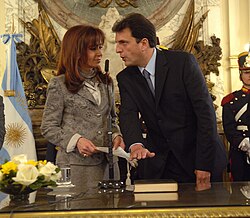
Despite his rapid ascent, tensions grew between Massa and the presidency over policies regarding inflation data, the nationalization of private pension funds, and regulatory powers. These differences led to his resignation from the Cabinet on July 7, 2009, after which he returned to his role as Mayor of Tigre.
Political Independence and Presidential Ambitions
By 2013, Massa sought to distance himself from the Kirchner administration, founding the Renewal Front. This move marked his attempt to carve out a centrist path in Argentine politics.
In the 2015 presidential election, Massa led the United for a New Alternative coalition. He campaigned on a platform of fighting corruption and promoting renewable energy, ultimately finishing third in the first round with 21% of the vote.
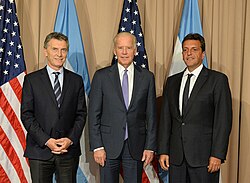
Following this, he continued to build his profile through legislative roles and various coalitions, including 1País in 2017.

Return to Government and Economic Stewardship
Massa returned to the fold of the center-left coalition Frente de Todos in 2019, serving as a National Deputy and the President of the Chamber of Deputies.
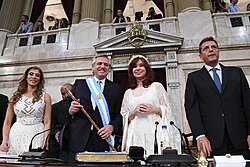
On August 3, 2022, President Alberto Fernández appointed Massa as the Minister of Economy. His appointment initially triggered a recovery of the Argentine peso against the US dollar, specifically affecting the "dólar blue" (the unofficial exchange rate).
The 2023 Presidential Campaign
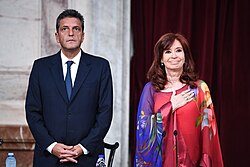
In 2023, Massa ran for president as the candidate for the Union for the Homeland coalition. He won the first round of voting with 36.6% of the vote. However, in the November run-off, he was defeated by Javier Milei, who won by a margin of nearly 12%. Following the election, Massa conceded and announced his intention to resign from politics.
Challenges and Controversies
Massa's tenure as Minister of Economy was marked by severe economic instability. Argentina faced a sharp acceleration in consumer prices, with annual inflation reaching 211.4% by December 2023.
Additionally, his administration faced scrutiny over the SIRA (the import system used to manage foreign exchange) and the management of AySA (Agua y Saneamientos Argentinos), the water and sanitation company led by his wife, Malena Galmarini, between 2019 and 2023.
Career Summary Table
| Period | Position | Entity/Administration |
|---|---|---|
| 2002–2007 | Executive Director | ANSES |
| 2007–2013 | Mayor (Intendente) | Tigre |
| 2008–2009 | Chief of the Cabinet of Ministers | President Cristina Fernández |
| 2019–2022 | President of the Chamber of Deputies | National Congress |
| 2022–2023 | Minister of Economy | President Alberto Fernández |
Frequently Asked Questions
What was Sergio Massa's role in the 2023 election?
Massa was the presidential candidate for the Union for the Homeland coalition. He won the first round of voting but lost the second-round run-off to Javier Milei.
What is the "dólar blue" mentioned in his economic tenure?
The "dólar blue" refers to the unofficial, parallel exchange rate of the US dollar in Argentina, which often differs significantly from the official government rate.
Which political parties has Sergio Massa been affiliated with?
He has been affiliated with the Union of the Democratic Centre (UCeDé), the Justicialist Party, and founded the Renewal Front. He has also been part of coalitions like Frente de Todos and Union for the Homeland.
What was Massa's experience in local government?
Massa served as the Mayor of Tigre on two separate occasions, using the position as a significant political base for his national ambitions.
What economic challenges occurred during his time as Minister of Economy?
His tenure saw a dramatic increase in inflation, with the annual rate reaching 211.4% by December 2023, and controversies surrounding the SIRA import system.