Sergey Konenkov: The Life and Legacy of the Russian Rodin
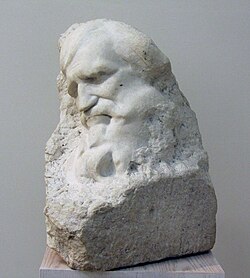
Sergey Timofeyevich Konenkov was a towering figure in 20th-century art, a master sculptor whose work bridged the gap between the Russian Empire and the Soviet Union. Often referred to as "the Russian Rodin", Konenkov's career spanned nearly a century, taking him from the peasant villages of Smolensk to the high-society circles of New York City and back to the heart of Moscow.
Key Facts
- Born: July 10, 1874, in Karakovichi, Smolensk Governorate.
- Died: December 9, 1971, in Moscow (aged 97).
- Education: Moscow School of Painting, Sculpture and Architecture and the St. Petersburg Academy of Arts.
- Major Accolades: Golden star of the Hero of Socialist Labour, Order of Lenin, and People's Artist of the USSR.
- Notable Subjects: Albert Einstein, Maksim Gorky, and various Russian literary giants.
Early Life and Academic Rebellion
Born into a peasant family, Konenkov's journey into the arts began at the Moscow School of Painting, Sculpture and Architecture, from which he graduated in 1897. He later pursued studies at the St. Petersburg Academy of Arts. However, his time at the Academy was marked by a clash with traditionalism. His diploma work—a massive clay statue of Samson breaking his chains—was so defiant of academic norms that his teachers reportedly destroyed the piece with hammers.
Following his education, Konenkov expanded his artistic horizons by traveling through Italy, France, Egypt, Greece, and Germany, absorbing the diverse sculptural traditions of Europe and the Mediterranean.
Artistic Evolution and Political Turmoil (1900–1922)
Konenkov's life was deeply intertwined with the political upheavals of his time. During the 1905 Russian Revolution, he stood on the barricades with workers and subsequently created portraits of the rebellion's heroes in Moscow.
His personality was as bold as his art. An account of his visit to the home of art collector Ivan Morozov describes Konenkov as dismissive of established masters like Manet, Degas, and Maillol, calling their work "rubbish," while praising the works of Vrubel and Victor Borisov-Musatov. Despite these frictions, Konenkov sold several pieces to Morozov, including a marble Torso and a wooden carving titled Young Woman.
Following the 1917 Revolution, Konenkov supported the Bolsheviks and worked for Narkompros (the People's Commissariat for Enlightenment), where he was tasked with delivering preservation orders for the Morozov art collection.
The American Years and the Einstein Connection
In 1922, Konenkov married Margarita Ivanovna Vorontsova. In 1923, the couple traveled to the United States for the Russian Art Exhibition at the Grand Central Palace. What was intended as a short visit turned into a 22-year residency in New York City.
During this period, Konenkov shifted his focus toward biblical themes, specifically the Apocalypse, and created numerous depictions of Jesus Christ, prophets, and apostles. In 1928–1929, he briefly returned to Italy to create a portrait of the writer Maksim Gorky.
One of his most famous commissions came in 1935 from Princeton University to sculpt Albert Einstein. This period was marked by complex personal dynamics; it is alleged that Einstein had a romantic affair with Konenkov's wife, Margarita, supported by love letters from 1945 and 1946. Some historical accounts, including those by Pavel Sudoplatov, suggest Margarita may have been a Soviet intelligence agent tasked with influencing American scientists like Robert Oppenheimer, though concrete evidence remains a subject of debate.
Return to the USSR and Final Years
In 1945, under the direct orders of Joseph Stalin, a ship was dispatched to New York to bring Konenkov back to the Soviet Union. He was granted a prestigious studio on Gorky Street in Moscow and received the honor of designing a plaque for the Senate Tower of the Kremlin to commemorate the first anniversary of the October Revolution.
In his final decades, Konenkov became the preeminent sculptor of the Russian intelligentsia, creating likenesses of Leo Tolstoy, Fyodor Dostoyevsky, Anton Chekhov, Aleksandr Pushkin, and Vladimir Mayakovsky, among others. He also contributed religious art, including wood-carved crosses for the Marfo-Mariinsky Convent.
Konenkov passed away in 1971 and is buried in the Novodevichy Cemetery in Moscow, where his own self-portrait serves as his tombstone.
Summary of Career and Works
| Period | Location | Key Focus / Works |
|---|---|---|
| Early Career | Russia | Academic sculpture, Revolutionary portraits |
| 1923–1945 | USA (New York) | Biblical themes, Albert Einstein sculpture |
| 1945–1971 | USSR (Moscow) | Portraits of literary giants, Kremlin commissions |
| Notable Pieces | Various | Kore (1912), Bather (1917), The Poor (1917), Lada (1909) |
Frequently Asked Questions
Why was Sergey Konenkov called "the Russian Rodin"?
He earned this nickname due to his mastery of sculpture and his ability to capture deep psychological expression and form, mirroring the influence of the French master Auguste Rodin.
What happened to Konenkov's diploma work at the Academy?
His clay statue of Samson tearing chains was considered too radical and contrary to the academic laws of the time, leading his teachers to destroy the work with hammers.
What was the nature of the relationship between Albert Einstein and Margarita Konenkova?
It is widely alleged that they had a love affair, supported by genuine love letters written in 1945 and 1946, though some sources also suggest Margarita may have had ties to Soviet intelligence.
How did Konenkov return to the Soviet Union from the United States?
He returned in 1945 via a ship sent specifically for him under the direct orders of Joseph Stalin.
Where can one find Konenkov's final resting place?
He is buried in the Novodevichy Cemetery in Moscow, and his grave is marked by a sculpture of his own self-portrait.