Seoul Economy: A Global Powerhouse of Finance, Tech, and Retail
As the capital of South Korea, Seoul stands as a titan in the global economy. Ranking fifth in global city GDP and second in Asian city GDP, the metropolis serves as the primary engine for the nation's prosperity. It is the headquarters for massive conglomerates, known as chaebols, including Samsung, Hyundai, LG, and SK. While the service sector dominates the city's labor force, Seoul's economic identity is a sophisticated blend of high-tech manufacturing, cutting-edge digital infrastructure, and a world-class financial sector.
Key Facts
- Global Standing: Ranked 5th in global city GDP and 10th in global financial competitiveness.
- Major Business Hubs: Divided into three primary districts: Downtown (CBD), Gangnam (GBD), and Yeouido (YBD).
- Tech Leadership: Recognized as one of the world's "most wired" cities with advanced fiber-optic and 5G infrastructure.
- Economic Drivers: A diverse mix of manufacturing, information technology, finance, and retail.
- Corporate Presence: Home to 11 of the 18 Fortune Global 500 companies based in South Korea.
The Three Pillars of Seoul's Business Districts
Seoul's commercial activity is concentrated within three distinct central business districts, each possessing a unique economic character.
Downtown Seoul (CBD)
With a history spanning 600 years, the Downtown area around Gwanghwamun and Cheonggyecheon remains an unparalleled business hub. It is the preferred location for foreign companies to establish their South Korean branch offices and serves as the center for major news agencies, law firms, and foreign financial institutions.
Gangnam (GBD)
Developed in the 1970s, Gangnam has evolved into a center for the technology, luxury retail, and private education industries. Its office market is heavily sustained by tech firms and high-end retail brands.
Yeouido (YBD)
Often referred to as the "Wall Street of South Korea," Yeouido is the heart of the nation's financial sector. Following the relocation of the Korea Stock Exchange in 1979 and subsequent market deregulation in the 1990s, it became the primary hub for securities exchanges, asset management, and native stock brokerage firms.
Manufacturing and Industrial Evolution
Seoul has undergone a significant industrial transformation. Traditional, labor-intensive manufacturing has largely been replaced by high-value sectors such as information technology, electronics, and assembly-type industries. Despite this shift, food and beverage production, printing, and publishing remain core industries.
The city hosts global manufacturing giants like Samsung, LG, Hyundai, Kia, and SK. The food and beverage sector is equally prominent, featuring companies like Jinro—producer of the world's best-selling soju—as well as Hite, Oriental Brewery, Nongshim Group, and Lotte.
Financial Competitiveness and Infrastructure
According to the 2024 Global Financial Centers Index, Seoul ranks 10th globally. The city's financial strength is distributed across its three main districts: Yeouido leads in brokerage and asset management, Downtown Seoul excels in banking, insurance, and foreign brokerage, and Gangnam thrives in fintech start-ups and real estate.
To bolster this position, Seoul announced plans in 2023 to invest $44.7 million over six years to create a dedicated area designed to attract foreign investment.
A Global Leader in Technology
Seoul is frequently described as the world's "most wired city," ranking first in technology readiness in PwC's Cities of Opportunity report. The city boasts world-leading internet connectivity, characterized by high fiber-optic broadband penetration and rapid 5G deployment.
Public infrastructure supports this digital lifestyle, including free Wi-Fi in over 10,000 public spaces and high-speed connectivity within the Seoul Subway system. In some residential areas, internet speeds have been shown to reach up to 52.5 Gbit/s.
Retail and Cultural Commerce
Seoul offers a diverse retail landscape ranging from traditional markets to ultra-modern luxury malls:
- Traditional Markets: Dongdaemun Market is the largest wholesale and retail market in South Korea, while Namdaemun Market is the city's oldest continually running market.
- Culture and Art: Insadong is the premier destination for traditional Korean artworks, while Samcheong-dong hosts numerous small art galleries.
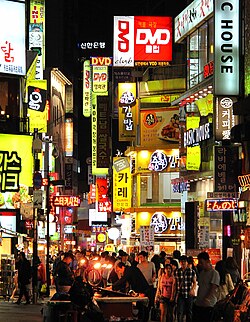
- Luxury and Fashion: Myeong-dong is famous for international brands and fashion boutiques, while Gangnam's Apgujeong-dong and Cheongdam-dong areas are known for upscale shopping.
- Specialized Markets: The Yongsan Electronics Market is the largest electronics market in Asia, and Noryangjin serves as a major fisheries wholesale market.
Economic Statistics Summary
| Indicator | Value | Year/Reference |
|---|---|---|
| Population | 9,501,528 | 2021 |
| Nominal GDP | ₩ 486 trillion | 2021 |
| GDP per capita (Nominal) | US$ 43,404 | 2021 |
| GDP Growth | 3.4% | 2021 |
| Credit Rating | AA (S&P) | 2019 |
Frequently Asked Questions
Which district in Seoul is the financial center?
Yeouido (YBD) is the primary financial district, often called the "Wall Street of South Korea," housing major stock exchanges and asset management firms. However, banking and insurance are also heavily concentrated in Downtown Seoul.
What are the main business districts in Seoul?
Seoul has three central business districts: Downtown Seoul (CBD) for historical business and foreign headquarters, Gangnam (GBD) for tech and luxury, and Yeouido (YBD) for finance.
How advanced is Seoul's technology infrastructure?
Seoul is a global leader in connectivity, featuring high fiber-optic broadband penetration, widespread free public Wi-Fi, and advanced 5G services.
What industries drive Seoul's economy?
The economy is driven by a diverse range of sectors, including information technology, electronics, finance, manufacturing, and a massive service sector.
Where can I find traditional Korean art in Seoul?
Insadong is the primary cultural art market in Seoul, specializing in traditional paintings, sculptures, and calligraphy.