Senate of the Republic: Composition and Electoral System of Italy
The Senate of the Republic serves as the upper house of the Italian Parliament, playing a critical role in the nation's legislative process. Governed by the Constitution of Italy, the Senate's structure and the methods by which its members are chosen have evolved through significant constitutional amendments to better reflect the modern Italian electorate.
Key Facts
- Total Elected Senators: 200 members.
- Voting Age: 18 years or older (lowered from 25 in 2021).
- Term Length: Five years (unless dissolved early by the President).
- Electoral System: A parallel system combining first-past-the-post and proportional representation.
- Regional Basis: Senators are elected regionally, with a minimum of 3 seats per region (except Aosta Valley and Molise).
Composition of the Senate
Under Article 57 of the Constitution, the Senate is elected on a regional basis. Historically, the Senate was larger and had a higher voting age requirement than the Chamber of the Deputies. However, constitutional amendments passed in 2020 and 2021 streamlined the body, reducing the number of senators from 315 to 200 and aligning the voting age for both houses at 18.
Of the 200 elected senators, 196 are assigned to Italian regions proportionally based on population. To ensure representation, most regions are guaranteed at least 3 senators, though the Aosta Valley and Molise maintain 1 and 2 senators, respectively. Additionally, 4 senators are elected by Italian citizens residing abroad.
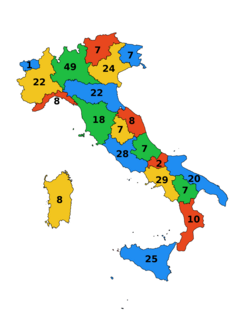
Regional Seat Distribution
The distribution of seats varies significantly by region, reflecting the population density across Italy. Lombardy currently holds the highest number of seats, while smaller regions maintain the constitutional minimums.
| Region | Seats |
|---|---|
| Lombardy | 31 |
| Campania | 18 |
| Lazio | 18 |
| Sicily | 16 |
| Veneto | 16 |
| Emilia-Romagna | 14 |
| Piedmont | 14 |
| Apulia | 13 |
| Tuscany | 12 |
| Calabria | 6 |
| Trentino-Alto Adige/Südtirol | 6 |
| Liguria | 5 |
| Marche | 5 |
| Sardinia | 5 |
| Abruzzo | 4 |
| Friuli Venezia Giulia | 4 |
| Basilicata | 3 |
| Umbria | 3 |
| Molise | 2 |
| Aosta Valley | 1 |
| Overseas constituencies | 4 |
Senators for Life
Beyond the elected members, the Senate includes senators for life. These positions are held by former presidents of the Italian Republic (ex officio) or up to five citizens appointed by the President for exceptional achievements in social, scientific, artistic, or literary fields. Unlike elected senators, these members serve for their entire lifetime.
Current life senators include figures such as economist Mario Monti, pharmacologist Elena Cattaneo, architect Renzo Piano, physicist Carlo Rubbia, and Holocaust survivor Liliana Segre.
The Electoral System
According to Article 58 of the Constitution, the Senate utilizes a parallel voting system. This means seats are allocated through two different methods simultaneously: 37% are decided by first-past-the-post (FPTP)—where the candidate with the most votes wins—and 63% are allocated via proportional representation using the largest remainder method.
Allocation of Seats
- Single-member constituencies: 74 senators are elected by plurality.
- Multi-member constituencies: 122 senators are elected via regional proportional representation.
- Abroad constituencies: 4 senators are elected via proportional representation.
Voting Mechanics and Thresholds
Voters use a single ballot to select both a constituency candidate and a supporting party list. To prevent extreme fragmentation, the system employs thresholds: parties must secure at least 1% of the national vote to be considered in single-member results, and at least 3% to receive seats in multi-member constituencies. Seats in multi-member constituencies are filled using closed lists, meaning voters cannot choose individual candidates within the list.
Voters have three options when casting their ballot:
- Marking the symbol of a party list, which also counts as a vote for that list's supported single-member candidate.
- Marking both the candidate's name and the symbol of a linked list. Panachage (voting for a candidate and a non-linked list) is prohibited and results in the annulment of the vote.
- Marking only the candidate's name. The vote counts for the candidate and is proportionally divided among the lists supporting them.
Frequently Asked Questions
Who is eligible to vote for the Italian Senate?
All Italian citizens aged 18 or older are eligible to vote. Prior to a 2021 amendment, the minimum voting age for the Senate was 25.
How are senators for life appointed?
Senators for life are either former presidents of the Republic or up to five citizens appointed by the President for outstanding merits in the arts, sciences, literature, or social fields.
What is the difference between a single-member and multi-member constituency?
In a single-member constituency, only one representative is elected based on who receives the most votes (plurality). In multi-member constituencies, several representatives are elected based on the proportion of votes each party receives.
Can the Senate be dissolved before its five-year term ends?
Yes, the President of the Republic has the authority to dissolve the Senate before its term expires, typically in scenarios where no government can secure a majority.
What happens if a voter practices panachage?
Panachage, which involves voting for a candidate and a party list that is not linked to that candidate, is not permitted. Doing so will result in the annulment of the vote.