Self-Service Systems: From Ancient Vending to Modern Automation
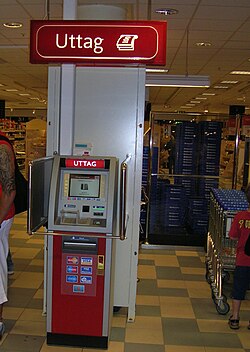
Self-service is a system where customers acquire goods or services themselves, handling the transaction at a point-of-sale (the place where a retail transaction is completed) rather than relying on a shop assistant or clerk to provide the service and take payment. This model has transformed industries ranging from grocery retail and banking to fueling and dining, shifting the role of the consumer from a passive recipient to an active participant in the service process.
Key Facts
- The first self-service grocery store, Piggly Wiggly, opened in 1916 in Memphis, Tennessee.
- The earliest recorded vending machine dates back to the 1st century AD, dispensing wine or holy water.
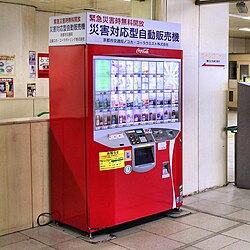
- Japan has the highest ratio of vending machines per person, with one machine for every 23 people.
- New Jersey is the only US state where drivers are not permitted to pump their own gasoline.
- Self-sourcing in IT refers to knowledge workers developing their own systems with minimal specialist intervention.
The Evolution of Retail and Grocery
Before the 20th century, grocery shopping was a highly assisted experience. Clerks would retrieve items from shelves, slice meats like ham or bacon to order, and weigh dry goods like flour from large barrels. The customer would wait while the clerk calculated the total at the till.
This changed on September 6, 1916, when Clarence Saunders opened the first Piggly Wiggly in Memphis, Tennessee. By providing customers with wicker baskets to select their own items, Saunders reduced the need for a "small army of clerks," allowing cost savings to be passed to consumers. By the 1950s, approximately 80% of the American grocery trade had transitioned to self-service.
In the United Kingdom, self-service trials began during the inter-war period with cafeterias and grocery shops. Following World War II, the model gained momentum to combat labor shortages. The first permanent self-service co-op opened in 1948, followed by Tesco's first self-service store in St Albans later that year. Major retailers like Sainsbury's, Waitrose, Morrisons, and Marks & Spencer adopted the model throughout the 1950s.
Today, the frontier of retail includes "till-less" stores like Amazon Fresh. These utilize "grab and go" technology involving surveillance cameras or "dash carts" equipped with touchscreens, barcode scanners, and sensors to track items automatically. Payment is seamlessly integrated via QR codes linked to user accounts.
Fueling and Banking Automation
Self-Service Petrol Stations
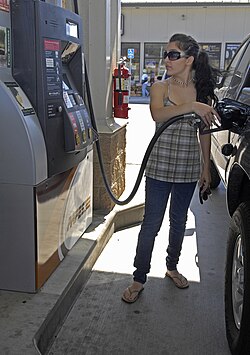
The transition to self-service fueling faced early hurdles. In 1930, the Hoosier Petroleum Co. attempted a trial but was blocked due to fire hazard concerns. It wasn't until 1947 that Frank Urich opened the first self-service gasoline station in Los Angeles, California. These early stations used attendants on roller skates to collect money and reset mechanical computer-driven pumps.
By 1964, remote fueling systems allowed attendants to dispense gas from inside a store, a concept that saw significant success. In the UK, the first self-service petrol station opened in Southwark, London, in 1961. The mid-1980s saw the integration of credit card readers, enabling "pay-at-the-pump" transactions. In modern-day America, self-service is the standard, with the exception of New Jersey.
The Rise of the ATM
Banking underwent a massive shift with the invention of automated machines. In 1960, Luther Simjian invented the Bankograph, an automated deposit machine. While it did not dispense cash and did not make Simjian a fortune, it laid the groundwork for the modern Automated Teller Machine (ATM).
In 1967, Europe saw the simultaneous entry of three independent ATM efforts: the Swedish Bankomat, the UK's Barclaycash, and the Chubb MD2. By 1973, networked cashpoints were being deployed by banks like Lloyds.
Vending Machines and Dining
Vending technology is ancient. Hero of Alexandria described a 1st-century AD machine that used a coin-operated lever to dispense specific amounts of liquid. Over centuries, the technology evolved from 17th-century brass tobacco dispensers in English taverns to the first fully automatic stamp dispensing machine patented by Simon Denham in 1867.
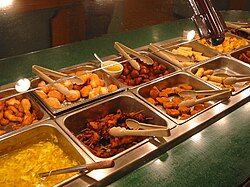
In the culinary world, the term "buffet" originated from the French word for a sideboard where food was placed. The modern "all-you-can-eat" restaurant concept was introduced in Las Vegas by Herbert "Herb" Cobb McDonald in 1946.
Self-Sourcing in Information Technology
In the digital realm, self-sourcing occurs when knowledge workers develop and support their own IT systems with minimal help from specialists. This is often referred to as End User Development, where non-programmers use tools like spreadsheets, macros, or scripts to complete data processing tasks.
Advantages and Disadvantages of Self-Sourcing
Self-sourcing can lead to improved requirement determination, increased participation, and faster results for small-scale projects. However, it carries significant risks, including:
- Inadequate expertise: Leading to human error and "user overconfidence" in the correctness of programs.
- Lack of security: End users may not understand how to build secure applications.
- Lack of documentation: Making it difficult for IT specialists to maintain or adapt systems later.
- Shadow IT: The creation of compartmentalized systems that lack organizational focus or design analysis.
Summary of Self-Service Evolution
| Sector | Key Milestone | Primary Driver |
|---|---|---|
| Grocery | Piggly Wiggly (1916) | Cost reduction and efficiency |
| Fueling | First US self-serve (1947) | Remote dispensing and automation |
| Banking | Bankograph (1960) | Automated deposits and withdrawals |
| Vending | Hero of Alexandria (1st Century AD) | Automated dispensing of goods |
Frequently Asked Questions
What is the difference between self-service and traditional service?
In traditional service, a clerk or assistant performs the tasks of selecting, weighing, or retrieving goods and handles the payment. In self-service, the customer performs these actions themselves.
Why is Japan known for vending machines?
Japan has an exceptionally high density of vending machines, with a ratio of approximately one machine for every twenty-three people.
What are the risks of "self-sourcing" in a business environment?
Risks include human error due to lack of expertise, security vulnerabilities, a lack of formal documentation, and the creation of "Shadow IT" which lacks organizational oversight.
How do modern "till-less" stores work?
Stores like Amazon Fresh use surveillance cameras or smart "dash carts" equipped with sensors and scanners to track items as customers pick them up, allowing for automated billing via a mobile app.
Is self-service fueling legal everywhere in the US?
No. While self-service is the norm across most of the country, New Jersey is the only state where drivers are not permitted to pump their own gasoline.