Seattle Downtown Transit Tunnel: From Dual-Mode Buses to Light Rail
For over a century, the city of Seattle grappled with how to move thousands of commuters through its dense downtown core without paralyzing surface streets. This struggle culminated in the creation of the downtown transit tunnel, a pioneering piece of infrastructure that evolved from a bus-only subway into a critical artery for the region's light rail system.
Early Visions and Subway Proposals
The idea of an underground transit system in Seattle is not new. As early as 1911, urban planner Virgil Bogue proposed a comprehensive "Plan for Seattle," which included a cut-and-cover subway (a construction method where a trench is excavated and then roofed over) under 3rd Avenue. This ambitious network featured routes connecting the Denny Regrade neighborhood to King Street Station, with stations designed to have direct entrances from major department stores.
Despite support from city engineers, the plan faced stiff opposition from local businesses and newspapers. In a municipal election on March 5, 1912, Seattle voters rejected the proposal by a margin of 10,000 votes.
The Birth of the Bus Tunnel
The concept resurfaced in 1974 during discussions between Governor Dan Evans and Mayor Wes Uhlman. While an initial 1975 study suggested a costly double-decked automated system, the high cost of ventilating diesel fumes led to its rejection. By 1979, a more pragmatic proposal emerged: a tunnel from South Jackson Street to Pine Street capable of handling 200 buses per hour, with the foresight to allow for future conversion to electric rail.
After years of debate between those favoring a surface-level transit mall and those supporting a tunnel, the Seattle City Council voted unanimously on October 17, 1983, in favor of an electric-only transit tunnel. To accommodate suburban commuters, the city agreed to use dual-mode buses—vehicles capable of operating as both diesel buses on surface streets and electric trolleybuses within the tunnel.
Construction and Challenges
Construction began in April 1987. To minimize disruption to the city's surface, Metro utilized tunnel boring machines for the 3rd Avenue segment, while the Pine Street section was built using the cut-and-cover method. The project faced several hurdles, including unanticipated soil conditions and payouts to disrupted businesses, which drove the final cost to $468.7 million—roughly 56% over the original budget.
The project was also marred by a minor political scandal in 1988. It was discovered that the Verde Fontaine granite used in the Westlake and Pioneer Square stations was sourced from South Africa during the Apartheid era. Despite a boycott of South African goods, the granite had been approved because it was finished in Italy. Metro eventually used contingency funds to replace the material.
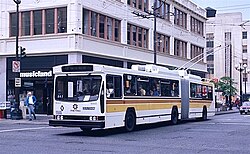
The Era of Bus-Only Operation
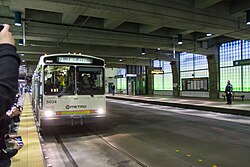
The tunnel officially opened on September 15, 1990. Initially, service was limited due to delays in the delivery of Breda dual-mode buses, but by 1991, the fleet was fully operational. In its first year, the tunnel served 28,000 daily passengers and significantly reduced peak-hour bus congestion on 3rd Avenue.
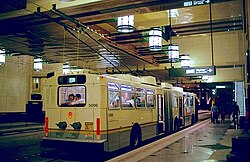
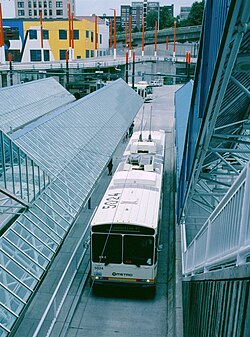
Over the next decade, the tunnel's utility expanded. In 1991, the SODO Busway extended service southward, and in 1992, direct access from Interstate 90 was established. By 1999, Sound Transit began using the tunnel for express routes to Bellevue.
Transition to Light Rail
In 1996, voters approved a massive regional light rail system. This necessitated a complex transition for the tunnel. Sound Transit took ownership of the facility in 2000, though a 2002 agreement allowed King County Metro to remain the owner while Sound Transit funded debt service and managed the conversion.
The transition required significant upgrades. The Breda dual-mode buses were replaced by hybrid diesel-electric buses in 2004, as the older electrical systems were incompatible with the new rail requirements. The tunnel closed on September 24, 2005, for a two-year renovation to install rails and upgrade stations.
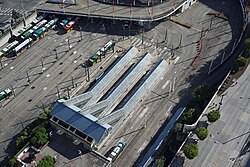
Joint Operations and the Final Shift
The tunnel reopened on September 24, 2007, marking a historic period of joint operations. For the first time in the United States, a tunnel with underground stations served both buses and light rail trains simultaneously. The Central Link light rail began service on July 18, 2009, initially running from Westlake station to Tukwila.
As light rail frequency increased, the need for buses in the tunnel diminished. The Convention Place station, which was too shallow to support northern rail extensions, was sold to the Seattle Convention Center and closed on July 21, 2018.
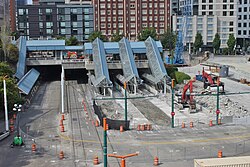
The era of buses in the tunnel officially ended on March 23, 2019. A ceremonial final trip was made by a preserved Breda dual-mode bus at 1 a.m., after which all remaining bus routes were redirected to surface streets with improved boarding and signal timing.
Key Facts
- Opening Date: September 15, 1990.
- Final Construction Cost: $468.7 million.
- Original Purpose: To reduce downtown congestion using dual-mode buses.
- Historic Milestone: First U.S. tunnel with underground stations to support joint bus and rail operations.
- End of Bus Service: March 23, 2019.
- Current Use: Dedicated light rail corridor for the 1 Line.
| Period | Primary Mode | Key Infrastructure/Event | Status of Convention Place |
|---|---|---|---|
| 1990–2005 | Dual-mode Buses | Breda bus fleet | Active |
| 2005–2007 | None | Rail conversion closure | Active |
| 2007–2019 | Joint Bus & Rail | Central Link launch (2009) | Closed 2018 |
| 2019–Present | Light Rail Only | 1 Line expansion | Demolished/Redeveloped |
Frequently Asked Questions
What were dual-mode buses?
Dual-mode buses were specialized vehicles that could operate using diesel engines on city streets and switch to electric trolley power (via overhead wires) while inside the tunnel to prevent the buildup of exhaust fumes.
Why was Convention Place station closed?
The station was too shallow to allow for the light rail's northern extension under Interstate 5. Additionally, the property was sold to the Seattle Convention Center for expansion.
How did the tunnel's cost increase during construction?
The budget rose by 56% due to unexpected soil conditions near Pine Street, legal payouts to businesses disrupted by construction, and the tragic death of an electrician during the project.
Is the tunnel still used for buses today?
No. Bus service officially ended on March 23, 2019, and the tunnel is now used exclusively for light rail trains.
What is the future of the tunnel?
Recent reports suggest the addition of crossover tracks at Symphony or Pioneer Square stations to improve efficiency, and there are proposals to add a third line for the Ballard Link Extension, which would require a significant multi-year closure.