Scottish Local Government Structure (1930–1975)
Between 1930 and 1975, Scotland operated under a complex system of local administration designed to manage the diverse needs of its urban centers and rural hinterlands. This era was characterized by a tiered hierarchy of authorities, ranging from powerful county councils to specialized burghs and landward districts, ensuring that governance reached from the smallest village to the largest city.
The system was not static; it evolved through various legislative acts and orders, such as the Local Government (Scotland) Act 1973, which eventually paved the way for the transition to the 1975 district system. Understanding this structure requires a look at the three primary types of administrative areas: large burghs, small burghs, and landward districts.
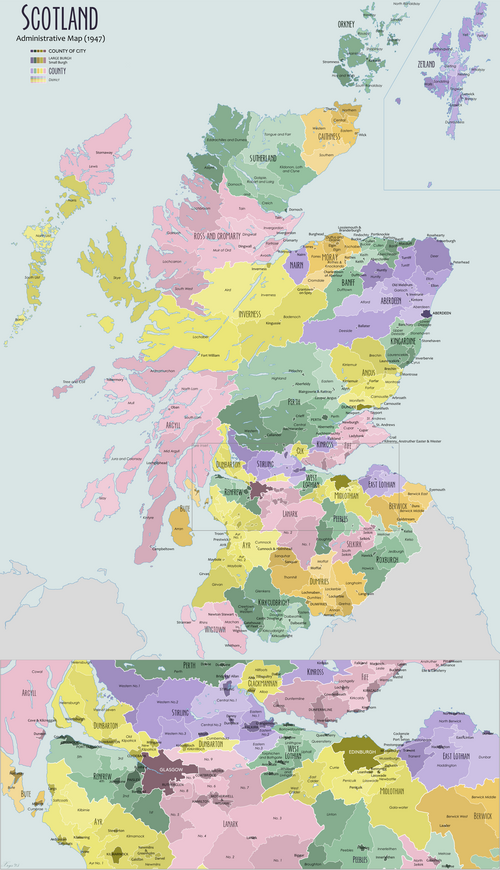
Key Facts
- Timeframe: The system described was in effect from 1930 until the major reorganization in 1975.
- Burgh Types: Localities were categorized as either Large Burghs or Small Burghs, with some holding the prestigious status of Royal Burgh.
- Landward Districts: These were rural administrative areas within a county that existed outside the boundaries of the burghs.
- Dynamic Boundaries: Boundaries frequently shifted, such as the County of Aberdeen extending at the expense of Angus between 1932 and 1946.
- Administrative Reach: The system covered all traditional counties, including combined entities like Moray and Nairn, and Perth and Kinross.
The Hierarchy of Local Authorities
Large and Small Burghs
Burghs were self-governing towns. Large Burghs typically possessed greater autonomy and handled more extensive administrative duties. Small Burghs had more limited powers and often shared certain responsibilities with the overarching county authority. A Royal Burgh was a town that had been granted a charter by the Crown, granting it specific privileges and status.
Landward Districts
The areas of a county not contained within a burgh were known as landward districts. These districts managed the rural populations and were often composed of several smaller parishes or village areas. For example, in the County of Aberdeen, the Deeside district encompassed areas such as Cruden, Ellon, and Tarves.
County-Specific Administrative Details
Each county maintained its own unique arrangement of burghs and districts. In the County of Fife, the system was particularly dense, featuring numerous Royal Burghs and a complex landward structure that saw the creation of the Glenrothes District between 1970 and 1975.
In the Highlands and Islands, the structure adapted to geography. The County of Inverness and the County of Ross and Cromarty managed vast areas, with some districts eventually transitioning into the Western Isles Islands Area. Similarly, the County of Zetland (Shetland) and County of Orkney managed their respective archipelagos through a series of landward districts and small burghs.
In the central belt, counties like Lanark and Dunbarton saw significant changes due to urban growth. For instance, East Kilbride became a large burgh in 1967, and the creation of the Cumbernauld Burgh in 1968 led to the reorganization of the surrounding landward districts.
Summary of Administrative Components
| Authority Type | Description | Key Characteristic |
|---|---|---|
| Large Burgh | Major urban centers with high autonomy | Independent administrative powers |
| Small Burgh | Smaller towns with limited autonomy | Shared powers with County authorities |
| Royal Burgh | Towns with a royal charter | Prestigious legal and historical status |
| Landward District | Rural areas outside burgh boundaries | Managed by County councils |
Frequently Asked Questions
What was the difference between a large burgh and a small burgh?
Large burghs had more extensive administrative powers and greater independence from the county council, whereas small burghs had more limited authority and relied more heavily on the county for certain services.
What is a Royal Burgh?
A Royal Burgh was a town that held a special charter from the Scottish monarch, which historically provided it with exclusive trading rights and a higher legal status than other burghs.
What were landward districts?
Landward districts were the rural administrative divisions of a county. They encompassed all the land and populations that did not fall within the boundaries of a designated burgh.
When did this system of local government end?
This specific system of counties, burghs, and landward districts was replaced in 1975 following the implementation of the Local Government (Scotland) Act 1973.
Did county boundaries remain the same between 1930 and 1975?
No, boundaries were frequently adjusted. For example, the County of Aberdeen expanded its territory at the expense of Angus in 1932, 1939, and 1946, and Midlothian lost territory to Aberdeen in 1954.