Scota and the Legendary Origins of the Gaels
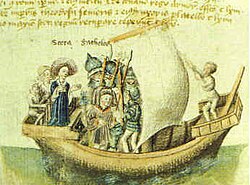
The origins of the Gaels—the ancestral people of Ireland and Scotland—are steeped in a blend of mythology and early medieval historiography. Central to these legends is Scota, a figure whose identity shifts across different manuscripts, serving as a symbolic link between the ancient Near East and the Atlantic fringes of Europe.
The First Literary Appearances
According to research by Edward J. Cowan, the first literary mention of Scota dates back to the 12th century. She appears in the Book of Leinster, specifically within a redaction of the Lebor Gabála Érenn (The Book of the Taking of Ireland). While the 9th-century Historia Brittonum contains the earliest surviving version of the Lebor Gabála Érenn narrative, it focuses on an unnamed Goídel Glas and makes no mention of Scota.
The Lineage of Scota and Goídel Glas
In the Lebor Gabála Érenn, Scota is identified as the mother of Goídel Glas, the eponymous ancestor from whom the Gaels derive their name. Scota was the daughter of an Egyptian pharaoh named Cingris, a name likely derived from Pharaoh Chenchres (known as Akenkheres in Egyptian records) as listed by Jerome.
Scota married Niul, the son of Fénius Farsaid. Fénius Farsaid is remembered in legend as the inventor of letters and the ancestor of the Phoenicians. Niul, a scholar of languages, traveled to Babylon to study the confusion of languages before being invited to Egypt by Pharaoh Cingris to marry Scota.
Their son, Goídel, is a pivotal figure in Gaelic lore. Legend says he was saved from a snake bite through a prayer from Moses. Goídel is credited with creating the Gaelic language by synthesizing the finest elements of the 72 languages existing at the time.
Alternative Versions of the Legend
Not all accounts agree on the family tree. In early Scottish versions written by Fordun, Gaythelos (Goídel Glas) is the son of Neolus (or Heolaus), a king from Greece who was exiled to Egypt and married the Pharaoh's daughter, Scota. Furthermore, while the Lebor Gabála Érenn describes Niul as a Scythian, the genealogist John O'Hart notes that Niul's father was a Phoenician and the brother of the legendary Cadmus.
Conflicting Identities and Legacy
As the legends evolved, Scota's role shifted. Some 12th-century sources describe her not as the mother, but as the wife of Geytholos (Goídel Glas), crediting her as the founder of the Scots and Gaels following their exile from Egypt.
Additional manuscripts of the Lebor Gabála Érenn introduce a different Scotia entirely: the wife of Míl Espáine, a descendant of Goídel who hailed from ancient Iberia. To this day, a landmark known as Scotia's Grave remains a famous site in Munster.
Modern historians view these figures as literary constructs. The names Goídel (Gaelic) and Scoti (Latin) provided the basis for these characters, who were created to integrate the Gaels into a broader historical and biblical narrative.
Key Facts
- First Mention: Scota first appears in 12th-century literature, specifically the Book of Leinster.
- Parentage: Often cited as the daughter of the Egyptian Pharaoh Cingris.
- The Eponymous Ancestor: Goídel Glas is the legendary forefather of the Gaels.
- Language Origin: Goídel is said to have formed the Gaelic language from 72 different tongues.
- Historical View: Historians believe Scota and Goídel were created to explain the etymology of the names "Gaels" and "Scoti."
| Source/Version | Relationship to Goídel Glas | Origin/Identity |
|---|---|---|
| Lebor Gabála Érenn | Mother | Daughter of Pharaoh Cingris |
| 12th-Century Sources | Wife | Founder of the Scots and Gaels |
| Fordun's Version | Wife of Neolus (Mother) | Daughter of the Pharaoh |
| Later Manuscripts | Wife of Míl Espáine | Associated with Iberia/Munster |
Frequently Asked Questions
Who was Scota in Irish mythology?
Scota is a legendary figure, often described as an Egyptian princess and the mother or wife of Goídel Glas, the ancestor of the Gaels.
How was the Gaelic language created according to legend?
It is said that Goídel Glas created the language by combining the best features of 72 different languages that existed at the time.
Is there any historical evidence for Scota's existence?
No. Historians suggest that Scota and Goídel Glas were fictional characters created to provide the Gaels with a historical narrative and to explain the origin of their names.
What is the significance of Scotia's Grave?
Scotia's Grave is a landmark in Munster associated with a version of the legend where Scotia was the wife of Míl Espáine, a descendant of Goídel.
Which ancient texts mention Scota?
She is primarily mentioned in the Book of Leinster and various redactions of the Lebor Gabála Érenn.