Savanna Ecosystems: The Dynamic Intersection of Grassland and Woodland
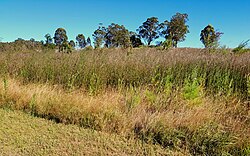
A savanna (or savannah) is a unique mixed woodland-grassland biome. It is defined by a specific structural characteristic: trees are spaced widely enough that their canopies do not close. This open canopy is vital, as it allows sufficient sunlight to reach the ground, supporting an unbroken herbaceous layer composed primarily of grasses.
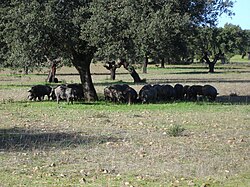
While many people imagine savannas as vast, empty plains with a few lonely trees, the reality is often much more complex. In many regions, tree densities are actually higher and more regularly spaced than in traditional forests.
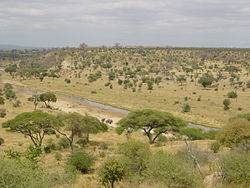
The Four Primary Savanna Forms
Ecologists categorize savannas into four distinct forms based on their vegetation structure:
- Savanna woodland: Characterized by a light canopy formed by trees and shrubs.
- Tree savanna: Features scattered trees and shrubs throughout the landscape.
- Shrub savanna: Defined by widely distributed shrubs.
- Grass savanna: An environment where trees and shrubs are mostly nonexistent.
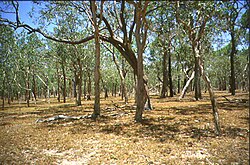
Global Distribution and Climate
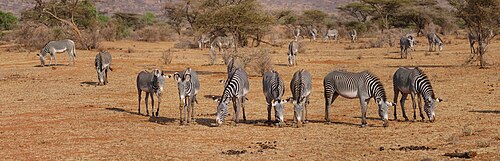
Savannas cover approximately 20% of the Earth's land area. Unlike the North American prairies or Eurasian steppes, which experience cold winters, savannas are typically found in warm to hot climates. They are prevalent in Africa, Australia, South America, and India.
These ecosystems often serve as transitional zones, frequently acting as a buffer between deserts and forests. A defining climatic feature of the savanna is seasonal water availability. Most rainfall is concentrated into a single season, often lasting six to eight months, followed by a distinct period of drought. Annual rainfall typically ranges from 500 mm to 1,270 mm.
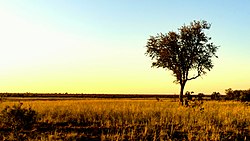
Variations in Tree Density
The distinction between woodland and savanna can sometimes be vague. While some definitions set the lower limit of tree coverage at 5–10% and upper limits between 25–80%, the density can vary wildly by region:
- South American Cerrado: The cerrado sensu stricto and cerrado dense can have tree densities of 800 to 3,300 trees per hectare (trees/ha), which is often higher than adjacent tropical forests (800–2,000 trees/ha).
- Guinean Savanna: Maintains approximately 129 trees/ha, compared to 103 trees/ha in riparian forests.
- Eastern Australia: Sclerophyll forests and savannas in this region show comparable densities of roughly 100 trees per hectare.
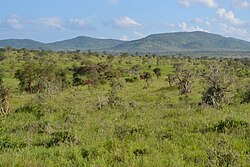
Key Facts
- Land Coverage: Savannas occupy about 20% of Earth's land surface.
- Climate: Characterized by warm to hot temperatures and highly seasonal rainfall.
- Structure: An open canopy allows light to reach the ground, supporting a continuous grass layer.
- Diversity: Can exist as woodland, tree savanna, shrub savanna, or grass savanna.
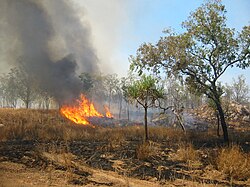
- Drivers: Ecosystem stability is influenced by rainfall variations and dry-season wildfires.
Ecological Dynamics and Threats
The dominance of a biome—whether it becomes a forest, savanna, or grassland—is not determined by climate alone. Historical events, particularly fire activity, play a crucial role in maintaining the savanna state. In some regions, multiple stable biomes can coexist.
However, these ecosystems face significant human-driven threats. Large areas of Australian and South American savannas have been cleared for land use. In Queensland, Australia, during the 2000s, approximately 4,800 km² of savanna were cleared annually, primarily to increase pasture production for livestock.
Methods of Land Clearing
Historically, pastoralists used girdling—the removal of a ring of bark and sapwood—to kill trees. By the 1950s, stem injection of arboricides (chemicals used to kill plants) became common. Later, heavy machinery and soil-applied chemicals like tebuthiuron allowed for more widespread clearing of woody vegetation to make room for pasture grasses and legumes.
Specialized Savanna Types
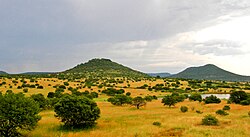
Savannas also exist at varying altitudes. Montane savannas are found in high-altitude mountain regions. Examples include:
- Bogotá Savanna: Located in the Andes at an average altitude of 2,550 metres.
- Angolan Scarp: A lower-altitude example, reaching up to 1,000 metres.
- Al Hajar and Eastern Anatolian: Other notable montane examples.
| Feature | Description |
|---|---|
| Canopy Type | Open (allows light to reach the ground) |
| Primary Ground Cover | Unbroken herbaceous layer (grasses) |
| Climate Pattern | Warm/hot with highly seasonal rainfall |
| Key Ecological Drivers | Fire activity and rainfall variation |
Frequently Asked Questions
What is the main difference between a savanna and a forest?
The primary difference is the canopy structure. In a forest, the canopy is closed, shading the ground. In a savanna, the canopy is open, allowing enough light to reach the floor to support a continuous layer of grasses.
Are savannas always low in tree density?
Not necessarily. While they have widely spaced trees, some savannas, such as the South American cerrado, can actually have higher tree densities than nearby tropical forests.
How does fire affect the savanna?
Fire is a key historical factor in maintaining savanna ecosystems. Dry-season wildfires help prevent the landscape from transitioning entirely into a closed-canopy forest.
Where are the world's savannas located?
They are primarily located in warm to hot regions of Africa, Australia, South America, and India.
What are montane savannas?
Montane savannas are mid- to high-altitude savannas located in mountain regions, such as the Bogotá savanna in the Andes.