Articles/Saudi Arabia: A Journey Through Ancient Heritage and Modern Transformation
Kingdom of Saudi ArabiaSaudi historyRiyadhIslamic heritageSaudi economy
Saudi Arabia: A Journey Through Ancient Heritage and Modern Transformation
The Kingdom of Saudi Arabia: A Journey Through History, Culture, and Modernity The Kingdom of Saudi Arabia stands as a land of profound historical significance and rapid modern transforma...
The Kingdom of Saudi Arabia: A Journey Through History, Culture, and Modernity
The Kingdom of Saudi Arabia stands as a land of profound historical significance and rapid modern transformation. As the birthplace of Islam and a global energy powerhouse, it occupies a unique position in the geopolitical landscape. From ancient archaeological sites that date back hundreds of thousands of years to the bustling, high-tech urban centers of today, the Kingdom offers a complex tapestry of tradition and progress.
Key Facts
The "Worshipping Servant" statue (2500 BCE), above one metre (3 ft 3 in) in height, is much taller than any possible Mesopotamian or Harappan models. Photo courtesy of the National Museum of Korea.[60]
Capital City: Riyadh
Official Religion: Sunni Islam
Government Type: Unitary Islamic absolute monarchy
Total Area: 2,149,690 km²
Primary Currency: Saudi riyal (SAR)
Major Economic Driver: Oil and gas
Ancient Roots and Pre-Islamic Heritage
At its greatest extent, the Umayyad Caliphate (661–750) covered 11100000 km2 (4300000 sq mi)[74] and 62 million people (29 per cent of the world's population),[75] making it one of the largest empires in history in both area and proportion of the world's population. It was also larger than any previous empire in history.
Long before the modern state was established, the Arabian Peninsula was home to diverse civilizations. Archaeological evidence suggests human activity in the region dating back as far as 350,000 years. Ancient inhabitants left behind a rich legacy of art and architecture, ranging from anthropomorphic stelae to sophisticated rock-cut tombs.
Anthropomorphic stela (4th millennium BCE), sandstone, 57x27 cm, from El-Maakir-Qaryat al-Kaafa (National Museum of Saudi Arabia, Riyadh): Anthropomorphic stela (4th millennium BCE), sandstone, 57x27 cm, from El-Maakir-Qaryat al-Kaafa (National Museum of Saudi Arabia, Riyadh)
One of the most notable historical sites is Hegra, located in the Al-'Ula region. This UNESCO World Heritage site features 131 monumental rock-cut tombs, showcasing the architectural mastery of the Nabatean civilization between the 1st century BCE and the 1st century CE.
Qaṣr Al-Farīd, the largest of the 131 rock-cut monumental tombs built from the 1st century BCE to the 1st century CE, with their elaborately ornamented façades, at the extensive ancient Nabatean archaeological site of Hegra located in the area of Al-'Ula within Al Madinah Region in the Hejaz. A UNESCO World Heritage Site since 2008.: Qaṣr Al-Farīd, the largest of the 131 rock-cut monumental tombs built from the 1st century BCE to the 1st century CE, with their elaborately ornamented façades, at the extensive ancient Nabatean archaeological site of Hegra located in the area of Al-'Ula within Al Madinah Region in the Hejaz. A UNESCO World Heritage Site since 2008.
The region also boasts significant artifacts from the Lihyanite kingdom, including colossal statues that reflect the standardized artistic styles of that era.
Colossal statue from Al-'Ula in the Hejaz (6th–4th century BCE), it followed the standardized artistic sculpting of the Lihyanite kingdom. The original statue was painted with white. (Louvre Museum, Paris)[67]: Colossal statue from Al-'Ula in the Hejaz (6th–4th century BCE), it followed the standardized artistic sculpting of the Lihyanite kingdom. The original statue was painted with white. (Louvre Museum, Paris)[67]
The Rise of Islam and the Middle Ages
The Battle of Badr, 13 March 624 CE
The history of the region is inextricably linked to the rise of Islam in the 7th century CE. The cities of Mecca and Medina became the spiritual heart of the Muslim world. The Hajj, the annual Islamic pilgrimage to Mecca, remains one of the most significant religious observances in the world.
The hajj is an annual Islamic pilgrimage to Mecca, the holiest city for Muslims.[329]: The hajj is an annual Islamic pilgrimage to Mecca, the holiest city for Muslims.[329]
Medina holds immense importance as the city where the Prophet Muhammad established the early Muslim community. Notable landmarks include the Quba Mosque, considered one of the oldest mosques, and the Mosque of the Prophet, which contains the tomb of Muhammad.
Quba Mosque in Medina, Hejaz is considered to be one of the oldest mosques, dating to the lifetime of the Islamic prophet Muhammad.[g]: Quba Mosque in Medina, Hejaz is considered to be one of the oldest mosques, dating to the lifetime of the Islamic prophet Muhammad.[g]
The Mosque of the Prophet in Medina containing the tomb of Muhammad: The Mosque of the Prophet in Medina containing the tomb of Muhammad
The Mosque of the Prophet in Medina containing the tomb of Muhammad: The Mosque of the Prophet in Medina containing the tomb of Muhammad
Supplicating pilgrim at Al-Masjid Al-Ḥarām (The Sacred Mosque) in Mecca. The Kaaba (the holiest site of Islam) is the cubic building in front of the pilgrim.: Supplicating pilgrim at Al-Masjid Al-Ḥarām (The Sacred Mosque) in Mecca. The Kaaba (the holiest site of Islam) is the cubic building in front of the pilgrim.
The Unification and the Modern State
Faisal (left) with Egypt's President Gamal Abdel Nasser in Cairo, 1969
The modern Kingdom of Saudi Arabia was formed through a series of historical stages involving the House of Saud. This process began with the Emirate of Diriyah in 1727 and progressed through various emirates and sultanates, culminating in the formal proclamation of the Kingdom of Saudi Arabia on September 23, 1932.
Expansion of the first Saudi State in 1810: Expansion of the first Saudi State in 1810
A pivotal moment in the 20th century occurred on March 4, 1938, when the Dammam No. 7 well struck oil in commercial quantities. This discovery fundamentally transformed the nation's economy, shifting it from a traditional society to a global energy leader.
The oil well Dammam No. 7 on March 4, 1938, the day it struck oil in commercial quantities, becoming the first in Saudi Arabia to do so: The oil well Dammam No. 7 on March 4, 1938, the day it struck oil in commercial quantities, becoming the first in Saudi Arabia to do so
Political Leadership and International Relations
The Kingdom is governed as an absolute monarchy. Currently, King Salman serves as the monarch, while Crown Prince Mohammed bin Salman holds the roles of Crown Prince and Prime Minister. The nation maintains complex international relationships, ranging from strategic partnerships with the United States to regional diplomatic engagements.
British Prime Minister Winston Churchill and Ibn Saud, the founding father and first king of Saudi Arabia, in Egypt in 1945: British Prime Minister Winston Churchill and Ibn Saud, the founding father and first king of Saudi Arabia, in Egypt in 1945
Egyptian President Abdel Fattah el-Sisi with King Salman, U.S. President Donald Trump and First Lady Melania participating in the inaugural opening of the Global Center to Combat Extremism, Sunday, May 21, 2017: Egyptian President Abdel Fattah el-Sisi with King Salman, U.S. President Donald Trump and First Lady Melania participating in the inaugural opening of the Global Center to Combat Extremism, Sunday, May 21, 2017
Princess Reema bint Bandar, the Saudi Ambassador to the United States of America, delivering an address at an event honouring the 75th anniversary of Saudi-US relations: Princess Reema bint Bandar, the Saudi Ambassador to the United States of America, delivering an address at an event honouring the 75th anniversary of Saudi-US relations
Geography and Environment
King Khalid (right) meeting Egypt's president Anwar Sadat with crown prince Fahd in the background at Cairo Airport in 1975
Saudi Arabia's landscape is diverse, characterized by vast deserts, mountain ranges, and unique geological formations. The country is home to more than 2,000 dormant volcanoes, with lava fields known as harrat covering significant portions of the Hejaz region.
Harrat Khaybar seen from the International Space Station. Saudi Arabia is home to more than 2000 dormant volcanoes.[135] Lava fields in Hejaz, known locally by their Arabic name of harrat (the singular is harrah), form one of Earth's largest alkali basalt regions, covering some 180,000 square kilometres (69,000 sq mi).[136]: Harrat Khaybar seen from the International Space Station. Saudi Arabia is home to more than 2000 dormant volcanoes.[135] Lava fields in Hejaz, known locally by their Arabic name of harrat (the singular is harrah), form one of Earth's largest alkali basalt regions, covering some 180,000 square kilometres (69,000 sq mi).[136]
Saudi Arabia topography: Saudi Arabia topography
Despite its vast size, the Kingdom faces significant environmental challenges, particularly regarding water scarcity. As of 2022, it was ranked as the third most water-stressed country in the world.
Saudi Arabia was the third most water stressed country in the world in 2022.[369]: Saudi Arabia was the third most water stressed country in the world in 2022.[369]
Demographics and Urbanization
The population is concentrated in major urban centers. Riyadh, the capital, is the largest city, followed by Jeddah and Mecca. These cities serve as hubs for commerce, administration, and religious life.
Map of Saudi Arabian administrative regions and roadways: Map of Saudi Arabian administrative regions and roadways
Major Cities by Population (Ranked)
Rank
Name
Region
Population
1
Riyadh
Riyadh
6,506,700
2
Jeddah
Mecca
3,976,400
3
Mecca
Mecca
1,919,900
4
Medina
Al Madinah
1,271,800
5
Hofuf
Eastern
1,136,900
Economy and Development
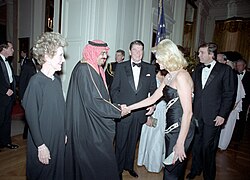
King Fahd with US President Ronald Reagan and future US President Donald Trump in 1985. The US and Saudi Arabia supplied money and arms to the anti-Soviet mujahideen fighters in Afghanistan.
The Saudi economy is heavily influenced by its vast oil and gas reserves. However, there is an increasing focus on diversification and technological advancement. The Kingdom invests heavily in education and research, evidenced by institutions like King Saud University and King Abdullah University of Science and Technology (KAUST).
The entrance gate of King Saud University, the kingdom's oldest university, founded in 1957: The entrance gate of King Saud University, the kingdom's oldest university, founded in 1957
Laboratory buildings at KAUST: Laboratory buildings at KAUST
The nation's economic strength is reflected in its significant GDP, which is a major component of the global economy.
Map of oil and gas pipelines in the Middle-East: Map of oil and gas pipelines in the Middle-East
Summary of National Profile
As many as 500 princes, government ministers, and business people, including Prince Fahd bin Abdullah, were arrested by Saudi Arabian authorities as part of the 2017 Saudi Arabian purge.
Kingdom of Saudi Arabia Overview
Category
Details
Official Language
Arabic
Total Area
2,149,690 km²
Population (2024)
33,702,731
GDP (PPP) 2026 Est.
$2.895 trillion
HDI (2023)
0.900 (Very High)
Frequently Asked Questions
Abdullah ibn Muhammad Al ash-Sheikh with Bogdan Borusewicz in the Polish Senate, 26 May 2014Verses from the Quran. The Quran is the official constitution of the country and a primary source of law. Saudi Arabia is unique in enshrining a religious text as a political document.[211]Major Iran–Saudi Arabia proxy conflict locations Iran shown in green, KSA shown in orangeDeera Square, central Riyadh. It is a former site of public beheadings.[293]Al-Musk Lake close to JeddahSaudi Arabia population density (people per km2)UIS literacy rate Saudi Arabia population, 15 plus, 1990–2015Saudi twins receiving care from doctors at King Abdulaziz Medical City in RiyadhHistorical development of life expectancy in Saudi ArabiaThe 3000-year-old ancient historical city of Dumat al-Jandal in Al Jawf ProvinceKing Abdullah practising falconry, a traditional pursuit in the countrySaad Khader (left) and Mohammad Al-Ali (right) in 1979Arabic coffee is a traditional beverage in Arabian cuisine.King Fahd International Stadium in Riyadh.Sarah Attar competing at the 2012 Summer Olympics as one of the first two females representing Saudi Arabia
What is the official religion of Saudi Arabia?
The official religion of Saudi Arabia is Sunni Islam.
What is the capital of Saudi Arabia?
The capital and largest city of Saudi Arabia is Riyadh.
How does the Saudi government function?
Saudi Arabia is a unitary Islamic absolute monarchy, led by a King and a Crown Prince who also serves as Prime Minister.
What are the main economic drivers of the country?
The economy is primarily driven by oil and gas, though there are ongoing efforts toward diversification.
What is the significance of the Quran in Saudi law?
The Quran is the official constitution of the country and serves as a primary source of law.
![The "Worshipping Servant" statue (2500 BCE), above one metre (3 ft 3 in) in height, is much taller than any possible Mesopotamian or Harappan models. Photo courtesy of the National Museum of Korea.[60]](/images/5b/eb/5beb516fa94e7a2fb5294b0998933a66773817dcfbb1516ff09cccc5103c0573.jpg)
![At its greatest extent, the Umayyad Caliphate (661–750) covered 11100000 km2 (4300000 sq mi)[74] and 62 million people (29 per cent of the world's population),[75] making it one of the largest empires in history in both area and proportion of the world's population. It was also larger than any previous empire in history.](/images/c2/c6/c2c62aef2db0d8e799d887ade81e66458219ab943a463184331e6d42edb0f56b.png)


![Colossal statue from Al-'Ula in the Hejaz (6th–4th century BCE), it followed the standardized artistic sculpting of the Lihyanite kingdom. The original statue was painted with white. (Louvre Museum, Paris)[67]](/images/17/9b/179b77c8d516b02de91d741a2e94fe2f439e02b9a5c1e79d4c66cf8aedecbec0.jpg)

![The hajj is an annual Islamic pilgrimage to Mecca, the holiest city for Muslims.[329]](/images/3f/cf/3fcf862c2297a9d48cbec3e7fc054f6977c74499db410b8de2a32e97026fd1c2.jpg)
![Quba Mosque in Medina, Hejaz is considered to be one of the oldest mosques, dating to the lifetime of the Islamic prophet Muhammad.[g]](/images/e7/95/e79564bc394029ccdcac2ade2bfc6cd55572f6c89b7752813407077dab9a648d.jpg)


![Harrat Khaybar seen from the International Space Station. Saudi Arabia is home to more than 2000 dormant volcanoes.[135] Lava fields in Hejaz, known locally by their Arabic name of harrat (the singular is harrah), form one of Earth's largest alkali basalt regions, covering some 180,000 square kilometres (69,000 sq mi).[136]](/images/7d/5a/7d5a754eb9cd718513edd84f7b7c311719315f5875196a46d94fa5ec1d3d5a92.jpg)

![Saudi Arabia was the third most water stressed country in the world in 2022.[369]](/images/ea/7a/ea7a280c50bceb38deff8663f35ea39b83fbd8905de2d2077e3ac919eb8306ad.webp)



![Verses from the Quran. The Quran is the official constitution of the country and a primary source of law. Saudi Arabia is unique in enshrining a religious text as a political document.[211]](/images/6a/26/6a2635e186867fb8a2512f6f3cfa94e3daafa5d4a3b911beea920dcf6a61f837.jpg)

![Deera Square, central Riyadh. It is a former site of public beheadings.[293]](/images/0b/c9/0bc98546688f1333c494349a9f5b9e4d736027876bd646c5bea01d380d9f8d14.jpg)


