San Diego International Airport and Coast Guard Air Station History
The evolution of aviation in San Diego is a story of strategic growth and critical public service. At the heart of this history is Lindbergh Field, which opened on October 16, 1934, along the Pacific Highway. Over the decades, this site has transformed into the modern San Diego International Airport (SDIA), serving as a vital hub for millions of travelers and a base for essential maritime safety operations.
The Growth of San Diego International Airport
From its humble beginnings, the airport expanded rapidly to accommodate the rising demand for air travel. The East Terminal opened on March 6, 1967, followed by the West Terminal on July 11, 1979. To better serve smaller aircraft and regional travel, a self-contained, full-service Commuter Terminal opened on July 23, 1996. This facility features four gates and is utilized by seven commuter airlines, handling approximately 25,000 passengers daily.
Further modernization continued with the expansion of the West Terminal, which was completed in November 1997. Today, the airport is a bustling center of activity, with 27 passenger and cargo airlines operating more than 500 flights every day, serving nearly 14 million passengers annually.
Establishing the Coast Guard Air Station
Parallel to the airport's growth was the establishment of a dedicated military presence for maritime safety. On December 11, 1935, the City of San Diego and the U.S. Government finalized negotiations to provide 23 acres (93,000 m²) of tideland for the construction of a Coast Guard Air Station adjacent to Lindbergh Field. This initiative received strong backing from the Chamber of Commerce, the Department of San Diego, and the Harbor Commission.
Following approval by San Diego citizens in a municipal election in April 1935, the land was deeded to the Coast Guard at no cost. Construction began in 1936, funded by the Federal Public Works Administration and executed by the M.H. Golden Co. Because the site was located in the bay, the project required extensive dredging and filling to reach grade level, with long piles driven into the soil for stabilization.
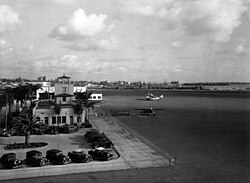
The initial facility included a barracks building, a mess hall, one hangar with a lean-to, two aprons, a runway connecting to the main field, and a small wooden seaplane ramp. Before the station's official commissioning, a Coast Guard Air Detachment operated out of half of a commercial hangar at Lindbergh Field, led by the notable figure Elmer F. Stone starting May 21, 1935.
Operational History and Wartime Efforts
The Air Station was officially commissioned in April 1937 under its first commanding officer, LT S.C. Linholm. At the time, it stood as the only Coast Guard air base in the state of California.
When the United States entered World War II in 1941, the station maintained its core duties: reporting the activities of local fishing boats, providing air transportation for government departments, and assisting those in distress. However, starting in October 1943, the primary focus shifted toward Air Sea Rescue—the specialized process of recovering personnel and aircraft from the ocean.
The intensity of these operations is evident in the records from 1944. Between January 1 and December 1 of that year, 124 aircraft went down in the unit's coverage area. Of the 201 pilots and crewmen involved, 137 were saved. Tragically, 59 were killed by impact or mid-air collisions, two went missing, and three others were lost due to equipment failure or delays in location.
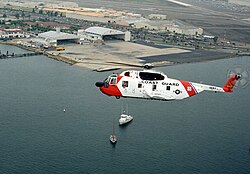
Modernization and Future Planning
The facility continued to evolve in the latter half of the century. A major rebuilding plan was proposed in June 1972, culminating in a completion ceremony on January 26, 1983.
Looking toward the future, the Port of San Diego initiated a master plan for the airport in April 1997. This plan focuses on incremental, cost-effective improvements to meet immediate regional demand while collaborating with the San Diego Association of Governments (SANDAG) and other agencies to develop a long-term regional air transportation strategy.
Key Facts
- Opening Date: Lindbergh Field opened on October 16, 1934.
- Annual Traffic: Nearly 14 million passengers travel through the airport each year.
- Daily Operations: Over 500 flights are operated daily by 27 airlines.
- CGAS Land: The Coast Guard Air Station was built on 23 acres of tideland.
- Wartime Rescue: In 1944 alone, the unit saved 137 of 201 personnel from 124 downed aircraft.
| Date | Event/Facility | Significance |
|---|---|---|
| Oct 16, 1934 | Lindbergh Field | Official opening of the municipal airport |
| April 1937 | CGAS San Diego | Commissioning of California's only CG air base at the time |
| Mar 6, 1967 | East Terminal | First major terminal expansion |
| July 11, 1979 | West Terminal | Second major terminal expansion |
| July 23, 1996 | Commuter Terminal | Dedicated facility for regional airlines |
| April 1997 | SDIA Master Plan | Initiation of long-term regional strategy |
Frequently Asked Questions
When did San Diego International Airport first open?
The airport first opened as Lindbergh Field on October 16, 1934.
How many passengers use the airport annually?
Almost 14 million passengers travel through the facility each year.
What was the primary focus of the Coast Guard Air Station during WWII?
While they continued general assistance and reporting, the primary focus shifted to Air Sea Rescue operations starting in October 1943.
How was the Coast Guard Air Station constructed on the bay?
The area was dredged from the bay and filled to grade level, with long piles driven into the soil to stabilize the building sites.
What is the purpose of the Commuter Terminal?
Opened in 1996, it is a self-contained facility with four gates used by seven commuter airlines to handle 25,000 passengers daily.