Salvador–Deputado Luís Eduardo Magalhães International Airport
Serving as the primary aerial gateway to the vibrant city of Salvador, Brazil, the Salvador–Deputado Luís Eduardo Magalhães International Airport (IATA: SSA, ICAO: SBSV) is a critical hub for both domestic and international travel. Known commercially as Salvador Bahia Airport, this facility blends modern infrastructure with a rich history, connecting the state of Bahia to the rest of the world.
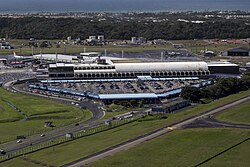
The airport is situated on a sprawling site of over 6 million square meters, nestled between native vegetation and sand dunes. Travelers arriving by road are often greeted by a scenic, bamboo-covered approach that has become a local attraction in its own right.
Key Facts
- Operator: Managed by Vinci SA since March 16, 2017.
- Passenger Volume: Handled 7,186,760 passengers in 2025.
- Hub Status: Serves as a hub for Gol Linhas Aéreas and Abaeté Aviação.
- Infrastructure: Features a 69,400 m² main terminal with 11 jetways.
- Connectivity: Directly linked to the Salvador subway via a free shuttle service.
History and Evolution
The airport's origins date back to 1925, when it was established as the Santo Amaro do Ipitanga Airport. During World War II, the facility underwent a complete reconstruction in 1941, supported by the American and Brazilian governments through Panair do Brasil.
The airport has undergone several name changes reflecting the region's political and cultural shifts. In 1955, it was renamed Dois de Julho International Airport to commemorate Bahia Independence Day—a name still widely used by the local population. On June 16, 1998, Federal Law renamed the facility to honor Luís Eduardo Magalhães (1955–1998), an influential politician from Bahia.
Modernization accelerated in 1998 with the opening of a new passenger terminal, which was further upgraded through the end of 2000. This terminal integrates a shopping mall and was designed to handle 6 million passengers annually. In 2017, the airport transitioned from state management under Infraero to private operation by Vinci SA, following a concession payment of R$ 2.35 billion.
Airport Infrastructure and Operations
The airport operates as a public/military facility, sharing some of its infrastructure with the Salvador Air Force Base of the Brazilian Air Force. It is positioned at an elevation of 20 meters (66 ft) above mean sea level.
Runway Details
The airport utilizes two asphalt runways to manage its aircraft operations:
- Runway 10/28: 3,003 meters (9,852 ft)
- Runway 17/35: 1,518 meters (4,980 ft)
Passenger Experience and Access
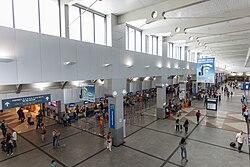
The main terminal is designed for efficiency and comfort, though it has seen steady traffic growth averaging 14% per year. To improve accessibility, the Aeroporto station on Line 2 of the Salvador subway opened on April 26, 2018. A free shuttle bus operates every 15 minutes (from 5 am to 1 am) connecting the terminal to the subway station, which provides direct access to downtown Salvador at Lapa.
Airlines and Destinations
Salvador Bahia Airport connects passengers to a wide array of domestic and international cities. Major carriers include Azul Brazilian Airlines, Gol Linhas Aéreas, and LATAM Brasil for domestic routes, while international connectivity is provided by airlines such as TAP Air Portugal (Lisbon), Air France (Paris), and Air Europa (Madrid).
| Feature | Detail |
|---|---|
| IATA / ICAO Codes | SSA / SBSV |
| Current Operator | Vinci SA |
| Time Zone | BRT (UTC−03:00) |
| 2025 Passengers | 7,186,760 |
| 2025 Aircraft Ops | 82,905 |
| Distance to Downtown | 28 km (17 mi) |
Frequently Asked Questions
What is the airport's current trade name?
While officially named Salvador–Deputado Luís Eduardo Magalhães International Airport, it is commonly known by the trade name Salvador Bahia Airport.
How do I get from the airport to downtown Salvador?
The most efficient method is using the free shuttle bus that runs every 15 minutes to the Aeroporto subway station (Line 2), which connects directly to the Lapa area in downtown Salvador.
Who operates the airport?
The airport is currently operated by Vinci SA, which won a 30-year concession for the facility on March 16, 2017.
Does the airport serve international destinations?
Yes, the airport offers international flights to cities including Lisbon, Paris, Madrid, Buenos Aires, Panama City, and Santiago de Chile.
Is the airport used for military purposes?
Yes, it is a public/military airport, and some of its facilities are shared with the Salvador Air Force Base.