Salpornis: The Unique Biology of Spotted Creepers
The genus Salpornis comprises a specialized group of birds known as spotted creepers. These birds occupy a fascinating position in the avian world, blending characteristics that have historically confused taxonomists. From their unique climbing habits to their complex genetic history, spotted creepers offer a glimpse into the evolutionary diversity of the superfamily Certhioidea.
Key Facts
- Classification: Now placed in its own family, Salpornithidae.
- Species: Includes the Indian spotted creeper (S. spilonota) and the African spotted creeper (S. salvadori).
- Etymology: The name derives from the Greek salpinktes (wren) and ornis (bird).
- Distinction: Unlike true treecreepers, they do not use their tails for support while climbing.
- Anatomy: Characterized by a tongue ending in five bristles and a tail with twelve rounded feathers.
Taxonomic Evolution and Classification
The classification of Salpornis has undergone significant revisions. Historically, these birds were grouped within the family Certhiidae (treecreepers) or the family Sittidae (nuthatches). However, recent scientific consensus has elevated the genus to its own distinct family, Salpornithidae.
Modern molecular phylogenetic analyses—the study of evolutionary relationships using DNA—confirm that spotted creepers belong to the superfamily Certhioidea. Despite this, their exact placement remains a subject of scientific debate. Some molecular evidence suggests a closer relationship to nuthatches (Sitta), while other studies indicate they are more closely related to the wallcreeper (Tichodroma muraria).
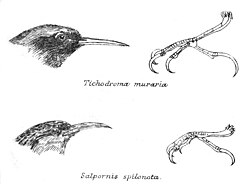
Physical Characteristics and Anatomy
Spotted creepers possess several distinct anatomical features that set them apart from their relatives. Their tail consists of twelve feathers with rounded tips, a departure from the stiffer tails found in many other climbing birds. Notably, they lack rictal bristles—the stiff hairs around the mouth found in many insectivorous birds—and have exposed nostrils.
One of the most specialized features of the genus is the tongue, which ends in five distinct bristles, likely an adaptation for their specific foraging techniques.
Species Diversity
The genus Salpornis is divided into two recognized species. While the African population was previously considered a subspecies of the Indian variety, further research has led to their separation.
- Indian spotted creeper (Salpornis spilonota): The type species for the genus.
- African spotted creeper (Salpornis salvadori): A distinct species featuring four recognized subspecies.
The decision to split these populations was based on three primary factors: differences in physical size, distinct vocalizations (calls), and variations in mitochondrial DNA sequences.
| Category | Details |
|---|---|
| Family | Salpornithidae |
| Superfamily | Certhioidea |
| Order | Passeriformes |
| Species 1 | Salpornis spilonota (Indian) |
| Species 2 | Salpornis salvadori (African) |
Frequently Asked Questions
How do spotted creepers differ from treecreepers?
While they appear similar, spotted creepers do not use their tails to support their weight while climbing, a behavior that is characteristic of true treecreepers (Certhia).
What does the name Salpornis mean?
The generic name is derived from the Greek words salpinktes, meaning wren, and ornis, meaning bird.
Why was the African spotted creeper split into a separate species?
The African population (S. salvadori) was separated from the Indian population (S. spilonota) due to evidence regarding differences in size, calls, and mitochondrial DNA sequences.
Which bird family is Salpornis most closely related to?
They are part of the superfamily Certhioidea. While they share similarities with treecreepers, molecular evidence is divided, suggesting potential close ties to either nuthatches (Sitta) or the wallcreeper (Tichodroma).