Saint Martin Demographics: Population, Language, and Culture
Saint Martin is a vibrant Caribbean collectivity characterized by a diverse population and a complex linguistic landscape. From its coastal urban centers to its deep-rooted religious traditions, the island reflects a blend of European, African, and Asian influences. While the territory is officially French, its daily life is a tapestry of multiple languages and cultural identities.
Key Facts
- Population: 31,477 inhabitants as of the January 2021 census.
- Population Density: 592 inhabitants per square kilometer.
- Official Language: French, though English is the predominant language spoken.
- Primary Ancestry: Mostly black or mixed Creole, with European and Indian minorities.
- Dominant Religion: Roman Catholicism (91.8%).
- Major Urban Hubs: Marigot (the capital), Grand-Case, and Quartier-d'Orleans.
Population Trends and Distribution
The population of Saint Martin has seen significant fluctuations over the last century. After a period of steady growth—rising from 8,072 in 1982 to a peak of 35,925 in 2007—the numbers have recently declined. The 2021 census recorded 31,477 residents, a decrease from the 35,334 reported in 2017.
This recent decline is largely attributed to the devastating impact of Hurricane Irma, which struck in early September 2017 and destroyed much of the island's infrastructure. Most of the population is concentrated along the coastal regions, particularly in the capital of Marigot, as well as Grand-Case and Quartier-d'Orleans.
| Year | Population | Annual Growth Rate (±%) |
|---|---|---|
| 1885 | 3,400 | — |
| 1954 | 3,366 | -0.01% |
| 1982 | 8,072 | +3.65% |
| 2007 | 35,925 | +2.74% |
| 2017 | 35,334 | -0.23% |
| 2021 | 31,477 | -2.85% |
Age Structure
The population is predominantly composed of working-age adults. According to demographic data, those aged 15 to 64 make up 63.22% of the population, while children (0–14) account for 21.12% and seniors (65+) represent 15.66%.
Language and Education
Although French is the official language, the Prefect has described the collectivity as "essentially anglophone." English is the predominant language due to the broader influence of English in the Caribbean. This linguistic divide creates challenges in the education system; in 2025, only 12% of students entering high school possessed sufficient mastery of French, contributing to a high drop-out rate.
Beyond French and English, the island is multilingual. Residents speak Dutch, Spanish, and Papiamento. In informal settings, the Virgin Islands Creole (an English-based dialect) is common on both the French and Dutch sides. Additionally, the Haitian community, which numbered 7,000 in 2000, utilizes Haitian Creole.
Educational Infrastructure
The public education system consists of several specialized institutions:
- Preschools: Including Jean Anselme, Jérôme Beaupère, Elaine Clarke, Evelina Halley, Ghyslaine Rogers, and Trott Simeone.
- Primary Schools: Including Omer Arrondell, Émile Choisy, Nina Duverly, Elie Gibs, Aline Hanson, Émile Larmonnie, Marie-Amélie Ledee, Clair Saint-Maximin, and Hervé Williams, as well as École élémentaire M-Antoinette Richard.
- Secondary Education: Three junior high schools (Collèges #1 Mont Des Accords, #2 Soualiga, and #3 Quartier d'Orleans) and the Lycée Professionnel des Îles Nord. The Cité Scolaire Robert Weinum serves as a joint public junior-senior high school.
Religious Landscape
Christianity is the primary faith on the island, with Roman Catholicism being the most prominent, practiced by 91.8% of the population. Other religious groups include Protestants (4.56%), Baháʼí (0.36%), Muslims (0.21%), and Hindus (0.20%), while 2.47% of the population identifies as having no religion.
The French territory is part of the Diocese of Basse-Terre and Pointe-à-Pitre, which also encompasses Guadeloupe and St. Barthélemy. This diocese is managed under the organization of the Catholic Church in France, with its episcopal see located at the cathedral of Our Lady of Guadeloupe in Basse-Terre.
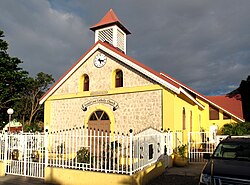
Approximately sixty priests serve the region across various parishes, including the Church of Saint Martin de Tours in Marigot, the Church of Saint Martin in Quartier d'Orléans, and the Church of Mary Star of the Sea in Grand Case.
Frequently Asked Questions
Why did the population of Saint Martin decrease between 2017 and 2021?
The population decrease was largely caused by the impact of Hurricane Irma in September 2017, which destroyed a significant portion of the island's infrastructure.
What is the most spoken language in Saint Martin?
While French is the official language, English is the predominant language spoken by the population due to the regional influence of the Caribbean.
What is the primary religion of the residents?
Roman Catholicism is the dominant religion, practiced by 91.8% of the inhabitants.
Which towns are the most populated on the island?
Most residents live in the coastal regions, specifically in the capital of Marigot, Grand-Case, and Quartier-d'Orleans.
How does the language barrier affect students in Saint Martin?
Because English is so dominant, many students struggle with French; in 2025, only 12% of students starting high school had sufficient mastery of the official language, which is linked to high drop-out rates.