Saint Hildegard of Bingen: The Polymath of the High Middle Ages
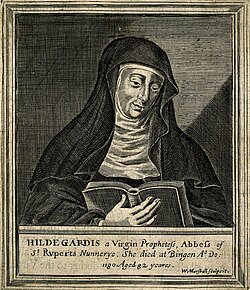
In the landscape of the High Middle Ages, few figures loom as large or as diversely as Hildegard of Bingen. Known as the "Sibyl of the Rhine," Hildegard was a true polymath—a person of wide-ranging knowledge—who excelled as a Benedictine abbess, composer, philosopher, mystic, and medical practitioner. Her life was a bridge between the spiritual and the material, blending deep mystical theology with an early scientific curiosity about the natural world.
Key Facts
- Born: c. 1098 in Bermersheim vor der Höhe, Holy Roman Empire.
- Died: September 17, 1179, in Bingen am Rhein.
- Primary Roles: Abbess, composer, visionary, and medical writer.
- Major Works: Scivias, Liber Divinorum Operum, and Ordo Virtutum.
- Unique Achievement: Invented a constructed language called Lingua Ignota.
- Church Status: Named a Doctor of the Church by Pope Benedict XVI in 2012.
Monastic Life and Leadership
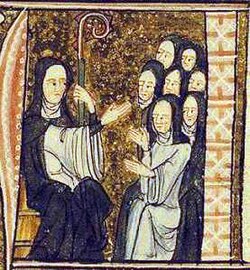
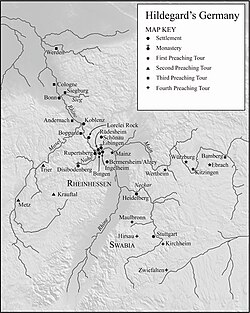
Hildegard's journey within the Catholic Church began at the convent of Disibodenberg, where she was elected magistra (mother superior) in 1136. Her leadership extended beyond the walls of a single convent; she founded two of her own monasteries: Rupertsberg in 1150 and Eibingen in 1165. These institutions provided her with the autonomy to pursue her intellectual and spiritual endeavors.
Throughout her life, Hildegard maintained a significant public presence, which was rare for women of her era. She engaged in extensive correspondence and conducted preaching tours to share her visions and theological insights.
Visionary Theology and Major Works
Hildegard is most renowned for her three massive volumes of visionary theology. In these texts, she describes enigmatic visions and interprets them through the "voice of the Living Light."
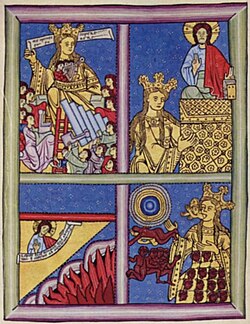
- Scivias ("Know the Ways"): Composed between 1142 and 1151, this work details her early visions. Hildegard supervised the miniature illuminations (decorative illustrations) in the Rupertsberg manuscript of this text.
- Liber Vitae Meritorum ("Book of Life's Merits"): Composed between 1158 and 1163, focusing on the rewards of a virtuous life.
- Liber Divinorum Operum ("Book of Divine Works"): Begun around 1163 and completed by 1174, this work explores the activity of God and the relationship between humanity and the cosmos.
![Scivias I.6: The Choirs of Angels. From the Rupertsberg manuscript,[47] folio 38r.](/images/4c/ad/4cad6c2f9b2a320dde7228052dd61b1778f060e6bf2f7ee721e06fd079aa5749.jpg)
Music and the Arts
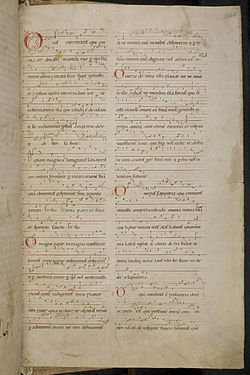
Hildegard is one of the most significant composers of sacred monophony—a style of music consisting of a single melodic line without harmonic accompaniment. She is one of the few known composers from the Middle Ages to have written both the music and the lyrics for her chants, and her surviving body of work is larger than that of any other composer from the period.
Beyond liturgical hymns, she wrote the Ordo Virtutum. This work is an early example of liturgical drama and is considered by many to be the oldest surviving morality play, a genre of drama that allegorizes the struggle between good and evil.
Science, Medicine, and the Lingua Ignota
Hildegard's curiosity extended into the physical world, leading some scholars to view her as the founder of scientific natural history in Germany. She authored botanical and medicinal texts, applying her observations of nature to the practice of healing.
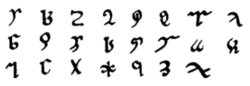
In one of her most eccentric intellectual pursuits, Hildegard created the Lingua Ignota, a constructed language. This unique linguistic system included its own alphabet, known as Litterae ignotae, which she used to express her mystical ideas.
Legacy and Recognition
While Hildegard was venerated locally for centuries, her formal recognition by the global Catholic Church occurred more recently. On May 10, 2012, Pope Benedict XVI granted her equivalent canonization—a process where the Pope recognizes a long-standing tradition of veneration as official sainthood without a standard trial. Later that year, she was named a Doctor of the Church, a title reserved for saints whose writings have significantly benefited the entire Church.
Today, Hildegard continues to inspire artists and musicians. Her works have been sampled and adapted by modern artists ranging from David Lynch and John Zorn to Björk and Rosalía.
Summary of Hildegard's Contributions
| Category | Key Details | Notable Examples |
|---|---|---|
| Theology | Visionary works interpreted via the "Living Light" | Scivias, Liber Divinorum Operum |
| Music | Sacred monophony and liturgical drama | Ordo Virtutum |
| Science | Botany, natural history, and medicine | Medicinal writings |
| Linguistics | Created a constructed language | Lingua Ignota |
| Leadership | Founded Benedictine monasteries | Rupertsberg and Eibingen |
Frequently Asked Questions
What does the title "Doctor of the Church" mean?
The title is a high honor granted by the Pope to saints who have made an exceptional contribution to the understanding of the Christian faith through their holiness of life and the originality of their theological teaching.
What was the Lingua Ignota?
The Lingua Ignota was a constructed language invented by Hildegard of Bingen, complete with its own unique alphabet (Litterae ignotae), used as a private or mystical means of communication.
What is a morality play, and why is the Ordo Virtutum important?
A morality play is a drama that uses allegorical characters to teach a moral lesson. The Ordo Virtutum is significant because it is arguably the oldest surviving example of this genre.
How was Hildegard canonized?
She underwent "equivalent canonization" in 2012. This means that instead of a traditional canonization process, Pope Benedict XVI recognized the centuries of existing veneration for her as sufficient evidence of her sainthood.
What is sacred monophony?
Sacred monophony is a form of music consisting of a single, unaccompanied melodic line. Hildegard is one of the most recorded composers of this style in modern history.