Saint Denis: The First Bishop of Paris and His Martyrdom
The history of early Christianity in France is deeply intertwined with the figure of Saint Denis, the first Bishop of Paris. According to historical and hagiographical accounts, Denis played a pivotal role in converting the Parisii, the Celtic people inhabiting the region, during a time of intense Roman persecution.
The Mission to Gaul
Denis was sent from Italia to Gaul during the third century to spread the Christian faith. This mission linked him to the "apostles to the Gauls," a group of seven missionary bishops sent under the direction of Pope Fabian. Upon his arrival, Denis was appointed as the first Bishop of Paris.
At the time, the Christian community in Lutetia (the Roman name for Paris) had been nearly dismantled by the persecutions of Emperor Decius. Denis, accompanied by his loyal companions Rusticus and Eleutherius, established their base on the Île de la Cité in the River Seine, while the main Roman settlement of Paris was situated on the higher ground of the Left Bank.
Martyrdom and the Legend of the Cephalophore
The success of Denis and his companions in converting the local population alarmed the pagan priests, who feared the loss of their influence. At the urging of these priests, the Roman Governor arrested the missionaries. Following a period of prolonged imprisonment, Denis and his two clergy members were executed by beheading on the highest hill in Paris.
This site, now known as Montmartre, is believed to have been a druidic holy place. While popular tradition suggests the name Montmartre derives from the Latin Mons Martyrum ("The Martyrs' Mountain"), some historians suggest it may have originated from Mons Mercurii et Mons Martis, referring to the gods Mercury and Mars.
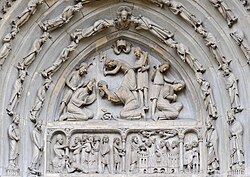
Following his execution, a famous legend describes Denis as a cephalophore—a term in hagiology (the study of saints' lives) referring to a saint who carries their own severed head. It is said that Denis picked up his head and walked several miles from the hill, preaching a sermon throughout the journey. This account is detailed in the Golden Legend and Butler's Lives of the Saints.
The location where Denis finally stopped preaching and died became the site of a small shrine, which eventually evolved into the Basilica of Saint-Denis, the traditional burial place for the kings of France. An alternative account suggests his body was thrown into the Seine and later recovered and buried by his converts.
Key Facts
- Role: First Bishop of Paris and missionary to the Gauls.
- Companions: Rusticus and Eleutherius, who were martyred alongside him.
- Execution Site: The highest hill in Paris, currently known as Montmartre.
- Legacy: The Basilica of Saint-Denis was built where he is said to have finished his final sermon.
- Classification: Recognized as a cephalophore in hagiographical tradition.
| Category | Details |
|---|---|
| Origin | Sent from Italia to Gaul |
| Authority | Directed by Pope Fabian |
| Location of Ministry | Île de la Cité, Lutetia (Paris) |
| Cause of Death | Beheading by sword under Roman Governor |
| Primary Sources | Gregory of Tours; Passio SS. Dionysii Rustici et Eleutherii (c. 600) |
Frequently Asked Questions
Who was Saint Denis?
Saint Denis was the first Bishop of Paris and a missionary sent from Italia to convert Gaul in the third century under the direction of Pope Fabian.
What is a cephalophore?
A cephalophore is a figure in hagiology who is depicted as carrying their own severed head. Saint Denis is one of the most prominent examples, as legend says he preached a sermon while walking with his head after beheading.
Where was Saint Denis martyred?
He was beheaded on the highest hill in Paris, which is now known as Montmartre and was likely a druidic holy site at the time.
What is the significance of the Basilica of Saint-Denis?
The basilica was built on the site where Saint Denis is said to have finally died after his miraculous walk. It later became the royal necropolis for the kings of France.
Which documents record the life of Saint Denis?
His life is mentioned by Gregory of Tours and in the "Passio SS. Dionysii Rustici et Eleutherii" (c. 600). His martyrdom is also detailed in the Golden Legend and Butler's Lives of the Saints.